



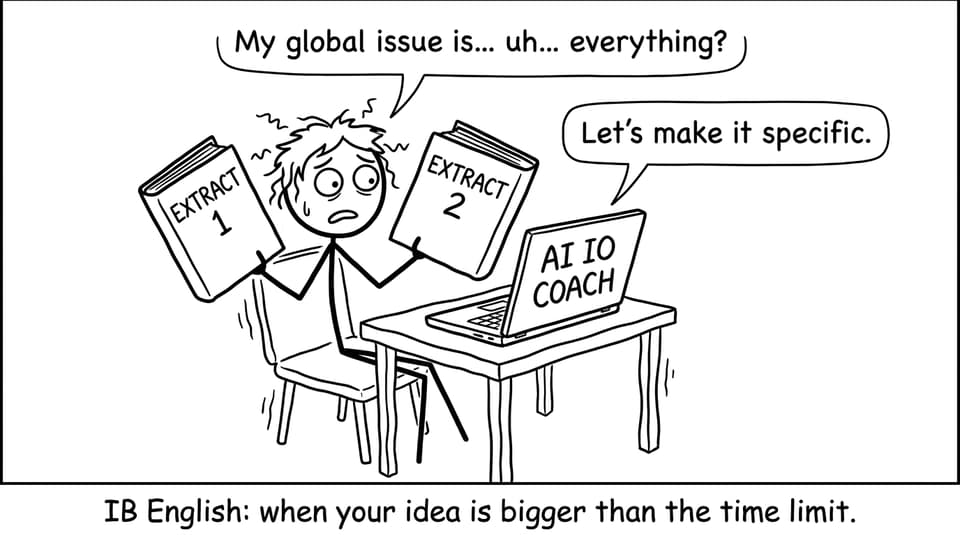
If you have ever tried to rehearse your Individual Oral and felt your brain go blank halfway through a sentence, you already understand the real challenge of IB English. The IO is not just knowing your texts. It is knowing what to do with them while a timer runs, your voice shakes a little, and you try to make a global issue sound like something you chose on purpose.
That is why an IB English IO practice tool matters. Not as a gimmick, but as a way to rehearse the exact skill the assessment rewards: clear thinking out loud.
The IB English IO in one quick checklist
Before you practise, make sure you know what you are rehearsing:
-
A focused global issue you can sustain for 10 minutes
-
Two extracts you can analyse (not summarise)
-
A balanced structure across both texts
-
Clear signposting and transitions
-
Pacing that fits the time limit
If any one of these is shaky, your IB English IO starts to feel like improvisation.
Why IB English students struggle with the Individual Oral
Most students do enough reading. The pain usually shows up in delivery.
In IB English, IO marks are won in the small, unglamorous moments:
-
An introduction that frames the global issue precisely (not broadly)
-
Analysis that stays tied to authorial choices (not plot recap)
-
A comparison that feels intentional, not accidental
-
A conclusion that lands the argument instead of drifting out
You can understand a poem perfectly and still lose marks because your explanation arrives late, or your link to the global issue fades, or one extract gets all your energy.
For a deeper breakdown of what the IO actually demands, keep this guide open while you practise: IB Oral (IO) Guide: Language & Lit and Literature.
How an IB English IO practice tool helps (and what AI changes)
RevisionDojo’s IO support is built around a simple idea: improvement comes from iterations, not from one heroic rehearsal.
Using the IO Practice tool, you can practise your IB English delivery in a repeatable loop:
-
Choose your extracts and state your global issue
-
Record or draft an IO-style response
-
Receive IB-aligned feedback on structure, clarity, analysis, and focus
-
Revise, then run it again with better timing and sharper signposting
This is also where RevisionDojo’s wider ecosystem starts to matter. When your feedback says “analysis is descriptive,” you can jump into IB English A Lang & Lit Revision Notes (SL/HL) to rebuild the skill quickly, then come back and re-attempt.
What to look for in IB English IO feedback
The most useful feedback does not just tell you what was “good” or “unclear.” It tells you where your marks are leaking.
A strong IB English IO practice tool should help you notice:
Where your global issue becomes vague
If you start with a sharp global issue and then stop naming it, your oral turns into general commentary. This is why planning helps, but rehearsing helps more.
To tighten your global issue choice, use: IB English A Fields of Inquiry for the Individual Oral.
Where analysis turns into summary
A reliable rule: if you are telling the listener what happens, you are losing time you needed for meaning.
If you want a clean routine for building analysis, pair practise with: IB English Study Techniques That Actually Work.
Where structure and timing break
In IB English, clarity is often just pacing with a plan. If your first extract runs long, the second one becomes rushed, and moderation will hear it.
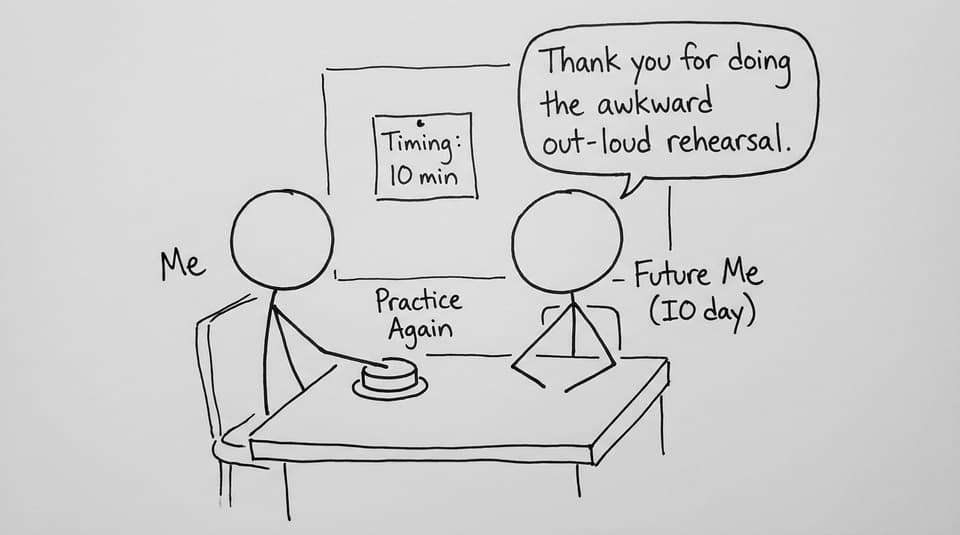
A repeatable IB English IO practice cycle (use this weekly)
Here is a simple rhythm that fits into real school weeks:
-
Draft a 60-second intro with your global issue and text map
-
Rehearse Extract 1 for depth, not speed
-
Rehearse Extract 2 to match depth and technique focus
-
Record a full run
-
Use feedback, then re-run only the weakest 3 minutes
That “re-run the weakest minutes” step is where students quietly get good at IB English.
If you need examples to calibrate what “good” sounds like, compare with: IB Language A: Individual Oral Examples.
How RevisionDojo supports IB English beyond the IO
Orals improve fastest when your overall English system is stable.
RevisionDojo helps you build that system with:
-
Study Notes and Cheatsheets for fast clarity: English A Lang & Lit Cheatsheets
-
Flashcards for quotations, techniques, and global issue phrasing (spaced repetition)
-
Questionbank to train Paper 1 and Paper 2 thinking: IB English A Lang & Lit Questionbank
-
AI Chat to unblock planning when your thesis feels muddy
-
Grading tools for rubric-aligned improvement loops
-
Predicted Papers and Mock Exams to make exam pressure familiar: English A Lang & Lit Predicted Papers
And if you want a practical playbook that ties it together, use: IB English Individual Oral: Strategies + Practice Tools.
FAQ: IB English IO practice with AI
Can an AI tool actually help my IB English Individual Oral?
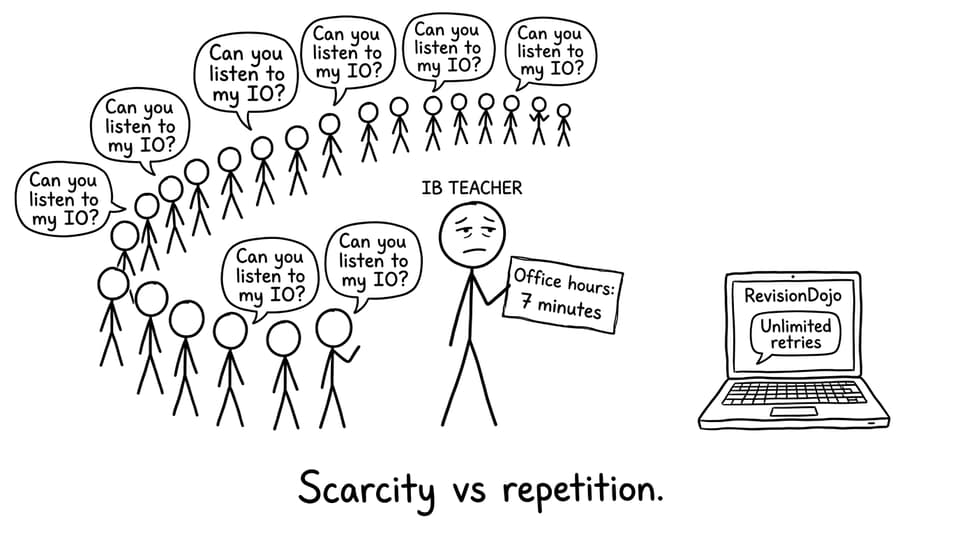
Yes, if you use it for iteration rather than validation. The biggest benefit in IB English is not a single score, but the ability to practise more times than your teacher realistically has hours to listen. An AI-supported IO practice tool gives you fast feedback on structure, clarity, and whether your global issue is sustained. That matters because the IO is a performance under constraints, and repetition reduces uncertainty. You still need your own thinking and your class texts, but AI can speed up the improvement loop. Used well, it replaces guesswork with deliberate rehearsal.
What should I practise first for IB English IO improvement?
Start with your introduction and global issue framing. In IB English, a strong intro acts like a contract with the examiner: here is my issue, here are my texts, here is how I will prove it. If the intro is vague, the rest of the oral feels unanchored even if your analysis is good. Next, practise transitions between extracts, because this is where many students lose coherence. Then practise timing, not by speaking faster, but by cutting summary and keeping technique-led analysis. Once those pieces work, full run-throughs become much more productive.
Will practising more times always raise my IB English IO score?
Only if each practice round includes feedback and one clear change. Repeating the same weak structure ten times just makes you better at the weak version. In IB English, the goal is to identify one or two improvements per cycle: a sharper global issue line, cleaner signposting, deeper method analysis, or better balance between extracts. That is why rubric-aligned feedback is so useful, because it tells you what to change rather than just that something felt “off.” A good cycle is practise, review, edit, re-run, then track whether the change actually worked. Over time, your delivery stabilises, and stability is what confidence sounds like.
Conclusion: make IB English IO confidence a routine
The best IB English IOs do not sound like talent. They sound like rehearsal.
If you want to walk into your recording knowing your global issue holds, your structure is balanced, and your timing is controlled, build a repeatable system with RevisionDojo. Start with the IO Practice tool, reinforce skills with Notes, Flashcards, and the Questionbank, and keep tightening your delivery until your oral feels inevitable.