

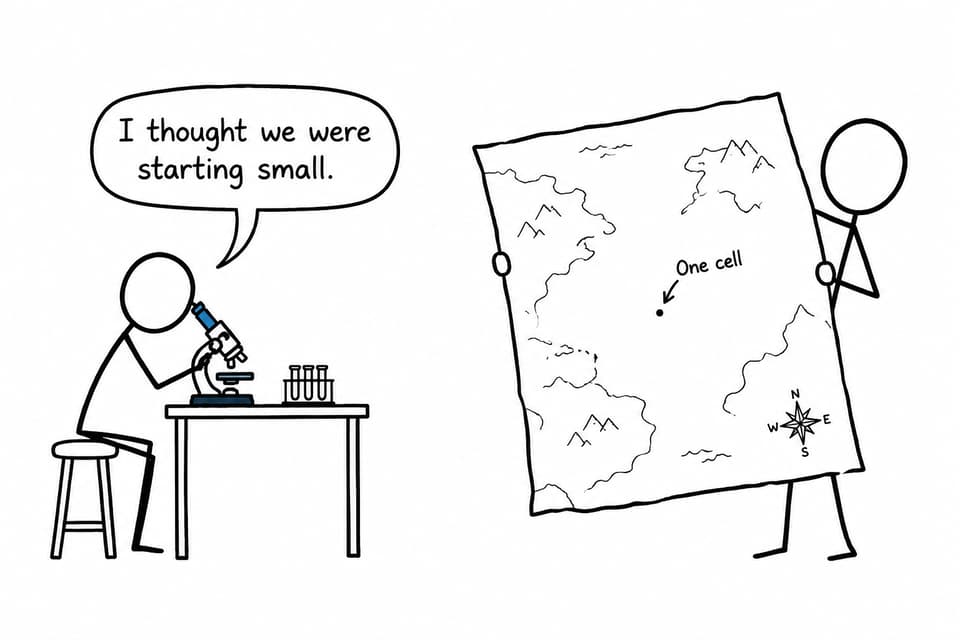
Starting IB Biology can feel strange because the first lesson may concern something microscopic, while the course itself seems enormous. Water, membranes, genetics, ecosystems, evolution and physiology all belong to the same map. Your first task is not to memorize that entire map. It is to understand how its pieces connect.
In your IB biology first year, the exact first-term sequence will depend on your school. The current IB Biology course, first assessed in 2025, does not require teachers to cover topics in one fixed order. Most classes begin with foundational molecular and cellular ideas, practical skills, data analysis and the vocabulary needed to answer IB questions accurately.
This guide explains what those opening months are likely to contain, what SL and HL students should expect, and how to build habits that remain useful throughout IB DP1.
Your first-term IB Biology checklist
By the end of a well-structured first term, you should be making progress in five areas:
- Understanding biological ideas rather than collecting isolated definitions
- Interpreting graphs, micrographs, tables and experimental results
- Using units, magnification and scientific notation correctly
- Responding precisely to command terms such as describe, explain and evaluate
- Recording practical work clearly enough that another student could understand what you did
Your class may not cover every topic discussed below. Use your teacher's scheme of work and the official IB subject guide as the final authority on local sequencing.
How the current IB Biology syllabus is organized
The current course is arranged around four themes:
- A: Unity and diversity
- B: Form and function
- C: Interaction and interdependence
- D: Continuity and change
Each theme is explored at four levels of biological organization: molecules, cells, organisms, and ecosystems. This creates a matrix rather than a simple chapter list. Water can be considered as a molecule, for example, but its properties also affect cells, whole organisms and ecosystems.
That structure explains an important feature of IB Biology: topics return. A membrane lesson may introduce phospholipids and transport. Later, the same principles help explain nerve impulses, kidney function and plant water relations. Learning the first topic well makes several later topics easier.
The IB Biology resource hub follows the current course and gives you a central place to find Study Notes, Flashcards, Questionbank practice and other subject-specific tools.
What you are likely to cover first
There is no universal first-term order, but molecular and cell biology are common starting points because they supply the language used throughout the course.
Water and biological molecules
Topic A1.1 examines water. You may study polarity, hydrogen bonding, cohesion, adhesion, solvent properties, and the thermal properties that make water biologically important. The challenge is moving beyond a list of properties.
If asked to explain why water supports transport in plants, writing that water is cohesive is only the beginning. A developed answer connects hydrogen bonding to cohesion between water molecules, then connects that cohesion to the maintenance of a continuous column in xylem vessels.
Early molecular work may also include nucleic acids, carbohydrates, lipids or proteins, depending on your teacher's sequence. Learn structures alongside functions. Knowing that phospholipids contain hydrophilic and hydrophobic regions matters because those regions explain bilayer formation.
Cell structure and microscopy
A2.2 Cell structure and B2.2 Organelles and compartmentalization are natural early units. You may compare prokaryotic and eukaryotic cells, recognize organelles in electron micrographs, and relate structures to functions.
You should be able to distinguish a mitochondrion from a chloroplast using visible evidence, not merely by guessing from the surrounding tissue. Cristae support identification of a mitochondrion. Thylakoid membranes or grana support identification of a chloroplast.
Microscopy also introduces quantitative skills. The central relationship is:
Both measurements must use the same unit before division. A frequent mistake is dividing a measurement in millimetres by one in micrometres without converting either value. Another is treating magnification as if it has a unit. It is a ratio and therefore has no unit.
For a fuller explanation of membranes, organelles and microscopy, use the cell biology exam guide.
Membranes and transport
B2.1 Membranes and membrane transport often follows cell structure. Expect phospholipid bilayers, membrane proteins, diffusion, osmosis, facilitated diffusion and active transport.
The distinctions matter. Facilitated diffusion uses membrane proteins but does not require direct energy input and moves substances down a concentration gradient. Active transport uses energy to move substances against a gradient. Students often see the word protein and incorrectly assume the process must be active.
Water movement also requires careful language. Avoid saying that water “wants” to move or that a solution “has osmosis.” Describe net water movement across a partially permeable membrane and identify the relevant difference in water potential or solute concentration for the context being studied.
The guide to common cell biology mistakes is useful once you have attempted a few questions and can recognize your own patterns.
Enzymes and metabolism
Some schools introduce C1.1 Enzymes and metabolism during the first term. You may investigate how temperature, pH or substrate concentration affects reaction rate. This is often where biological knowledge meets experimental design.
A strong explanation does more than state that high temperature denatures an enzyme. It connects rising kinetic energy to more frequent successful collisions, then explains how sufficiently high temperatures disrupt bonds maintaining the enzyme's three-dimensional structure. The active site changes, reducing successful enzyme-substrate binding.
Be cautious with absolute claims. An enzyme does not necessarily “die,” and denaturation is not simply the enzyme becoming hot. Precise causal language earns more credit than dramatic language.
Practical work begins immediately
IB Biology is an experimental science. The official course allocates 40 hours to the experimental programme at SL and 60 hours at HL. These totals include practical work, the collaborative sciences project and the scientific investigation.
Your first-term experiments may be modest, but they establish habits required for the internally assessed scientific investigation. You could examine osmosis in plant tissue, enzyme activity, membrane permeability or specimens under a microscope.
For each investigation, identify:
| Element | What to record |
|---|---|
| Independent variable | What is deliberately changed, including its range and units |
| Dependent variable | What is measured and how it is measured |
| Controlled variables | Factors kept consistent and how they are controlled |
| Raw data | Original measurements with headings, units and uncertainties where appropriate |
| Processed data | Calculations, means, rates, percentages or other transformations |
| Evaluation | Specific limitations and realistic improvements |
A vague statement such as “human error affected the results” is rarely useful. Identify the actual limitation. Perhaps cylinders of potato tissue had unequal surface areas, or the temperature changed during an enzyme trial. Then explain the likely effect on the data and propose a feasible improvement.
Assessment you should understand from the beginning
For the current course, first assessed in 2025, external examinations contribute 80% of the final subject grade and the scientific investigation contributes 20% at both SL and HL.
Paper 1 contributes 36%. It contains Paper 1A, with multiple-choice questions, and Paper 1B, with data-based questions. Paper 2 contributes 44% and includes data-based, short-answer and extended-response questions. The scientific investigation is an individual written report based on a student-formulated research question.
At SL, Paper 1 lasts 1 hour 30 minutes and Paper 2 lasts 1 hour 30 minutes. At HL, Paper 1 lasts 2 hours and Paper 2 lasts 2 hours 30 minutes. HL contains additional syllabus content and demands greater depth, but both levels require interpretation, application and experimental reasoning.
This is why simply rereading a textbook is not enough. Begin mixing concise IB Biology revision notes with retrieval practice and unfamiliar data. Predicted Papers and Mock Exams become more useful once you have covered enough of the syllabus, while topic-based Questionbank practice is valuable from the opening weeks.
Command terms change what a correct answer looks like
A student can know the biology and still lose marks by answering the wrong kind of question. Command terms tell you what intellectual action is required.
| Command term | What your answer should do |
|---|---|
| Identify | Give the requested name, value or feature without unnecessary development |
| Outline | Provide a brief account or summary |
| Describe | Give a detailed account of features, patterns or events |
| Explain | Give reasons or mechanisms, showing why or how something occurs |
| Distinguish | Make the differences between two or more ideas clear |
| Compare and contrast | Give relevant similarities and differences |
| Calculate | Reach a numerical answer and show relevant working |
| Evaluate | Weigh strengths and limitations to reach a supported judgement |
Suppose a graph shows enzyme activity increasing from 20°C to 40°C and falling sharply after 45°C. A describe question requires the pattern, supported by values where available. An explain question requires molecular reasoning about kinetic energy, collisions and denaturation. Description says what happened. Explanation says why.
Use cell biology question guidance to practise matching the depth of your answer to the command term.
Common first-term mistakes
New IB students often work hard in ways that feel productive but reveal little about what they can actually retrieve. Highlighting every sentence creates a colourful record, not necessarily a durable memory.
More subject-specific problems include:
- Memorizing organelle definitions without practising identification in micrographs
- Giving functions without connecting them to structural adaptations
- Omitting units from tables, graph axes and calculated values
- Drawing a best-fit line by joining every plotted point
- Confusing correlation with evidence of causation
- Writing that active transport moves substances from “low to high” without naming concentration
- Describing results when the command term asks for an explanation
- Using a percentage change without showing the original and final values correctly
Flashcards can help with vocabulary, but pair them with application. RevisionDojo's AI Chat can clarify a misconception, while its Grading tools can show whether an answer contains the required reasoning. The Coursework Library and Tutors become especially useful when you begin planning investigations and need models of scientific thinking rather than a template to copy.
A realistic weekly routine for IB DP1
Biology becomes manageable when revision follows the course in small loops.
After each lesson, spend 10-15 minutes reducing the material to several questions. At the end of the week, answer those questions without notes. Then complete a short set of mixed questions containing both content and data analysis.
A useful cycle is:
- Learn a concept from class and structured Study Notes.
- Retrieve it using Flashcards or a blank-page summary.
- Apply it to several Questionbank problems.
- Review the mark guidance and classify each error.
- Reattempt the missed questions several days later.
Classify mistakes as knowledge, interpretation, command term, calculation or careless execution. That small act turns a disappointing answer into useful evidence. For broader syllabus planning, the guide to memorizing the IB Biology syllabus explains how to connect topics instead of treating them as separate lists.
Start small, but start actively
Your first term is not about proving that you already understand the whole of life. It is about building a dependable method for moving between scales: molecule to cell, cell to organism, and organism to ecosystem.
Learn the foundational ideas carefully. Treat practical work as training rather than interruption. Pay attention to command terms from your first question, not your final month. Most importantly, practise retrieving and applying knowledge before the volume of content grows.
RevisionDojo brings the current course together through its Questionbank, Study Notes, Flashcards, AI Chat, Grading tools, Predicted Papers, Mock Exams, Coursework Library and Tutors. If you want a useful next step, open the IB Biology hub and try 10 free subject questions. Ten questions are enough to show what you understand, what you only recognize, and what should come next.