

If you’ve ever spent 30 minutes on one Math HL question, you know the feeling: your brain loops the same idea, your confidence shrinks, and the solution feels like it’s hiding behind frosted glass. Then, sometimes, a single clean step appears and everything clicks.
Those “click” moments aren’t luck. In Math HL, they’re usually the result of a system: knowing what the IB actually tests, practicing in the right order, and reviewing mistakes like they’re data (not proof you’re “bad at math”). This guide gives you that system.

A quick Math HL study checklist
Use this as your weekly baseline for Math HL revision:
-
Map your weak topics against the syllabus (not vibes).
-
Learn concepts fast using concise notes.
-
Drill one sub-skill at a time with exam-style questions.
-
Log mistakes and turn patterns into flashcards.
-
Schedule one timed session per week to train pacing.
-
Use feedback tools (AI Chat, grading, markschemes) to fix method gaps.
If you want one place to run that loop, start at RevisionDojo.
Start with the Math HL syllabus, not the textbook
A textbook is a library. The syllabus is the exam blueprint.
In Math HL, the biggest time-waster is “studying broadly” and hoping it transfers. Instead, build a topic map and label each area as:
-
Green: you can solve standard questions quickly.
-
Yellow: you understand, but you hesitate or make method slips.
-
Red: you can’t start without help.
Then anchor your plan to your course (AA or AI). RevisionDojo’s subject hubs make this easier, such as IB Mathematics Analysis and Approaches resources, where topics are already organized like the real course.
Build understanding fast, then earn marks with targeted practice
Math HL punishes shallow familiarity. But it also rewards students who master a small method and then scale it.
A useful rhythm is Understand, Apply, Reflect:
Understand (10-20 minutes)
Use short notes and worked examples to get the “why.” For calculus-heavy weeks, you can pair your review with topic pages like Calculus in IB Math AA.
Apply (25-45 minutes)
Switch immediately to exam-style questions. Make your practice narrow:
-
“Integration by parts, medium difficulty”
-
“Complex numbers in polar form”
-
“Vector geometry proof-style questions”
RevisionDojo’s Calculus Questionbank is perfect for this kind of precise drilling.
Reflect (10 minutes)
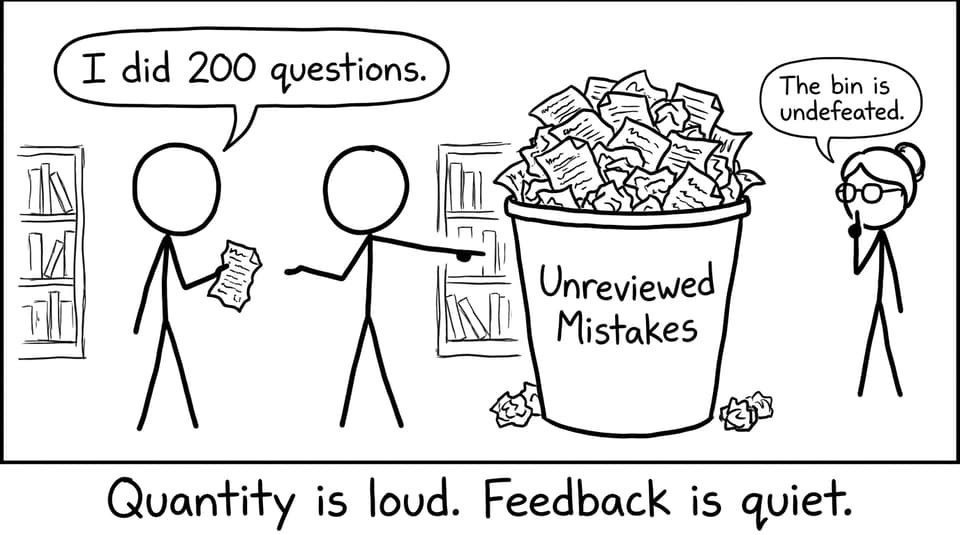
Write a mistake log with labels like:
-
Concept gap (I didn’t know what to do)
-
Method gap (I knew the topic but used the wrong approach)
-
Presentation gap (I skipped justification or lost marks in steps)
-
Time gap (I could do it, but too slowly)
That last part is where most Math HL improvement actually happens.
Use timed practice to train calm (not just speed)
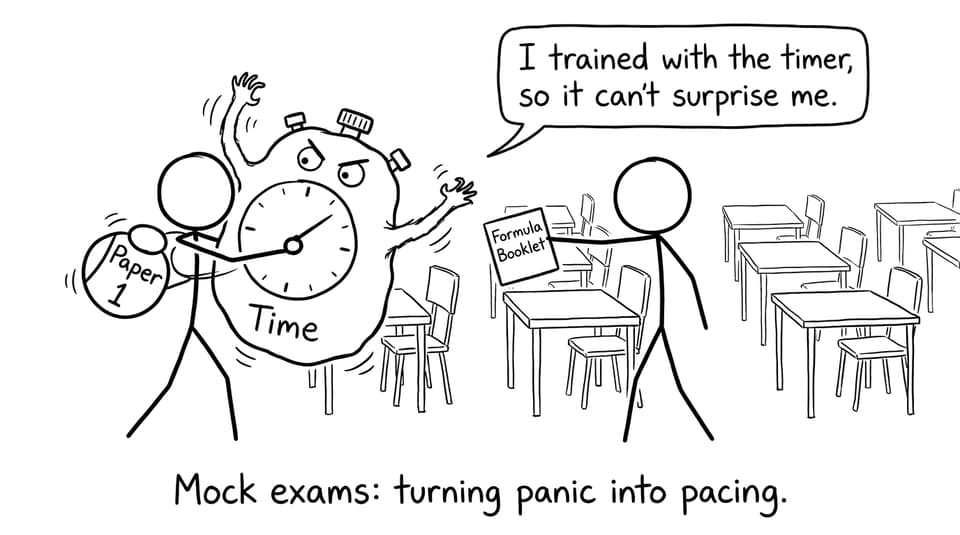
Many students “know the math” but lose marks because timing turns every question into a negotiation.
Timed sessions teach you two skills that matter in Math HL:
-
Decision-making: when to move on, when to return.
-
Endurance: staying accurate after 90+ minutes of focus.
A simple weekly structure:
-
2 focused topic sessions (untimed)
-
1 mixed set (light timing)
-
1 timed mini-paper or section (full realism)
If you want a clear workflow, borrow tactics from How to Use RevisionDojo to Prepare for IB Math Mock Exams and then scale up gradually.
Treat the formula booklet like a tool you practice with
In Math HL, the formula booklet can save you time, but only if you can navigate it under pressure.
Two strong habits:
-
Practice locating formulas quickly during revision (don’t “save it” for exam day).
-
Learn which formulas still require interpretation (the booklet gives tools, not judgment).
For a deeper walkthrough, use IB Math HL Formula Booklet: Complete Guide and the IB Mathematics Analysis and Approaches Data Booklet.
Make RevisionDojo your Math HL improvement loop
The hidden problem in Math HL is fragmentation: notes in one place, practice somewhere else, feedback nowhere. RevisionDojo is built to keep the loop tight:
-
Study Notes to compress understanding
-
Flashcards for active recall and spaced repetition
-
Questionbank for exam-style practice by topic and difficulty
-
AI Chat when you’re stuck (so you don’t lose an hour)
-
Grading tools to learn how marks are awarded in steps
-
Predicted Papers and Mock Exams for timed realism
-
Coursework Library for IA support
-
Tutors when you need a human diagnosis
To go further, these guides pair well with this article:
Closing: make Math HL feel predictable
Math HL gets easier when it becomes predictable: same syllabus signals, same method choices, same pacing habits. Build the loop this week: one topic, a targeted question set, a mistake log, and a short timed session. Then repeat.
When you want everything in one place, Questionbank, Study Notes, Flashcards, AI Chat, Grading tools, Predicted Papers, Mock Exams, Coursework Library, and Tutors, use RevisionDojo to turn effort into marks, and marks into calm.