


There’s a specific kind of silence that hits right before an IB Math exam: you know you studied, but your brain suddenly asks, “Do I really remember that one trig identity?”
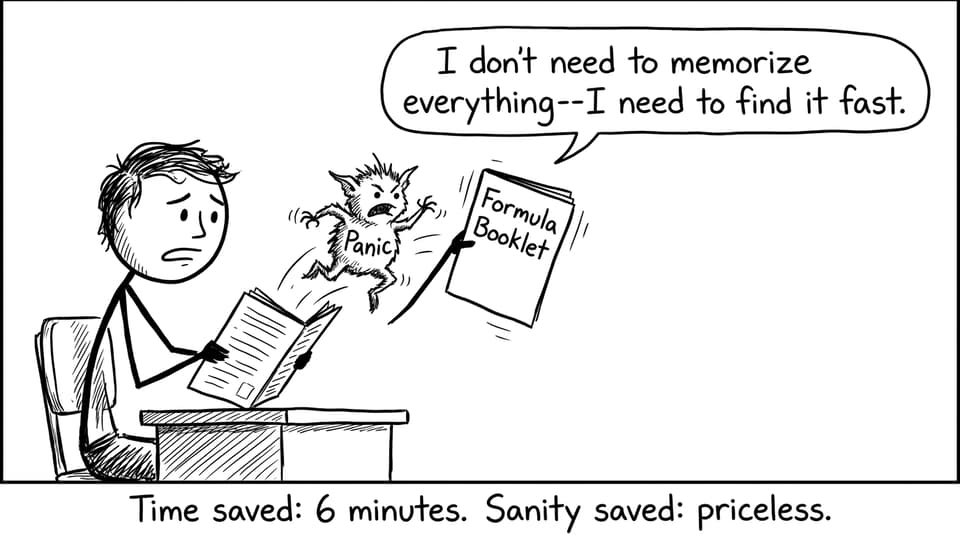
The good news is you’re not meant to carry every formula in your head. The IB Math HL formula booklet exists to reduce memory load so you can spend your attention on method, reasoning, and clear communication.
What the IB Math HL formula booklet actually does
The booklet is a provided reference during exams. It’s not a shortcut for thinking, but it is a shortcut for searching. In IB Math, marks often come from selecting the right tool and showing a logical sequence of steps.
If you’re in AA, keep the official structure in mind while revising with a clean copy like RevisionDojo’s IB Mathematics Analysis and Approaches Data Booklet. (AI students can use the parallel resource: IB Mathematics Applications & Interpretation Data Booklet.)
Quick checklist (print this mindset)
-
Know where key formulas live (navigation beats memorization).
-
Practice opening the booklet mid-question (real exam behavior).
-
Link each formula to a “when would I use this?” trigger.
-
Train with exam-style sets so IB Math timing feels normal.
Essential sections you’ll rely on in IB Math HL
Algebra and functions (your everyday workhorse)
Expect exponent and logarithm laws, the quadratic formula, sequences/series, and transformations/inverses. In IB Math, these show up everywhere: simplifying early steps, setting up models, and making exact forms clean.
For structured practice, use the topic hubs like IB Mathematics Analysis and Approaches Resources and reinforce techniques with targeted drills.
Calculus (where HL time gets expensive)
Derivatives, integrals, and standard results are the obvious pieces. The less obvious win is speed: knowing the booklet location means you don’t burn two minutes remembering something you can confirm in ten seconds.
Pair the booklet with focused review in IB Mathematics Analysis and Approaches Calculus and deeper reading in IB Mathematics Analysis and Approaches Calculus Notes.
Trigonometry and geometry (high frequency, easy to misquote)
Identities, compound angles, and degree/radian relationships are classic places to lose marks through tiny errors. In IB Math, “small” mistakes compound fast.
If trig is a pain point, keep a dedicated revision lane open: IB Math - Cosine Rule & Trigonometric Identities.
Vectors + statistics/probability (where the booklet prevents silly slips)
Vector operations (including HL-heavy content) and probability distributions are perfect booklet territory: you still need interpretation, but you shouldn’t gamble on memory. For HL vectors, see Vector Product (HL). For probability/statistics structure, use Statistics and Probability.

How to use the booklet like a scorer (not a survivor)
The best IB Math students don’t “look up formulas.” They build a mental index:
-
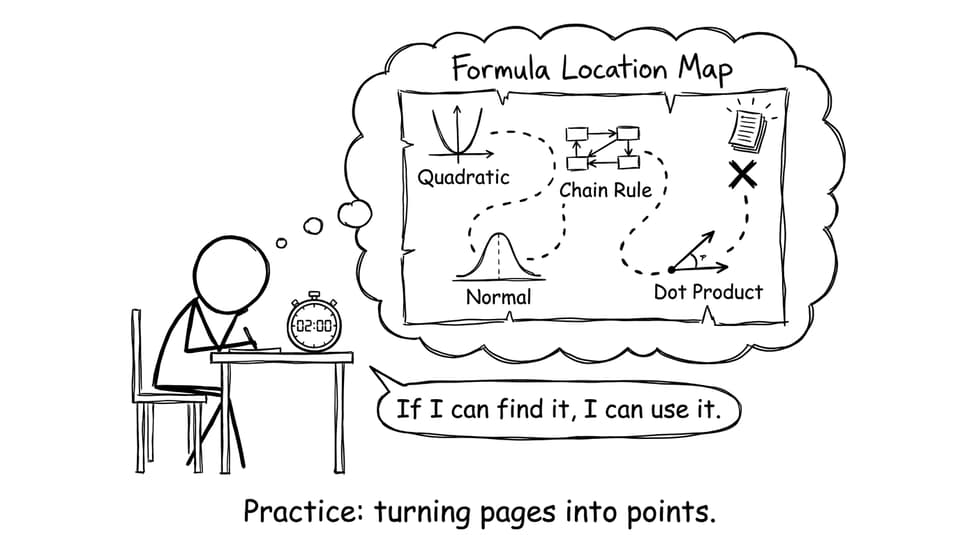
Formula location map: practice finding 5 core items per topic under time.
-
Method first, formula second: decide the approach, then confirm the exact form.
-
Show working relentlessly: the booklet supports method marks, but doesn’t replace them.
To make this practical, combine booklet navigation with targeted practice like IB Math: Targeted Revision Using the Questionbank and sets such as AA Calculus Questionbank.
FAQ
Can I bring my own formula sheet into an IB Math exam?
No. In IB Math, you are only allowed the official formula/data booklet provided in the exam. That rule matters because IB wants every student to work from the same reference material. However, you can use a personal study sheet while revising at home to train recall and organization. Many students build a “top 25 formulas I use weekly” sheet, then use the official booklet to verify notation. The goal is not to replace the booklet, but to reduce hesitation under pressure. RevisionDojo helps by giving you syllabus-aligned notes and practice so your study sheet stays accurate.
Is the IB Math HL formula booklet different from SL?
Depending on your course pathway and assessment materials, HL students encounter additional depth and more advanced applications. In practice, HL also demands faster switching between topics and more multi-step problems, so booklet navigation becomes more important. Even when formulas overlap, HL questions often combine them in unfamiliar ways. That’s why you should train “finding + applying” rather than just “recognizing.” Use the correct course hub (AA or AI) so your IB Math revision matches your syllabus. If you’re unsure where you fit, start with IB Mathematics: Analysis and Approaches (AA).
How should I study the formula booklet for IB Math HL?
Treat it like a tool you rehearse with, not a PDF you read once. First, skim it and label the big sections (algebra/functions, calculus, trig/geometry, vectors, stats/probability). Next, do timed question sets where your only goal is to locate the needed formula quickly and write it correctly. Then, do full problems and reflect: did the formula help you choose a method, or did you search randomly? This is where RevisionDojo becomes a home base: Study Notes for understanding, Questionbank for targeted drills, Flashcards for recall, and AI Chat for stuck moments. Add Mock Exams, Predicted Papers, and Grading tools when you want the full exam feel, and use Tutors when a topic keeps repeating in your error log.
Conclusion: make IB Math feel lighter on exam day
The IB Math HL formula booklet isn’t there to rescue you from learning. It’s there to give you breathing room so your best thinking shows up when it counts.
If you want to turn formulas into marks (not just pages), build your routine around RevisionDojo: start from the right syllabus hub, learn with Study Notes, drill with the Questionbank, and pressure-test everything with Mock Exams and Predicted Papers. That’s how IB Math revision becomes calmer, faster, and more reliable.