

How to Score a 7 in IB Math AA HL: Proven Strategies for Top Marks
There’s a moment every IB Math AA HL student recognizes: you finish a hard question, look at your working, and it feels like you just fought the syllabus and survived. But then you open the markscheme and realize the exam wasn’t testing bravery. It was testing clarity.
A 7 in IB Math AA HL is not a personality trait. It’s a pattern of choices repeated for long enough that your brain starts to anticipate the examiner’s logic. And that’s good news, because patterns can be practiced.
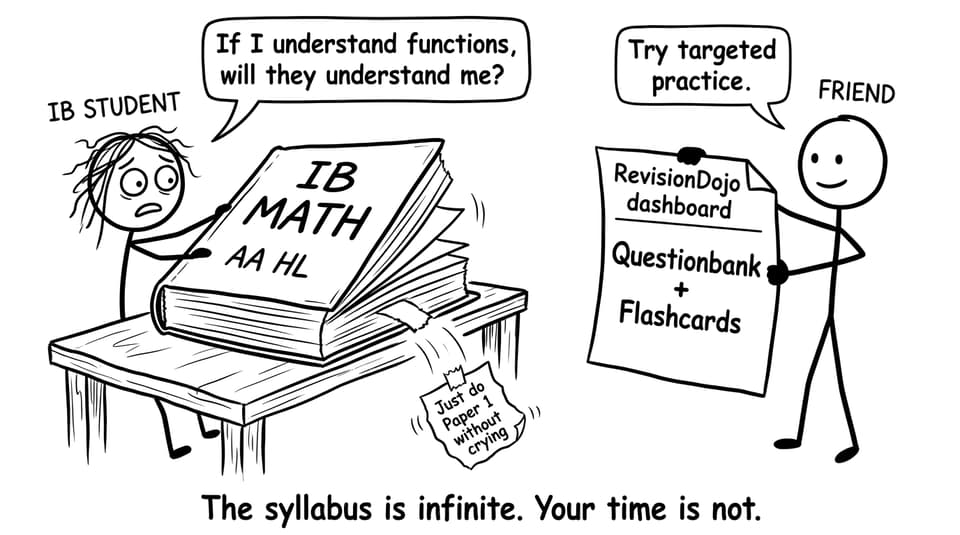
This guide breaks down exactly how top scorers approach IB Math AA HL: what they prioritize, how they practice, and how they use RevisionDojo to turn effort into marks.
A quick overview checklist for a 7 in IB Math
If you want a simple north star, aim to do these consistently:
-
Learn each topic conceptually first (not just procedures)
-
Practice IB Math questions by paper type and difficulty
-
Keep an error log and revisit it weekly
-
Train Paper 1 fluency (algebra, exact values, clean steps)
-
Train Paper 2 efficiency (calculator + interpretation)
-
Train Paper 3 resilience (novel problems + communication)
-
Use the formula booklet like a tool, not a crutch
-
Treat the IA like 20% you can control
For the syllabus map and topic-by-topic resources, keep the IB Math AA hub open as your home base: IB Mathematics Analysis and Approaches Resources.
Know the IB Math AA HL assessment (so you revise on purpose)
Before strategy, you need the shape of the game. IB Math AA HL is assessed through:
-
Paper 1 (120 mins): no calculator, heavy on algebraic control and exact reasoning
-
Paper 2 (120 mins): calculator allowed, stronger emphasis on modeling and interpretation
-
Paper 3 (60 mins): HL-only, unfamiliar contexts, extended reasoning
-
Internal Assessment (IA): mathematical exploration worth 20%
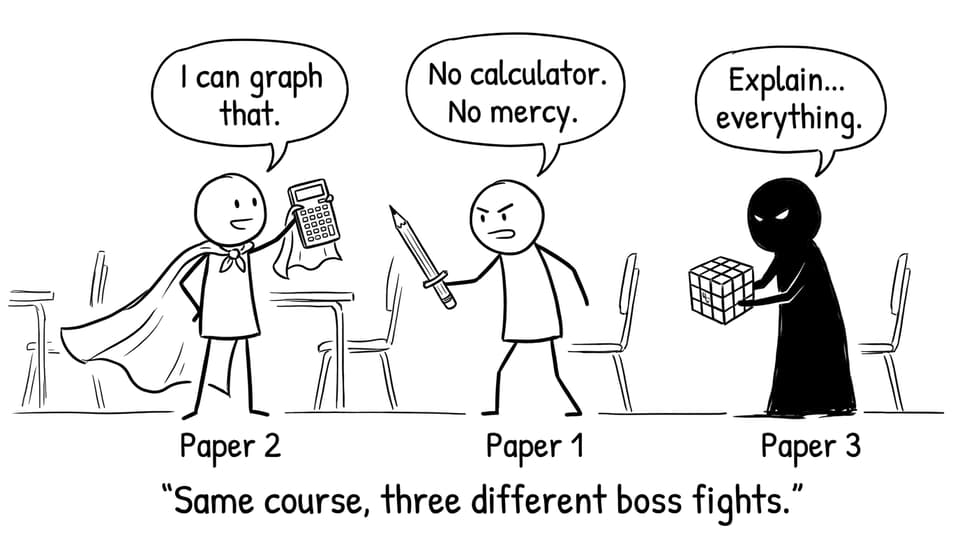
The trap is revising as if all components reward the same skill. They don’t. Paper 1 rewards disciplined manipulation. Paper 2 rewards efficient technology use and communication. Paper 3 rewards composure, structure, and making sense of the unfamiliar.
If you want a focused breakdown of how these papers differ in demands, use: IB Math AA HL Paper 1 vs Paper 3: Crucial Differences.
Build conceptual foundations (the hidden difference between a 6 and a 7)
At the top end, IB Math stops being “Can you do this method?” and becomes “Do you understand what’s happening well enough to adapt?” That’s why the highest scorers spend more time upfront on meaning.
Three high-return habits:
Explain the idea before you calculate
Before you start manipulating symbols, write a one-line plan: What is the goal and what tool matches it? In IB Math, that small pause prevents long, beautiful wrong answers.
Connect topics instead of isolating them
The AA HL course rewards connections: functions link to calculus, calculus links to series, vectors link to geometry and proof. When you revise, ask “What topic does this depend on?” and “Where else does this technique show up?”
Use RevisionDojo notes to learn the story behind the method
When you’re rebuilding understanding fast, concise explanations beat rereading a thick textbook. RevisionDojo’s topic pages (plus Study Notes and Flashcards) help you see structure without drowning in detail, especially when you’re bouncing between topics like calculus and functions.
For a strong calculus starting point: IB Math AA Calculus.
Prioritize the highest-impact IB Math AA HL topics (without skipping the rest)
Yes, you must cover the whole syllabus. But smart students still bias their time toward the topics that compound across papers.
Give extra attention to:
-
Calculus: differentiation, integration, applications, series
-
Functions and graphs: transformations, inverse/composite, behavior and interpretation
-
Algebra: sequences and series, logs/exponentials, complex numbers, proof
-
Probability and statistics: distributions, inference, interpretation
-
Vectors: 3D geometry, lines/planes, reasoning with dot and cross products
Then make your revision measurable. Not “revise vectors,” but “hit 25 mixed vector questions and correct every presentation error.”
To practice calculus with exam-style feedback: IB Mathematics AA Calculus Questionbank.
Train like it’s a sport: the 3-phase IB Math plan
A 7 rarely comes from one heroic month. It comes from cycles.
Foundation phase: understand + basic accuracy
-
Use Study Notes and Lessons to relearn the idea
-
Do easy-to-medium Questionbank sets until you stop making “definition mistakes”
-
Build Flashcards for formulas and triggers (when to use what)
Integration phase: mix topics to build exam instincts
This is where IB Math becomes realistic. Mix calculus with functions, or vectors with trig. You’re training selection, not just execution.
A practical guide for building this kind of routine is here: The Ultimate IB Math Study Routine for Busy Students.
Simulation phase: timed papers + honest review
By this point, your main enemy is not content. It’s pacing, decision-making, and presentation under stress.
RevisionDojo’s ecosystem makes this loop easier: drill in the Questionbank, switch to exam-style timing with Mock Exams and predicted papers, then use AI Chat and grading tools to understand what the markscheme wanted.
Master Paper 1: fluency without a calculator
Paper 1 is where small algebra slips become expensive. Your goal is to become boringly accurate.
Focus on:
-
Algebraic manipulation speed (factorizing, simplifying, rearranging)
-
Exact values and clean trig identities
-
Proof and justification language
-
Writing steps that earn method marks even when you stumble
Most students don’t lose marks because they “don’t know the topic.” They lose marks because their working is too jumpy for the examiner to reward.
Use this as your Paper 1 playbook: How to Prepare for IB Math AA Paper 1 (No Calculator).
Master Paper 2: calculator efficiency + interpretation
Paper 2 rewards students who can switch smoothly between technology and reasoning.
Train these skills deliberately:
-
Graphing quickly and reading key features (intercepts, asymptotes, turning points)
-
Solving equations numerically while still showing correct setup
-
Using regression and statistical functions with commentary
-
Checking answers with the calculator without replacing your method
In IB Math, the calculator is not there to save you. It’s there to extend you.
Paper 3: become calm in unfamiliar territory
Paper 3 often feels like the syllabus walked into a room wearing a disguise. The strongest Paper 3 students do two things well:
-
They translate messy contexts into clean variables and constraints
-
They communicate structure: definitions, assumptions, method, conclusion
When practicing, don’t just mark right/wrong. Ask: Did I make my thinking easy to award marks to? That’s the Paper 3 mindset.
Use the IB Math formula booklet strategically
You’ll be given a formula booklet in exams. But students who rely on it tend to waste time searching and second-guessing.
Instead:
-
Know what’s inside it (and what isn’t)
-
Practice retrieving formulas quickly during timed sessions
-
Learn the “setup steps” that go with common formulas (so you can earn method marks)
RevisionDojo’s aligned resource helps you build that familiarity: IB Mathematics Analysis and Approaches Data Booklet.
The error log method: turn mistakes into predictable marks
If your revision doesn’t include a system for mistakes, your future self will repeat them under pressure.
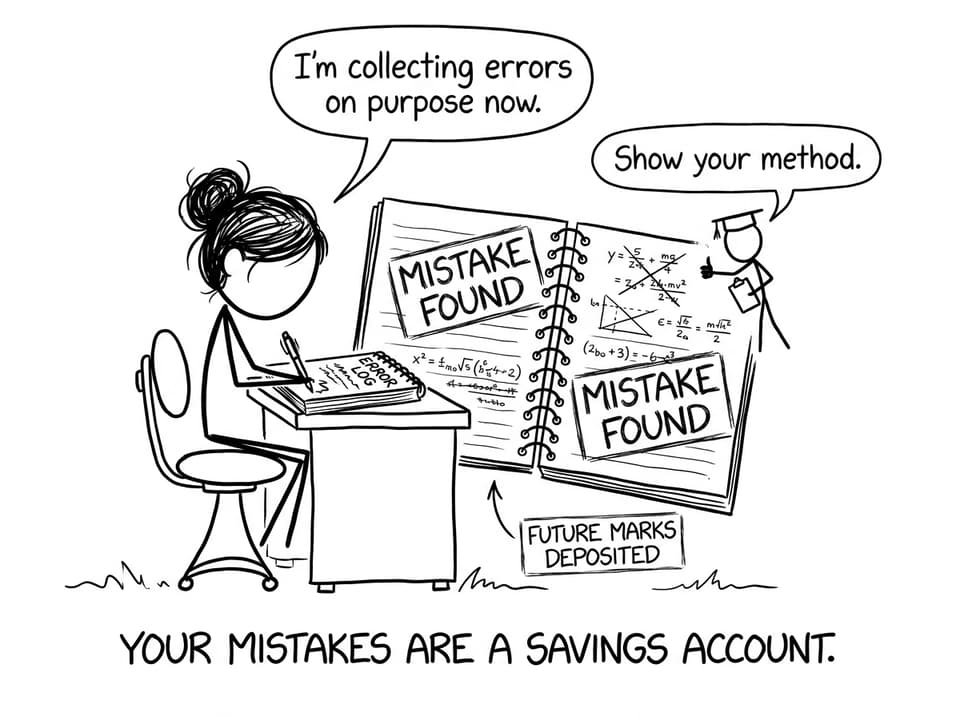
Make an error log with four columns:
-
Question type/topic
-
What I did wrong (be specific)
-
Why it happened (rushed, forgot condition, misread command term)
-
The fix (a rule, a trigger, or a worked example)
Then revisit it every week. In IB Math, improvement is often just the same mistake stopped early.
Maximize the IA: protect your 20%
A 7 gets easier when your IA is strong, because you’re not asking the final exams to do all the work.
High-scoring IA patterns:
-
A focused research question with real mathematical depth
-
Clear structure: aim, method, results, reflection
-
Personal engagement that shows choice and interpretation, not just calculation
-
Honest limitations and what they imply
If you need exemplars to calibrate your standard, use: IB Math AA Coursework Exemplars.
How RevisionDojo helps you score a 7 in IB Math
A strong plan still needs strong tools. RevisionDojo is built to reduce wasted effort while increasing exam realism:
-
Questionbank for targeted, topic-filtered practice and fast feedback
-
Study Notes to rebuild understanding quickly
-
Flashcards for daily retrieval practice (formulas, identities, definitions)
-
AI Chat to unblock you when you’re stuck and explain markscheme logic
-
Grading tools to tighten method marks and presentation
-
Predicted Papers to rehearse exam-style patterns without guessing what matters
-
Mock Exams to train timing and stamina
-
Coursework Library for IA calibration and structure
-
Tutors when you need human help early, not late
To go deeper on targeted practice strategy, see: How to Use the Questionbank for Targeted Math Revision.
Final thoughts: a 7 in IB Math is built, not discovered
A 7 in IB Math AA HL doesn’t require being a “math person.” It requires acting like a strategist: learn concepts deeply, practice with intention, and treat mistakes as data. When your revision loop is clear, your confidence becomes quieter and more reliable.
If you want one next step today, make it simple: open the IB Mathematics Analysis and Approaches Resources, pick one weak topic, do a focused Questionbank set, and start an error log. Then repeat tomorrow.
That’s how IB Math turns from intimidating to inevitable.