


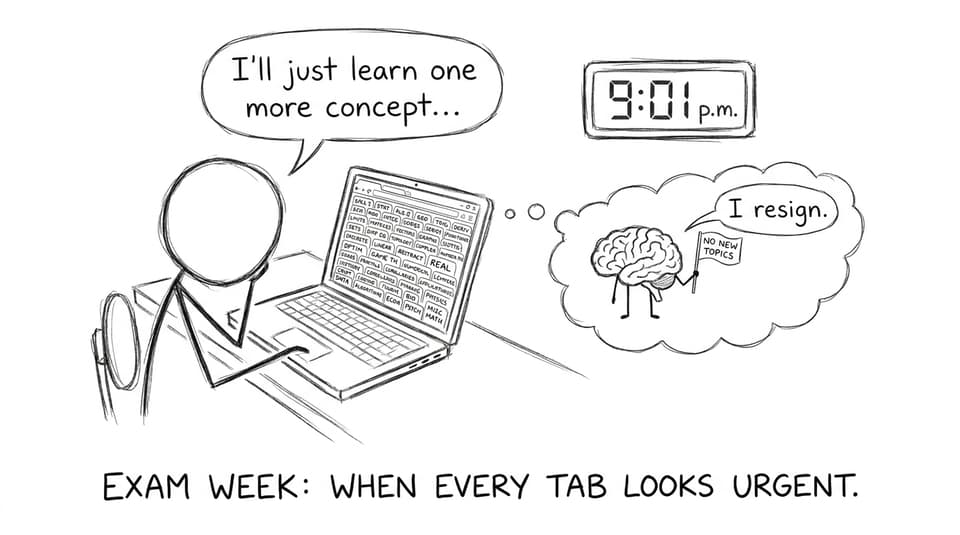
Exam week always lies to you.
It says: If you just push harder, you’ll feel ready.
But every experienced IB student learns the opposite lesson the hard way: during IB Math exam week, the goal isn’t to learn more. It’s to remember better. The content you needed is already in your head somewhere. Your job now is to make it show up on demand, under time pressure, with calm hands and a clear process.
That’s why the smartest IB approach looks almost boring from the outside: short focused blocks, daily timed practice, and deliberate rest. If you want one place to run that system, RevisionDojo helps you move cleanly between IB resources, Flashcards, Study Notes, Questionbank, AI Chat, Grading tools, Predicted Papers, Mock Exams, a Coursework Library, and Tutors without losing momentum.
IB Math exam week checklist (save this)
Use this IB checklist as your default when you don’t know what to do next:
-
2-3 hours max of real revision per day (more usually backfires).
-
Start with weakness, end with confidence.
-
Active recall first: Flashcards and questions, not rereading.
-
One timed mini-paper daily (30-60 minutes).
-
One small error log (3-5 bullets) after marking.
-
Hard stop at night so sleep can do its job.
For structure ideas that extend beyond this week, borrow the rhythm from Best Study Schedule For IB Math Exams.
Why IB exam week is about strategy, not cramming
Cramming feels productive because it’s loud. Strategy feels productive because it’s measurable.
In IB Math, marks usually disappear for predictable reasons: a missed definition, a shaky method, a command term misunderstood, or a timing spiral. Exam week is when you tighten those bolts. RevisionDojo is built around that tightening: concise notes for clarity, targeted Questionbank sets for accuracy, Flashcards for recall, and analytics that point to what’s actually costing you marks.
If you’re balancing multiple subjects too, the mindset in How to Stay Sane During IB Exam Season is worth adopting: protect your process, not your panic.
Plan your week around the next paper (not the whole syllabus)
A small change that saves a lot of stress: plan around the next IB Math paper you’ll sit.
A simple IB countdown plan
-
3 days before the next paper: focus on your high-frequency core topics (for AA: functions and calculus; for AI: modeling, statistics, and interpretation).
-
2 days before: mixed sets that force topic switching.
-
1 day before: definitions, formulas, and a light timed warm-up only.
If you’re AA, start by opening the IB Math AA hub and choosing two topics you actually need.
If you’re AI, pick one topic page and stay specific. For instance, building confidence in functions is easier when you revise from both Notes and questions in one chain: Functions Notes (Math AI) then Functions Questionbank (Math AI).
Use active recall: questions and Flashcards beat rereading
During IB exam week, passive review is a trap. It makes you feel familiar with a page, but the exam doesn’t ask for familiarity. It asks for retrieval.
Here’s a clean loop:
-
Study Notes (10-15 min): clarify one sub-skill.
-
Questionbank (25-35 min): apply it immediately.
-
Flashcards (5-10 min): lock in definitions, steps, and “trigger cues.”
If you want a detailed guide to the question practice side, use How to Use the Questionbank for Targeted Math Revision.
And if your understanding feels shaky (you know the steps but not the “why”), the approach in How to Use RevisionDojo Notes to Simplify IB Math AI Concepts translates well to any math track.
The 30-10-5 rule for IB Math exam week
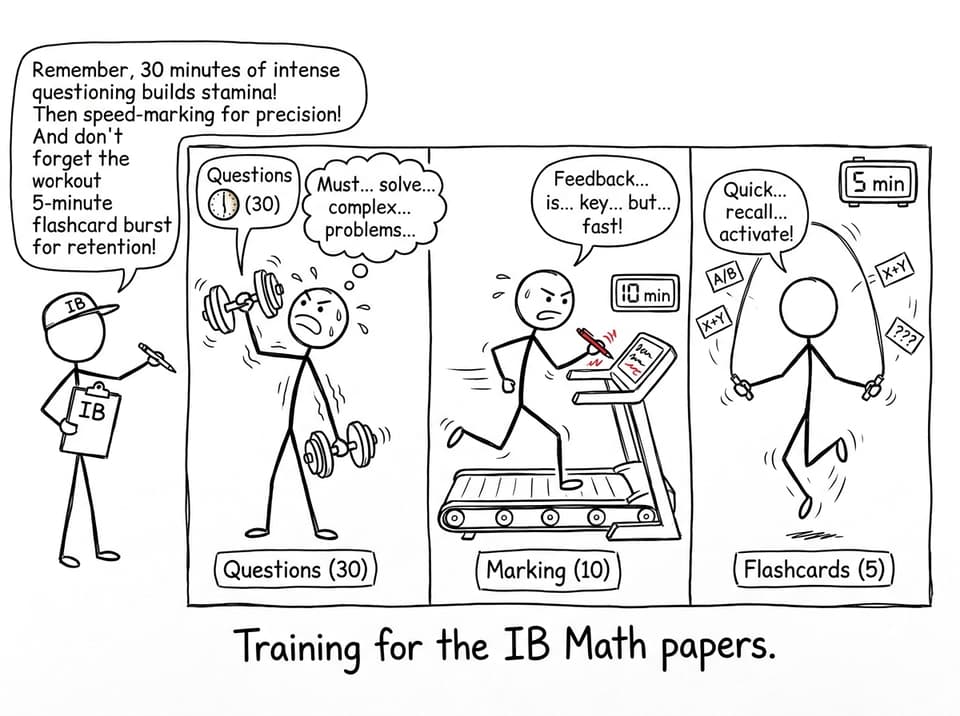
When stress rises, attention gets expensive. Short cycles protect quality.
Try this for one IB session:
-
30 minutes: solve a tight set of questions.
-
10 minutes: mark with full honesty using solutions and Grading tools.
-
5 minutes: write 3 rules in your error log (example: “If it says ‘hence’, use my previous result.”).
Do two cycles, take a real break, then stop.
If you want more ideas like this, 10 Quick Revision Hacks Before Your IB Math Exams pairs well with the 30-10-5 routine.
Start each day with your weakest topic (then earn an easy win)
Your first block is your sharpest block. Use it on the topic that has been quietly stealing marks.
For AA students, one high-return option is calculus practice that is narrow enough to fix quickly. A good example is the Math AA Calculus Questionbank, where you can focus your reps instead of wandering.
For AI students, if algebraic setup is the issue, go straight into a specific set like Number and Algebra Questionbank (Math AI).
Then end your day with a strength topic. That’s not avoidance. That’s confidence training, and IB performance is partly emotional: calm students read better.
Simulate exam conditions daily (small, not heroic)
A full-length paper every day is usually too much during IB exam week. But a short timed simulation is perfect.
Aim for 30-45 minutes:
-
A half paper section, timed.
-
No pausing, no checking.
-
Mark it immediately.
RevisionDojo’s Mock Exams and Exam-style workflows are designed for this kind of rehearsal. If you want a step-by-step setup, follow How to Use RevisionDojo to Prepare for IB Math Mock Exams.
If you want a more “exam-like package” to rehearse timing and coverage, use IB Predicted Papers as a structured simulation tool. Treat them as rehearsal, not prophecy.
Protect your sleep: stop studying late
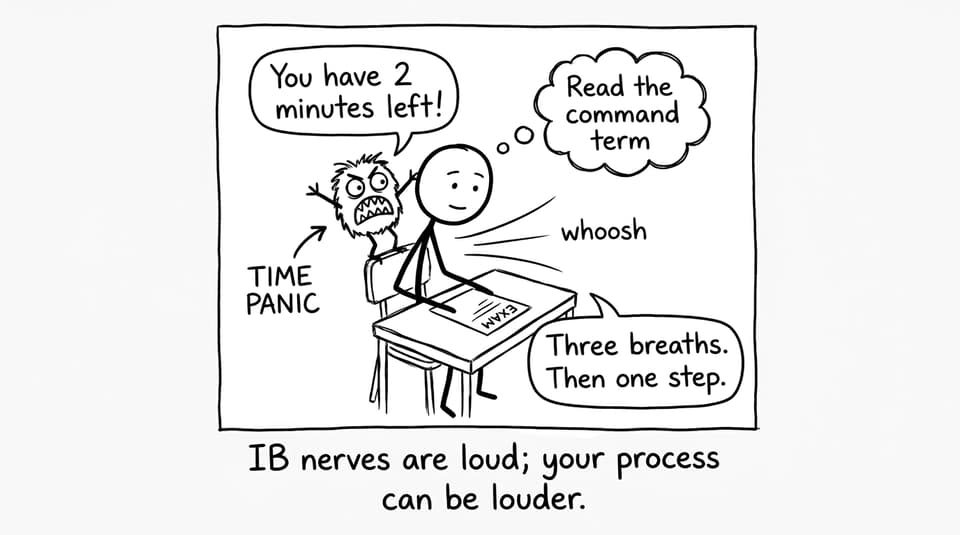
One of the most counterintuitive IB truths: studying later can make you score less.
Memory consolidation needs sleep. Decision-making needs sleep. Even basic algebra needs sleep when you’re doing it at speed.
Set a cutoff (many students choose 9 p.m.). After that: light review only, then downshift. A calm night is part of revision.
Conclusion: your IB goal is recall under pressure
IB Math exam week isn’t the time to prove how much you can do. It’s the time to prove you can do the right things, reliably, when it counts.
Run the loop: clarify with notes, retrieve with Flashcards, perform with timed Questionbank sets, and review with a small error log. If you want that entire system in one place, RevisionDojo connects Questionbank, Study Notes, Flashcards, AI Chat, Grading tools, Predicted Papers, Mock Exams, Coursework Library, and Tutors into a single exam-week routine.
Open your next paper plan, pick one weak topic, and start your first 30-10-5 cycle now.