



Reading in IB Chinese B has a particular kind of pressure. You can go back to the text (a luxury compared to listening), yet every re-read feels like it costs something you can’t afford: time, confidence, momentum. And the truth most students learn late is that strong readers aren’t the ones who know every character. They’re the ones who can keep moving, keep inferring, and keep answering.
That’s why this guide is built for IB Languages students who want to improve reading in IB Chinese B in a way that actually transfers to the exam. You’ll get a simple checklist, a few high-impact habits, and a Paper 2 strategy that rewards calm thinking over perfect vocabulary.
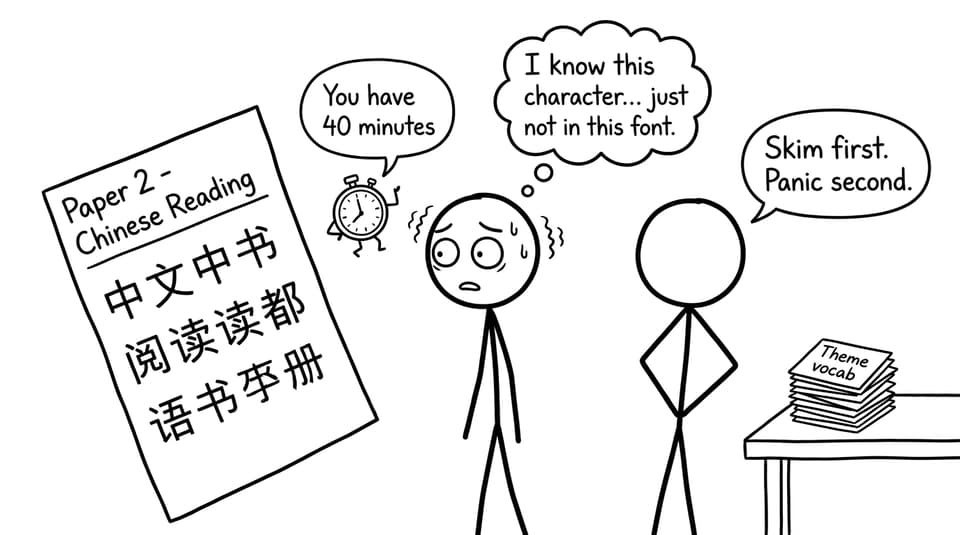
Quick checklist for IB Chinese B reading (save this)
-
Read Chinese daily for 10-15 minutes (stamina beats cramming).
-
Skim first: title, first lines, repeated words, tone markers.
-
Scan second: names, dates, numbers, connectors (因此, 然而).
-
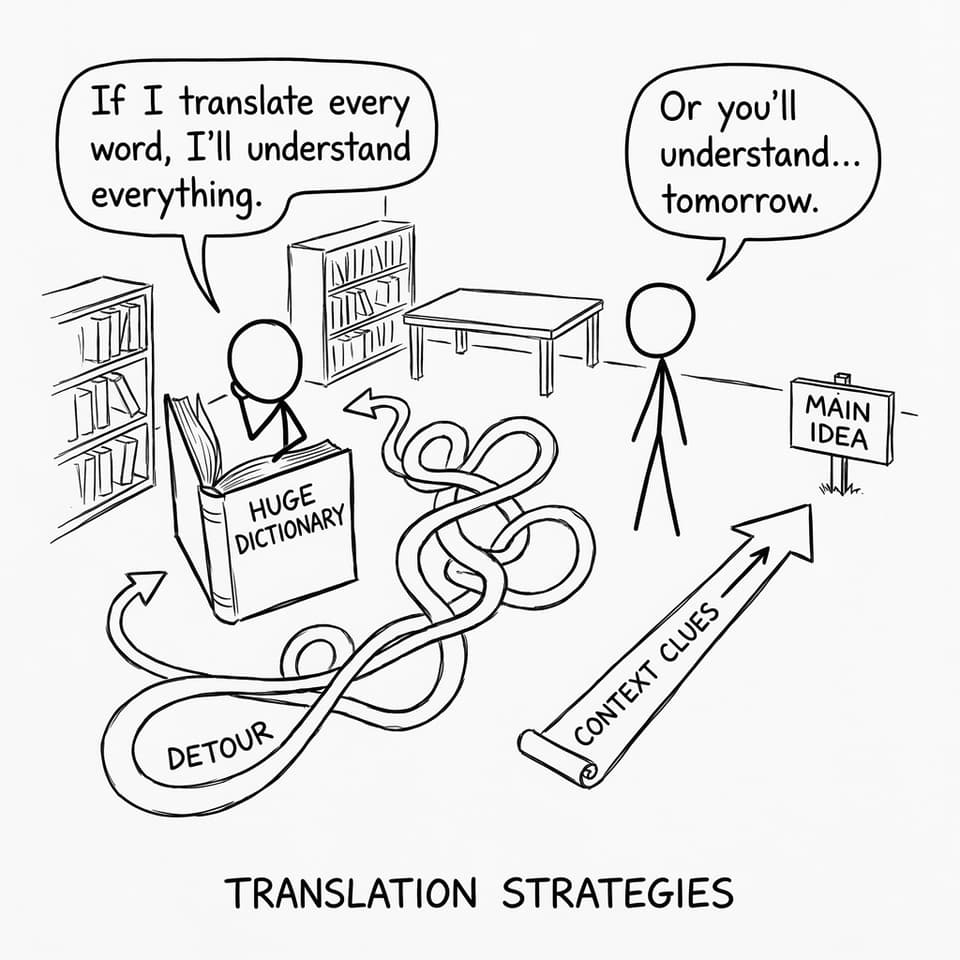
Guess unknown words using context before you ever reach for a dictionary.
-
Build theme vocabulary across the five prescribed themes.
-
Summarize each text in 2-3 sentences (in Chinese when possible).
-
Do regular Paper 2-style sets under time pressure.
If you want an exam-aligned place to practise these skills, start with the IB Chinese B hub, where RevisionDojo pulls together Questionbank practice, Study Notes, Flashcards, and AI Chat in one workflow.
Why reading matters in IB Chinese B (and in IB Languages)
In IB Languages, reading isn’t just “comprehension.” It’s decision-making. Every text asks: can you identify the main idea quickly, find evidence fast, and answer precisely without drifting into extra detail?
For IB Chinese B specifically, reading often feels harder because:
-
Texts can be dense with formal structures and compact phrasing.
-
Cultural references and idioms can hide the author’s purpose.
-
Many students default to word-for-word translation, which slows everything down.
A better goal is this: understand enough to answer exactly what’s asked.
To see what examiners are really targeting, pair this article with Reading Strategies for IB Chinese B Paper 2 and then test yourself using RevisionDojo’s Questionbank.
The habit that changes everything: daily reading with a tiny rule
Here’s a quiet story most IB students recognise.
You start the week telling yourself you’ll “do more Chinese.” You save three articles, bookmark a graded reader, maybe even open a notes app. Then the week gets loud. Deadlines pile up. You promise yourself you’ll catch up on the weekend. By Sunday night, “catch up” becomes a two-hour session of staring at characters until they blur.
Daily reading fixes that, but only if it’s small enough to survive a busy week.
Try this rule:
Read one short text a day, and stop while it still feels doable.
Ten minutes is enough. The goal isn’t volume. It’s consistency. Over time, your brain starts recognising patterns faster: connectors, cause-effect phrasing, opinion markers, and recurring topic vocabulary.
Use RevisionDojo Study Notes to anchor what you read into clear structures, then convert key phrases into Flashcards. If you want a broader system for learning with notes effectively across IB, this pairs well with Digital IB Study Notes: Access Anywhere, Anytime.
Skimming and scanning: the Paper 2 reading strategy that saves time
Most students read like it’s a novel. Paper 2 reading rewards a different mindset: you’re hunting.
Skim for the skeleton
Skimming is about grabbing the frame:
-
Title and subheadings
-
First and last sentences of paragraphs
-
Repeated words (often the theme)
-
Tone signals: 其实, 当然, 难道, 令人担忧的是
Skimming first prevents the classic trap: spending three minutes decoding a sentence that doesn’t answer a single question.
Scan for the evidence
Scanning is targeted:
-
Names, dates, places, numbers
-
Comparisons: 比…更…, 不如…
-
Cause-effect: 因为, 因此, 导致
-
Contrast: 然而, 不过, 虽然…但是…
Then answer. Move. Keep momentum.
For a structured overview of how reading tasks are built in IB Languages, you can also reference this cross-subject guide: Paper 2 (Reading) strategies for success. The skill transfers even if the language changes.
Context clues: how strong readers “know” words they’ve never learned
A secret of good reading in IB Chinese B is accepting that you will meet unknown words. The exam expects it. The winning move is learning how to keep meaning.
Use these context tools:
-
Category clues: words nearby tell you the domain (education, environment, media).
-
Example markers: 比如 / 例如 often reveal the meaning through instances.
-
Synonym/contrast clues: 不是…而是… or 与其…不如… help narrow the idea.
-
Grammar role: is it a verb, noun, adjective? Your answer often only needs the function.
Train this deliberately: when you see an unknown word, wait ten seconds before looking it up. Make a guess. Then verify. That “guess loop” is exactly what reading under pressure requires.
RevisionDojo’s AI Chat can help here in a smart way: paste a sentence and ask for two paraphrases (one simpler, one more formal), then turn the best phrasing into Flashcards.
Theme vocabulary: stop collecting words, start collecting advantage
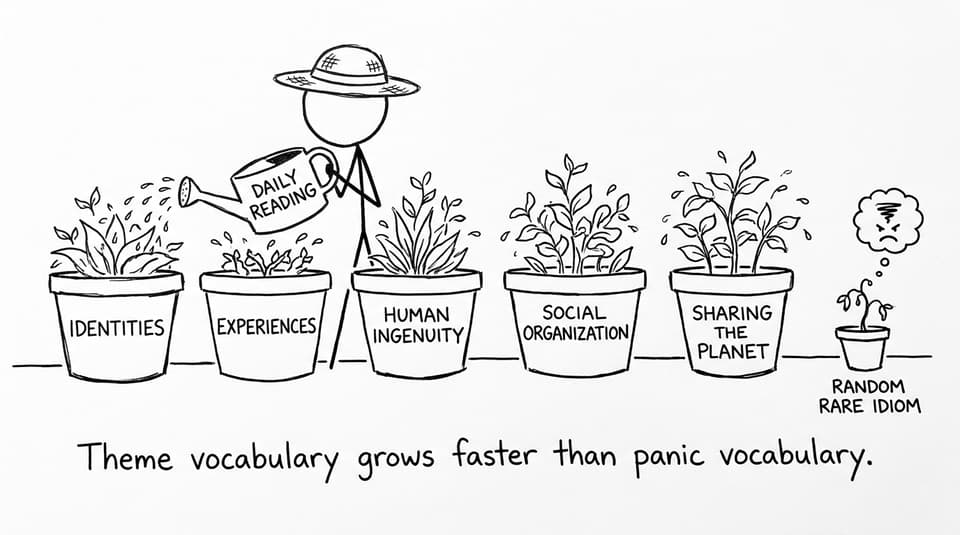
IB Chinese B texts are tied to the prescribed themes. That means vocabulary should be organised the same way. Random lists feel productive, but theme lists create speed.
Build mini-banks for:
-
Identities (饮食, 健康, 习惯, 价值观)
-
Experiences (旅行, 节日, 童年, 跨文化)
-
Human Ingenuity (科技, 媒体, 创造力, 网络)
-
Social Organization (教育, 社区, 政府, 规则)
-
Sharing the Planet (污染, 环保, 可持续发展, 资源)
Then practise in context: one short paragraph per theme per week. On RevisionDojo, you can combine Study Notes with Flashcards, then test retention using the Questionbank. When you’re ready, build a timed set using the Mock Exams and Grading tools to see what actually sticks.
Tone and text type: the IB Languages multiplier
In IB Languages, many reading questions quietly test “what is the writer doing?” not just “what is the writer saying?”
Build the habit of labelling the text type early:
-
Informative article: neutral, data-driven, explanatory transitions.
-
Opinion piece: judgement words (应该, 必须), rhetorical questions, strong stance.
-
Blog / personal post: personal anecdotes, casual tone, direct address.
-
Formal letter / notice: fixed structures, polite register, official phrasing.
Once you know the type, you predict what the author will do next. Prediction speeds comprehension more than any last-minute vocabulary sprint.
A simple weekly plan (that fits real IB life)
-
Mon: 10 minutes reading + 3-sentence summary.
-
Wed: One Paper 2-style reading set using the IB Chinese B reading practice area.
-
Fri: Theme vocabulary refresh with Flashcards (10 minutes).
-
Weekend: One mixed skills block: reading + writing response, then get feedback via AI Chat or a Tutor.
If you want a broader resource stack built specifically for Chinese B, this complements Best Resources for IB Chinese B Students.
Closing: make reading your calm advantage
Reading in IB Chinese B doesn’t get easier because you “finally learned enough characters.” It gets easier when you stop treating the text like a wall and start treating it like a map: skim the shape, scan the landmarks, infer what’s missing, and move forward.
That mindset is at the heart of IB Languages success. And it’s exactly what RevisionDojo is built to train: targeted Questionbank sets, clear Study Notes, Flashcards that stick, AI Chat for fast clarification, Grading tools for feedback, Predicted Papers and Mock Exams for exam readiness, plus a Coursework Library and Tutors when you need human support.
If you want to improve reading quickly, start today with one short text, one summary, and one timed practice set inside the IB Chinese B hub. Momentum is a skill you can build.