




If you have ever plotted your IA data and felt a small panic when the points refused to behave, you are not alone. Real data is messy on purpose. That mess is exactly what makes an IB Math IA worth reading. In an IB classroom, anyone can copy a standard equation. But the students who score well are the ones who turn real-world noise into a model they can defend, test, and refine.
This guide shows you how to develop mathematical models from real data in the IB Math IA, without turning your exploration into a “trendline hunting” exercise. Along the way, you will see how RevisionDojo supports the process with Study Notes, Questionbank practice, Flashcards for retention, AI Chat when you get stuck, and examiner-aligned tools like Grading, Mock Exams, Predicted Papers, and the Coursework Library.
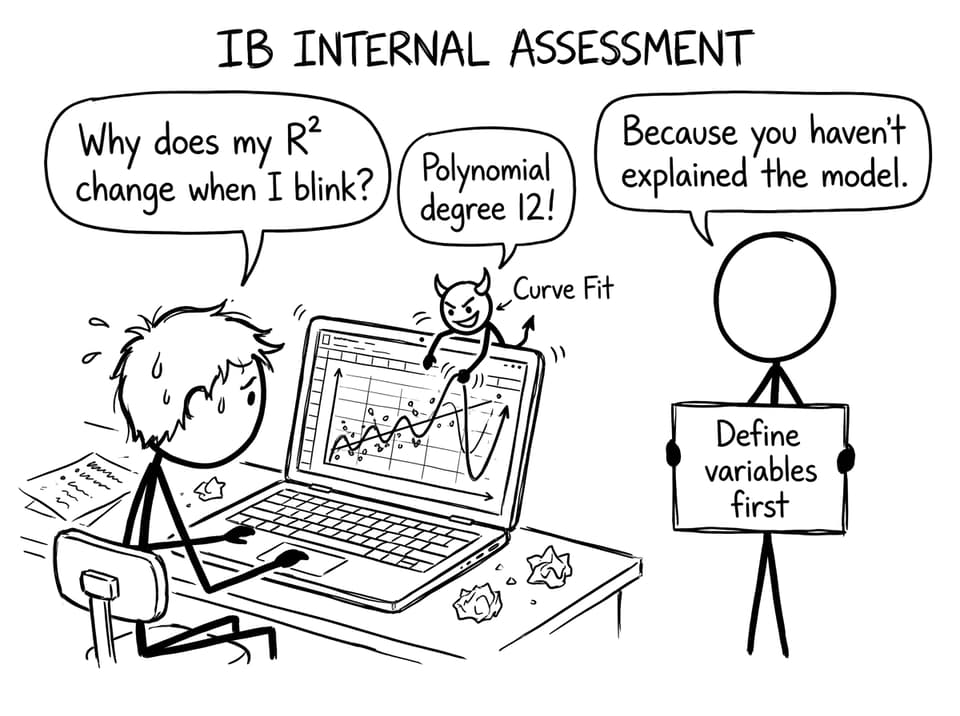
IB modeling quick-start checklist (use this before you calculate)
Before you build anything, set up the basics. This is the part most IB students skip, then regret later.
-
Choose a dataset you can explain in one sentence (what it measures, where it came from, and why it matters).
-
Define variables with units and realistic ranges.
-
Plot the data early (scatterplot first, always).
-
Decide 2-3 plausible model families to test (not 12).
-
Pick at least one accuracy check: residual plot, error metrics, or parameter reasonableness.
-
Write assumptions as you go, not at the end.
If you want a bigger planning framework, start with How to Write a Top-Scoring Math IA (2025 Guide) and then tighten your structure using How to Structure Your IB Math IA Logically.
What “a mathematical model” really means in an IB Math IA
A mathematical model is not just an equation that fits. It is a translation: you take a real situation, decide what matters, simplify the rest, and express the relationship with mathematics.
In an IB Math IA, examiners reward models that show:
-
Choice (you justify why this form makes sense)
-
Process (you fit, test, then refine)
-
Interpretation (parameters mean something in context)
-
Reflection (limitations are honest and mathematically aware)
A simple example is exponential growth: (N(t)=N_0e^{kt}). The equation matters less than your explanation of why exponential behavior is reasonable, what (k) represents, and where the model breaks.
If you want modeling pitfalls to avoid, keep How to Avoid Common Mistakes in IB Math IA Modeling open while you draft.
How to develop mathematical models from real data (step-by-step)
Start with the story your data is already telling
Plot your data and describe the pattern in plain language before you name any function type. “Increases quickly then levels off” is more useful than “maybe logistic?” because it forces you to look.
This is also where RevisionDojo’s Study Notes and AI Chat help: you can ask, “What model families match a curve that rises then saturates?” and then cross-check with syllabus-appropriate methods.
If your topic is still forming, browse The Best IB Math IA Topics for 2025 to see datasets that naturally lead to modeling.
Define variables and parameters like an examiner will challenge them
In an IB IA, unclear notation quietly destroys marks. Define:
-
Independent variable (input) and dependent variable (output)
-
Units for each variable
-
Parameters/constants and what they represent physically or practically
Example framing:
-
(t) = time (days)
-
(T(t)) = temperature (°C)
-
(a) = baseline temperature, (b) = rate of change per day
Then when you estimate (b), you are not just “doing regression”; you are estimating a real-world rate.
Choose model families on purpose (not because your calculator offered them)
Most IB Math IA datasets fall into a few families:
-
Linear: constant rate of change
-
Quadratic: curvature with one turning point, symmetry, or acceleration-like behavior
-
Exponential/logarithmic: growth/decay or diminishing returns
-
Trigonometric: seasonality, cycles
-
Polynomial/piecewise: only if you can justify complexity and interpret it
A good rule: if you cannot explain what each parameter means, the model is probably too fancy for your data.
Fit the model and show evidence of refinement
Use regression or curve fitting (GDC, spreadsheet, GeoGebra, Python). Then document your modeling choices:
-
Why you selected that model family
-
The fitted equation with parameter values
-
A graph with the model curve overlaid on data
Avoid the trap of showing only the “final perfect equation.” A strong IB exploration often includes a first attempt and a refined second attempt, with a reason for the change.
RevisionDojo supports this phase in a surprisingly practical way: use Grading tools to check whether your explanations sound like mathematical communication (Criterion B), and use the Coursework Library to compare how top students present regressions without drowning the reader.
Interpret parameters in context (this is where marks appear)
When you write “(a=2.14)” you have done mathematics. When you write “(a=2.14) means the predicted starting value is 2.14 units at (t=0), which is plausible because…” you have done an IB Math IA.
Interpretation ideas:
-
Does the intercept make real-world sense?
-
Is the rate parameter realistic compared to known values?
-
If the model predicts negative values, does that violate context?
This is also where Tutors can be helpful: not to choose your model for you, but to pressure-test your interpretation like an examiner.
Test accuracy using at least two lenses
Use more than one check, because real data can fool a single metric.
-
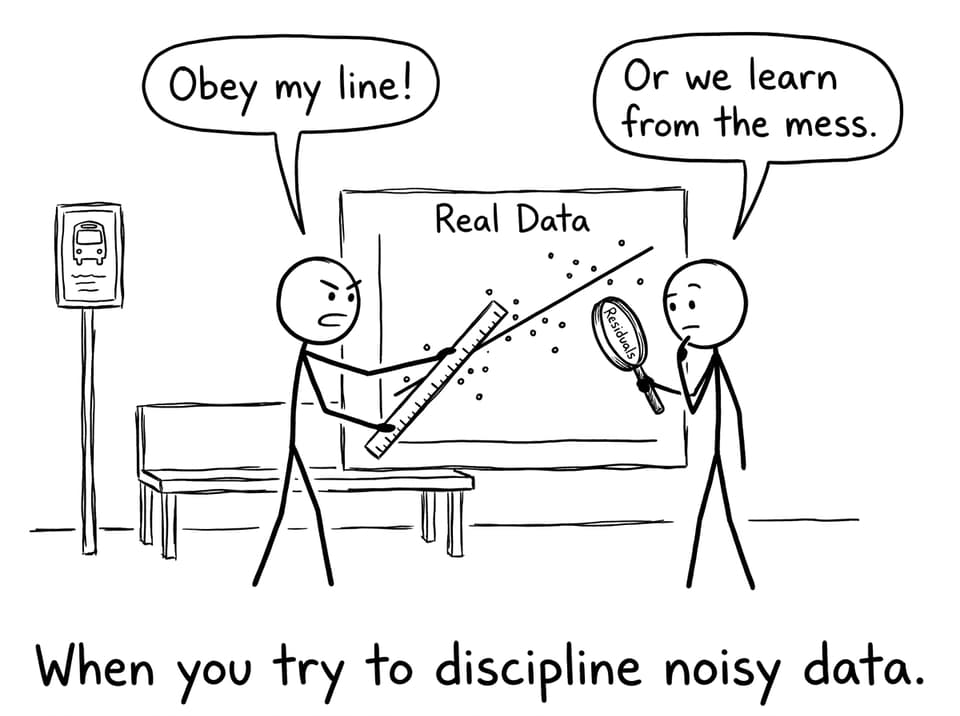
Residual plot: are residuals random, or is there a pattern?
-
(R^2): useful, but not the whole story
-
Error measures: mean absolute error, percentage error on held-out points
-
Reasonableness: do predictions stay realistic outside the sampled range?
When you are also studying for exams, this modeling mindset helps your IB performance: you start thinking like someone who tests assumptions, not someone who just gets an answer.
For revision support, build the underlying skills (functions, regression, graph interpretation) with How to Use the Questionbank for Targeted Math Revision. Then reinforce key model types with Flashcards so they become automatic under pressure.
Write limitations that sound like insight, not apology
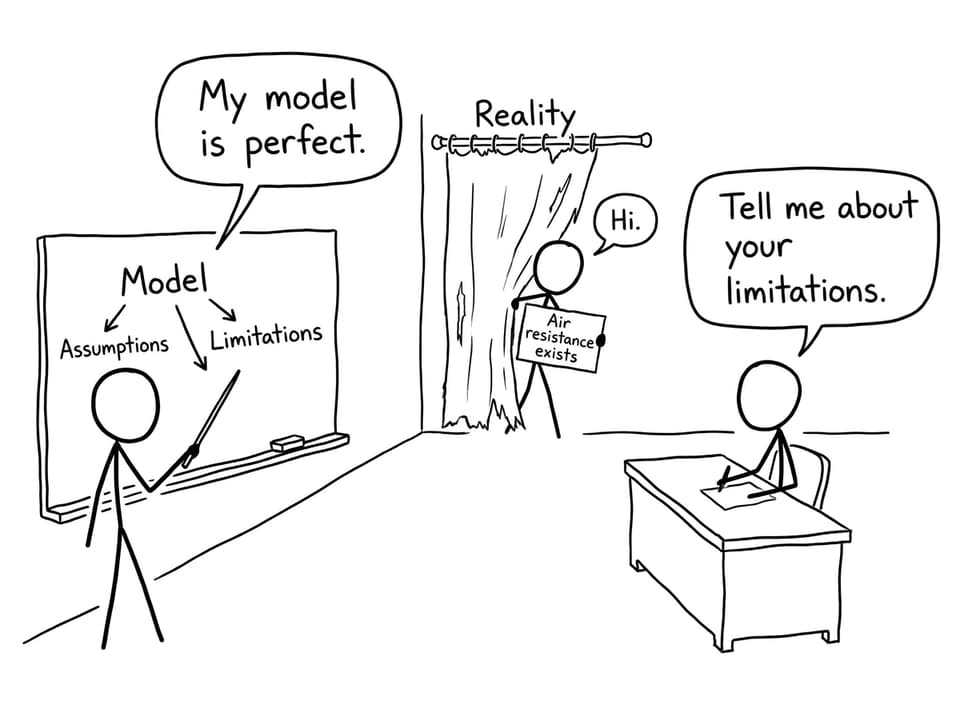
Every model is wrong in some way. Your job in an IB Math IA is to show you know how it is wrong.
Strong limitation statements include:
-
A specific assumption (e.g., constant rate, no external factors)
-
The direction of the impact (overestimates later values, underestimates peaks)
-
A realistic improvement (piecewise model, extra variable, better data collection)
If you want help on tone and structure, How to Incorporate Simulations in Mathematical Modeling is a good companion, because simulation sections often force clearer assumptions.
Conclusion: your IB model is a conversation with reality
A strong IB Math IA model is rarely the first curve you fit. It is the one you can explain, test, and improve without flinching. Start with real data, choose model types deliberately, interpret parameters like they mean something (because they do), and evaluate accuracy with honesty.
When you build that habit, you are not just writing an IA. You are training the same mindset that pays off in IB exams: clear definitions, justified methods, and calm evaluation.
If you want a single place to bring it all together, RevisionDojo helps you move from learning to execution: Study Notes for concepts, Questionbank for exam-style practice, Flashcards for recall, AI Chat for quick clarification, Grading tools for rubric alignment, plus Predicted Papers and Mock Exams when exam season hits. Build your model, then practice the skills behind it as an IB student who wants both a stronger IA and stronger exam performance.