
IB Stress has a particular sound.
It’s the quiet buzz of your phone at 1:12 a.m. when you promise yourself you’ll only watch “one more” explanation of fields. It’s the way your brain can remember a meme perfectly, yet forgets whether you should use (V=IR) or (P=IV) in a question you’ve seen three times. And it’s the realization that the IB Physics new syllabus (2025 onward) isn’t just “the same, but shuffled”; it’s built to reward understanding under pressure.
If you have one week, you’re not aiming for perfection. You’re aiming for control. Control of your time, your energy, and your accuracy when it matters.
This survival guide gives you a one-week plan designed for the IB Physics new syllabus 2025 onward, built around the fastest way to reduce IB Stress: deliberate practice, tight feedback loops, and calm consistency.
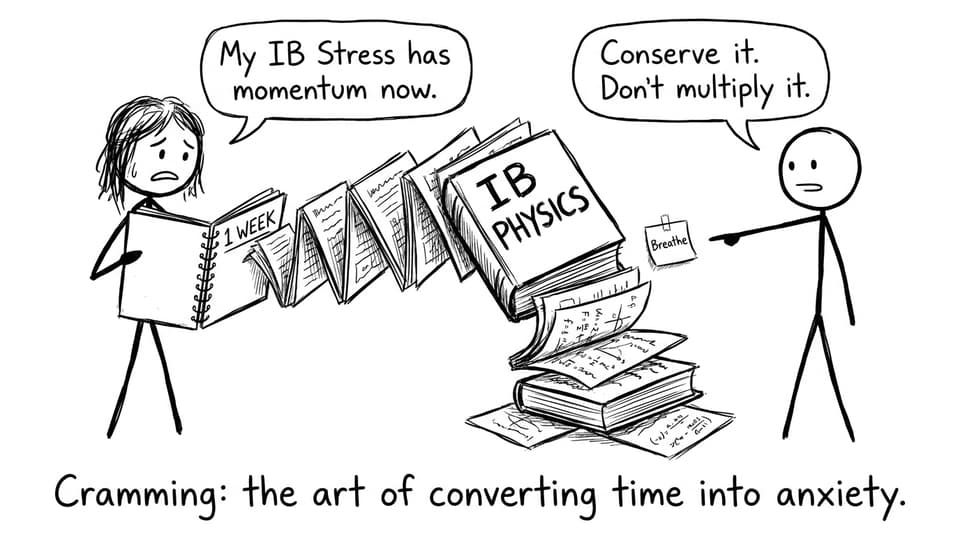
The one-week cramming checklist (read this first)
When IB Stress spikes, you don’t need more motivation. You need fewer decisions.
Use this checklist to lock your week in:
-
Pick your level (SL/HL) and commit to the topic list from the IB Physics (new) hub.
-
Build one daily loop: NotesthenQuestionsthenReview mistakesthenFlashcards.
-
Do at least one timed set daily (even 15-25 minutes).
-
Keep an error log: the same mistakes repeat, especially under IB Stress.
-
Sleep like it counts (because it does).
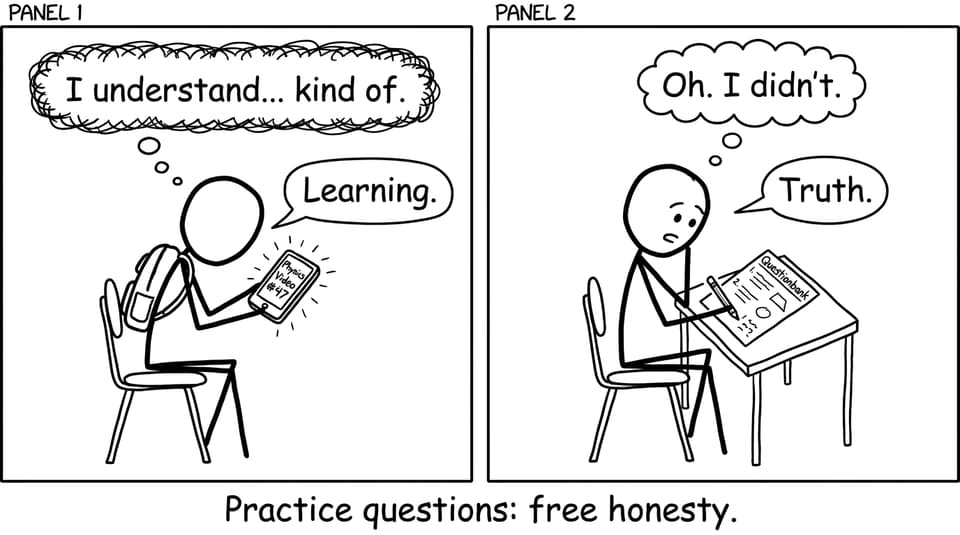
If you only follow one rule: Practice questions are your compass. Reading makes you feel safe. Questions tell you the truth.
What actually changed in IB Physics 2025 onward (and why it affects cramming)
The new syllabus is organized into Topics A to E (Space, Time and Motion; Particulate Nature of Matter; Wave Behaviour; Fields; Nuclear and Quantum Physics). The big shift is not just content; it’s emphasis.
Three cramming-relevant shifts:
-
More conceptual understanding: You’ll be rewarded for explaining mechanisms, not just recalling equations.
-
More data handling and experimental thinking: You need comfort with interpreting graphs, uncertainty, and reasoning.
-
HL assessment structure has changed: if you’ve heard people talk about “HL Paper 3,” you need the updated reality. Read IB Physics HL Paper 3: What You Need to Know in 2025 so you stop studying for a ghost.
That’s why the fastest path through IB Stress isn’t a giant reread. It’s targeted loops that train you for the exam’s style.
Your 7-day survival plan (IB Physics 2025 syllabus)
This plan assumes 4-6 focused hours/day. If you have less, keep the structure and shrink the blocks. The structure is what reduces IB Stress.
Day 1: Diagnose, then build your map
Goal: Find your weak topics fast.
-
Skim your course outline on the IB Physics (new) hub and list Topics A to E.
-
Do a mixed diagnostic set in RevisionDojo Questionbank (not too long; 30-45 minutes is enough).
-
Sort your errors into:
-
Concept gap (you don’t understand)
-
Recall gap (you knew it once)
-
Process gap (algebra, units, graph reading)
-
Then build your map:
-
Choose 3 high-impact topics to prioritize (usually A, B.5 circuits, D fields).
-
Choose 2 lighter topics for shorter sessions (often C waves + E basics).
To kick off mechanics efficiently, use Mechanics for IB Physics (new) and pair it with the Flashcards decks for active recall.
Day 2: Topic A: mechanics that actually earns marks
Goal: Stop losing marks to setup mistakes.
Mechanics questions punish sloppy starts. Under IB Stress, students rush straight to numbers. Don’t.
Your loop:
-
Read targeted notes on motion first: A.1 Kinematics Notes.
-
Drill the “setup ritual” on every question:
-
define variables
-
write knowns with units
-
choose equation
-
substitute
-
check units
-
Then add energy (it’s the fastest shortcut across mechanics):
Finish with 20-30 Questionbank problems. Review mistakes using RevisionDojo AI Chat: ask it why your approach failed, not just what the answer is.
Day 3: Topic B: thermal + circuits (the calmest way to rack up points)
Goal: Build reliable recall for definitions and relationships.
Split the day:
-
Thermal fundamentals (short, clear, high-yield)
-
B.5 Current and circuits (a frequent mark source)
For circuits, go straight to: B.5 Current and Circuits Notes.
Under IB Stress, circuits fail in predictable ways:
-
mixing up series vs parallel rules
-
forgetting what potential difference means physically
-
skipping power and energy calculations
Do a small set of circuit questions, then create Flashcards for your mistakes, not the textbook’s definitions.
Day 4: Topic C: waves without the confusion spiral
Goal: Get fluent with graphs, phases, and resonance logic.
Waves are where many students trade time for anxiety: lots of diagrams, lots of “I think I get it,” not enough proof.
A faster approach:
-
Study for 30 minutes.
-
Immediately do 15-25 questions.
-
Mark and rewrite the explanation in your own words.
If you feel IB Stress rising, don’t switch to more videos. Switch to fewer questions, done slowly, accuracy-first.
RevisionDojo’s Study Notes + Questionbank loop is built for this: clarity, then application.
Day 5: Topic D: fields (where units save your life)
Goal: Stop treating fields as memorization.
Fields feel abstract until you anchor them to relationships:
-
field strength is “effect per unit something”
-
potential is “energy per unit something”
Use the big-picture notes first: Topic D: Fields Notes.
Then sharpen orbit logic (often examined because it blends concepts):
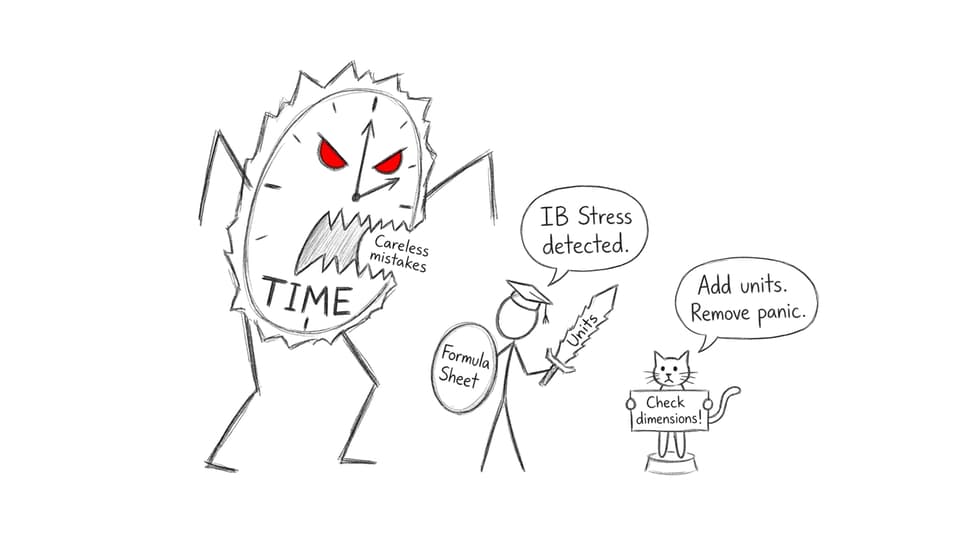
Key anti-IB Stress tactic here: do a “units check” after every line. It’s hard to panic when your work is logically constrained.
Day 6: Topic E + full mixed practice
Goal: Convert knowledge into speed and stamina.
Use RevisionDojo’s Mock Exams and Grading tools to simulate pressure and get fast feedback. This day is about building familiarity so the exam room feels less novel.
Start with core notes:
Then do a mixed timed set. Afterward, write three “error rules,” like:
-
“Underline the command term before writing.”
-
“No substitution until the equation is written.”
-
“State the physical meaning before the math.”
This is how you lower IB Stress: you give your future self instructions.
Day 7: Light review, heavy confidence
Goal: Arrive calm, not fried.
Do not turn the last day into a punishment.
-
45-60 minutes Flashcards (active recall only)
-
30-45 minutes of “favorite mistakes” (redo questions you previously got wrong)
-
20 minutes planning your exam approach (timing, skipping strategy, reset routine)
If IB Stress is loud today, use a dedicated stress plan from RevisionDojo:
Then stop. The brain that rests is the brain that retrieves.
How RevisionDojo turns “cramming” into a system
A week is short. That’s why your tools matter.
On RevisionDojo, you can build a simple pipeline that reduces IB Stress because it makes progress visible:
-
Study Notes for fast clarity when you’re stuck
-
Questionbank for exam-style practice by subtopic
-
Flashcards for daily retrieval (especially definitions, laws, units)
-
AI Chat to debug misconceptions and explain markscheme logic
-
Grading tools to turn “I think I’m okay” into “I drop marks here”
-
Predicted Papers and Mock Exams to normalize exam pressure without guesswork
-
Coursework Library so internal deadlines don’t quietly fuel your IB Stress
-
Tutors when you need a human to diagnose a pattern you can’t see alone
If you want a deeper strategy for top scores under the new syllabus, keep this open: How to get a 7 in IB Physics (New Syllabus 2025 Onward).
Closing: make peace with the week you have
A one-week sprint doesn’t reward guilt. It rewards precision.
If you follow this plan, IB Stress won’t vanish, but it will change shape. It becomes a signal to return to the system: NotesthenQuestionsthenReviewthenFlashcards. One more loop. One more correction. One more proof that you can do this.
When you’re ready, build your week around RevisionDojo’s IB Physics (new) resources and let the platform handle the structure: Questionbank practice, Flashcards, AI Chat explanations, Grading tools, Predicted Papers, Mock Exams, and support when you need it.
IB Stress is real. So is progress. Make the next hour small enough to start, thenthen let it stack.