



A 7 in IB Physics rarely comes from a single heroic weekend. It usually arrives quietly: after the tenth time you fixed the same mistake, after you started trusting units more than vibes, after you stopped collecting resources and began collecting evidence.
The 2025 syllabus era rewards that kind of student. Not the one who can recite a definition, but the one who can use it under time pressure, with unfamiliar contexts, and still stay calm.
This guide is a practical path to a 7 in IB Physics (new syllabus 2025 onward): what to focus on, what to repeat, and how to build an exam-ready routine using RevisionDojo.
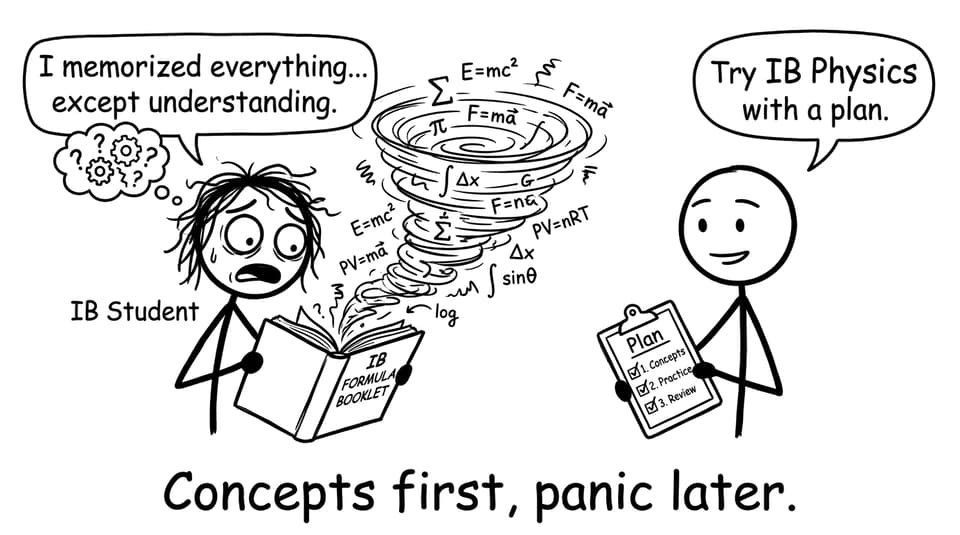
The 7-in-IB-Physics checklist (save this)
If your revision plan doesn’t include all five, it’s probably not a 7 plan yet:
-
Learn one micro-topic at a time (not “Mechanics,” but “momentum change in 2D collisions”).
-
Do IB Physics questions immediately after learning (same day).
-
Keep a mistake log and retest within 48 hours.
-
Build timing stamina weekly using realistic exam formats.
-
Treat your IA as a scoring asset, not background stress.
For a clean hub of syllabus-aligned materials, start here: IB Physics resources.
What changes with IB Physics 2025 onward (and what stays true)
The details of assessment evolve, but the skill the IB keeps rewarding is stable: transfer. Can you take a core idea (fields, energy, waves, uncertainty) and apply it when the surface story changes?
So your strategy should match the direction of travel:
-
Prioritize conceptual understanding over memorising isolated steps.
-
Practice with exam-style prompts that force interpretation.
-
Get comfortable explaining reasoning, not just writing an answer.
RevisionDojo makes this easier because the learning loop is connected: Study Notes for clarity, Flashcards for recall, Questionbank for application, and AI Chat when you get stuck mid-problem.
How to study IB Physics for a 7: the “tight loop” method
A high scorer doesn’t do more topics. They do fewer topics more intelligently.
Learn fast, then prove it with IB Physics questions
Pick a single micro-topic and spend 15-25 minutes learning it from one reliable source. Use IB Physics Notes: Boost Your Study with RevisionDojo when you want explanations that are built to convert into marks.
Then immediately switch to questions. Use the RevisionDojo Questionbank to filter by topic and difficulty, and do a short set while the idea is still “warm.”
Mark, log, re-attempt (this is where 7s are made)
Every session ends with two artifacts:
-
A 3-5 bullet mistake log (what happened, why, the fix).
-
1-3 flashcards based on your errors (equations, definitions, common traps).
That second part matters because IB Physics is full of “almost right” thinking. Flashcards aren’t for trivia; they’re for preventing repeat losses.
Use the data booklet like a tool, not a crutch
Top students don’t avoid the data booklet. They learn to navigate it under pressure.
Work with the IB Physics Data Booklet open while you practice, and train these habits:
-
Check units before substituting numbers.
-
Rearrange equations symbolically first.
-
Write the physical meaning of the equation in one sentence.
Exam performance in IB Physics: technique beats adrenaline
Timed practice is where knowledge turns into marks.
Build stamina with predicted papers and mock exams
Once per week, simulate a real section. Then review mistakes as seriously as you attempted the questions.
Two useful resources for this stage:
This is also where RevisionDojo’s Grading tools and AI Chat pull their weight: you can get mark-scheme-aligned feedback quickly, then ask one precise question like, “Which statement would earn the method mark here?”
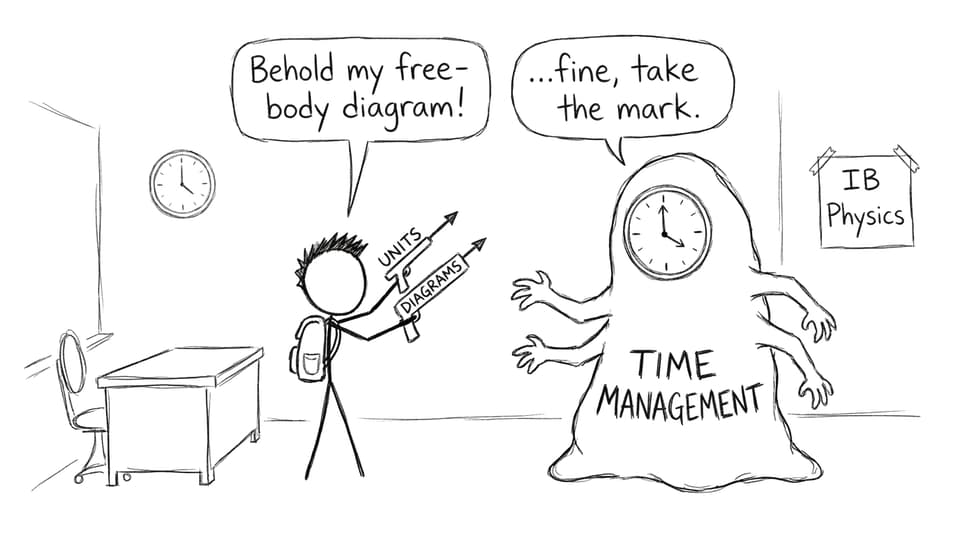
A simple IB Physics timing rule
If you get stuck, don’t negotiate with the problem for six minutes. Write what you know (diagram, given values, units, starting principle), take the easy marks, then move.
Later, your mistake log tells you what to drill in the Questionbank.
Don’t leave IA marks on the table
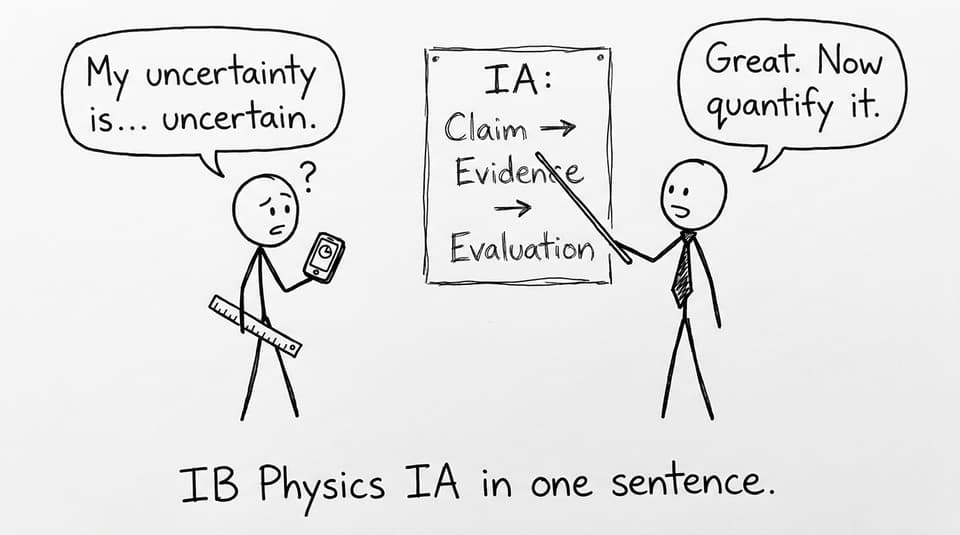
A strong IA doesn’t need fancy equipment. It needs clean reasoning, controlled variables, and honest evaluation.
Start with examples and structure:
Then use RevisionDojo’s Coursework Library and Grading tools to tighten your analysis and communication. If you want human feedback at a critical point (research question, method, evaluation), that’s when Tutors save weeks.
The real secret to a 7 in IB Physics
A 7 isn’t a personality trait. It’s a feedback habit.
If you want the simplest next step: open RevisionDojo, choose one weak IB Physics topic, study it with Study Notes, drill it in the Questionbank, lock it in with Flashcards, and finish with one timed block each week using Predicted Papers or Mock Exams. Add AI Chat when you’re stuck, and use the Coursework Library plus Grading tools to keep your IA strong and stress low.
Start here: RevisionDojo.