



The moment your mind goes blank in an IB exam
It usually happens in the first five minutes.
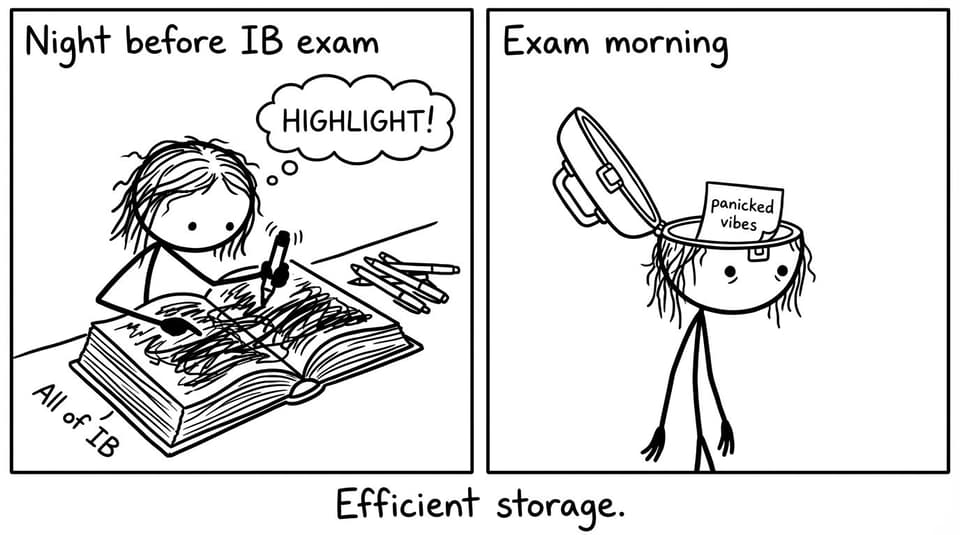
You open the booklet, read a question you swear you revised, and then your brain does something deeply unhelpful: it goes quiet. Not peaceful quiet. More like a power outage. You can still read words, you can still hold a pen, but the answer feels like it has been removed from the universe.
If you have ever frozen during an IB exam, you are not weak, not lazy, and not "bad at exams." You are human. And the weird part is this: the freeze is often a sign your brain is trying to protect you.
This article explains why IB exam brain freezes happen, what to do mid-exam when your memory locks up, and how to train your mind so your knowledge shows up when it matters.
A quick checklist: what brain freeze in IB exams actually looks like
Use this as a quick self-diagnosis. If you recognize yourself here, you are dealing with a normal stress response.
- You reread the same line 5 times and it still does not "land."
- You know you studied, but you cannot retrieve the facts or steps.
- Your hands are cold, your breathing is shallow, your heart is loud.
- Easy questions feel suspiciously hard.
- Time feels faster than usual.
- You jump between questions, searching for "a win," but nothing clicks.
In an IB context, freezes are common because the exams combine high stakes, dense content, unfamiliar phrasing, and tight timing. That mix is basically engineered to trigger the brain's threat system.
The real reason your brain freezes during IB exams
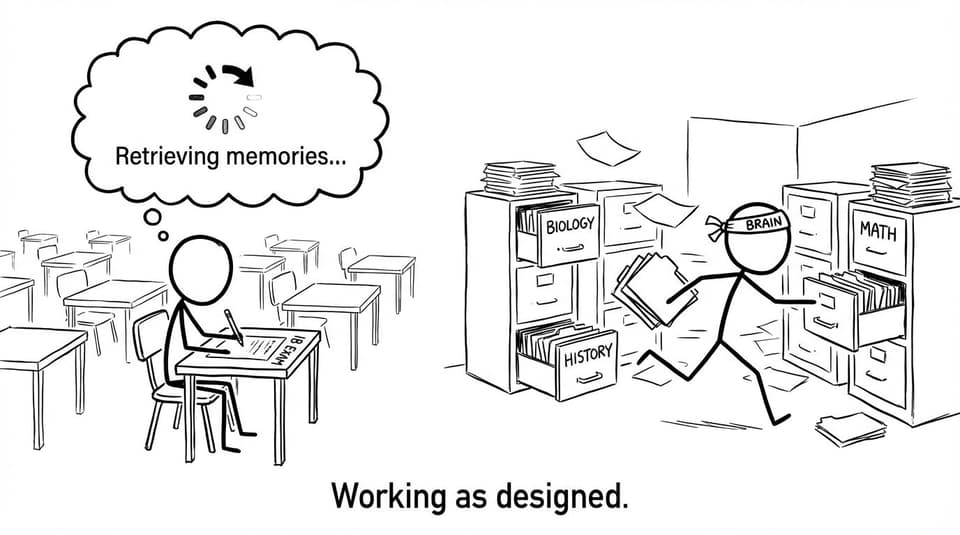
A brain freeze is not "forgetting everything." It is a retrieval problem. The information may still be stored, but stress changes which parts of your brain are running the show.
Stress hijacks working memory
Working memory is the mental whiteboard you use to hold steps, definitions, numbers, and logic while you solve a problem. In many IB papers, you need a lot of working memory: unpack the command term, recall the model, apply it, structure a response, check time.
Under pressure, stress hormones push your brain into survival mode. Survival mode is great for reacting quickly. It is not great for calmly assembling a 9-mark explanation.
Working memory shrinks. Your mind feels "full" even though nothing is in it. That is the paradox of freezing.
Your brain chooses safety over recall
When your brain senses threat, it prioritizes fast reactions over deep thinking. The part of you that wants to craft a beautiful IB answer gets interrupted by the part that wants to avoid danger.
An exam is not a tiger. But your nervous system can treat it like one.
Retrieval depends on cues, and exams change the cues
You might have learned a topic while:
- sitting at your desk with music,
- reading your notes in a certain order,
- using a particular worksheet,
- studying at night with a certain mood.
Then the IB exam asks you the same concept with different cues: unfamiliar context, different wording, different diagrams, different pressure.
The knowledge is there, but the path to it is foggy.
Perfectionism makes freezing more likely
Many IB students freeze not because they cannot answer, but because they cannot answer "perfectly."
Your brain tries to produce the best possible first sentence, fails, and then decides to stop producing anything at all. It is a surprisingly common pattern in essays, explanations, and extended response questions.
What to do in the moment: a freeze protocol that works
You do not need a motivational speech. You need a procedure.
Reset your physiology in 30 seconds
Try this sequence during an IB exam freeze:
- Put your pen down for 3 seconds.
- Exhale longer than you inhale (for example: inhale 3, exhale 6) three times.
- Drop your shoulders. Unclench your jaw.
- Tell yourself one true sentence: "This is a stress response. It will pass."
Longer exhales signal safety to your nervous system. That helps working memory come back online.
Get points before you get elegant
Perfectionism is gasoline for freezing. So switch goals.
- Write a rough bullet list.
- Define the key term in plain language.
- Draw a quick diagram.
- Write the formula, even if you cannot use it yet.
In an IB exam, marks are often earned through method, structure, and partial reasoning. A messy start can become a strong answer.
Use "adjacent recall"
If the exact fact will not come, recall something next to it.
Examples:
- If you cannot remember a biology process step, write the steps you do remember and label the missing one as "Step ?".
- If you cannot recall a history date, anchor it to a nearby event and explain the sequence.
- If you cannot remember a math method name, show the method.
Adjacent recall often reactivates the missing memory. Your brain likes momentum.
Change the question, not your confidence
When stuck, move strategically:
- Switch to a different question that uses a different skill.
- Collect easy marks to reduce threat.
- Return with calmer physiology and proof you can perform.
Your confidence should be based on evidence, not feeling. In an IB exam, the fastest evidence is a completed page.
How to prevent IB exam brain freeze (the part nobody wants to hear)
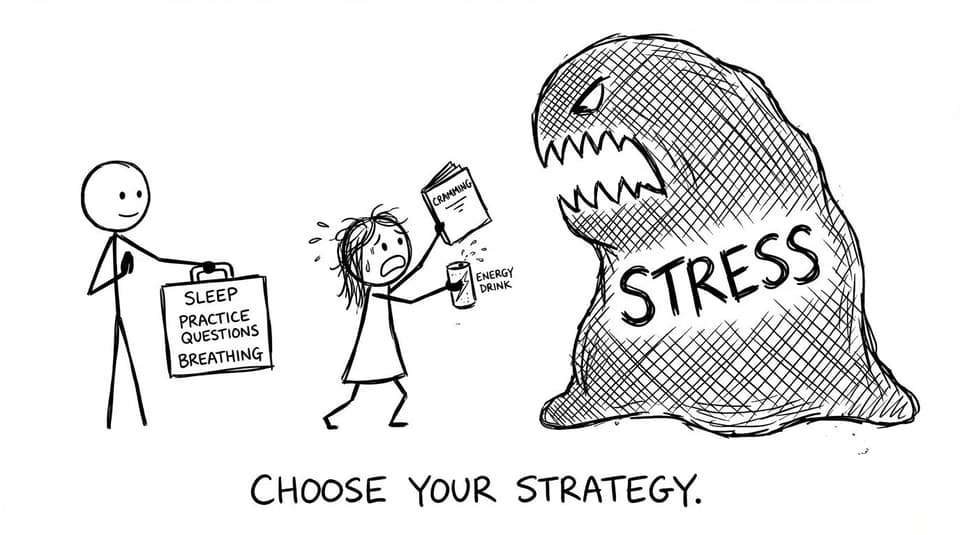
Prevention is less about "studying harder" and more about studying in a way that trains retrieval under pressure.
Practice retrieving, not rereading
Rereading feels safe. Retrieval feels risky. IB exams reward the risky one.
You prevent freezing by making your revision look more like the exam:
- answer questions without notes,
- time yourself,
- mark your work,
- repeat weak topics until recall is boring.
This is where RevisionDojo's features matter because they make retrieval practice frictionless: the Questionbank for targeted practice, Mock Exams for full-paper stamina, and Grading tools to see exactly where your marks leak.
Normalize exam conditions in small doses
You do not need to "simulate the whole exam" every time. Start smaller:
- 8 minutes for one hard question.
- no phone nearby.
- silent room.
- strict marking.
The goal is to teach your brain: "This environment is not dangerous." That reduces the threat response that causes an IB freeze.
Build scripts for common question types
Freezing happens when your brain has to invent structure under stress.
Instead, build templates:
- For explain questions: definition, then mechanism, then consequence, then link back.
- For evaluate questions: claim, then evidence, then limitation, then judgement.
- For calculations: write knowns, then formula, then substitution, then units, then check.
RevisionDojo's Study Notes and Flashcards are ideal for turning messy topics into simple scripts, and the AI Chat can help you refine a response structure until it feels automatic.
Sleep is not a moral choice, it is a memory tool
Sleep strengthens memory retrieval pathways. If you cut sleep to "get one more topic done," you may store more content but reduce your ability to access it.
In other words: you can trade knowledge for recall. And IB exams are graded on recall.
Train calm with repetition, not inspiration
Most students try to calm down by thinking calming thoughts. That is unreliable.
Instead, build calm into the routine:
- Start revision sessions with 60 seconds of slow exhale breathing.
- End sessions by doing one timed question (so your brain pairs pressure with completion).
- Use weekly mini-mocks so exam conditions stop feeling rare.
Over time, your nervous system learns that the IB exam feeling is survivable.
The RevisionDojo way to make "blank mind" less likely
Even strong students freeze when their preparation is broad but not deep.
A calmer approach is to make your prep specific:
- Use the Questionbank to practice one subtopic until you stop making the same mistake.
- Use Predicted Papers to reduce surprise and build confidence with likely themes.
- Use Mock Exams to build stamina and pacing.
- Use Grading tools to convert "I think I'm good" into "I know my weak marks are X."
- Use Study Notes for fast clarification, and Flashcards for daily retrieval.
- Use the Coursework Library to reduce the background stress of internal deadlines.
- Use Tutors when you need an outside brain to diagnose a recurring block.
When your system is clear, your brain is less likely to interpret the IB exam as chaos.
Closing: your brain isn't broken, it's rehearsing the wrong conditions
An IB exam freeze feels personal, but it is mostly mechanical: stress shrinks working memory, unfamiliar cues block retrieval, and perfectionism turns a small pause into a shutdown.
The way out is not "more pressure." It is better rehearsal. Train retrieval, practice under realistic conditions, build answer scripts, and learn a simple reset for the moment your mind goes blank.
If you want a system that makes this easier, RevisionDojo is built for it: targeted Questionbank drills, exam-style Mock Exams, structured Study Notes, quick Flashcards, supportive AI Chat, reliable Grading tools, Predicted Papers, a Coursework Library, and access to Tutors when you need a human guide.
Your knowledge deserves a clear path to the page in your next IB exam. Build that path before you walk into the room.