
A good IB History IA question feels like turning on a desk lamp. The same books are there, the same topic is there, but suddenly you can see what matters. A weak question is the opposite: you work harder, write more, and still end up in the dark because the question never gave you a clear path to analysis.
Under first assessment 2028, the IB leans even more into inquiry. That means your IB History Historical Investigation lives or dies by the research question. Not because examiners want fancy wording, but because a well-built question forces you to do the kind of thinking the rubric rewards: selecting evidence, weighing interpretations, and making judgments.
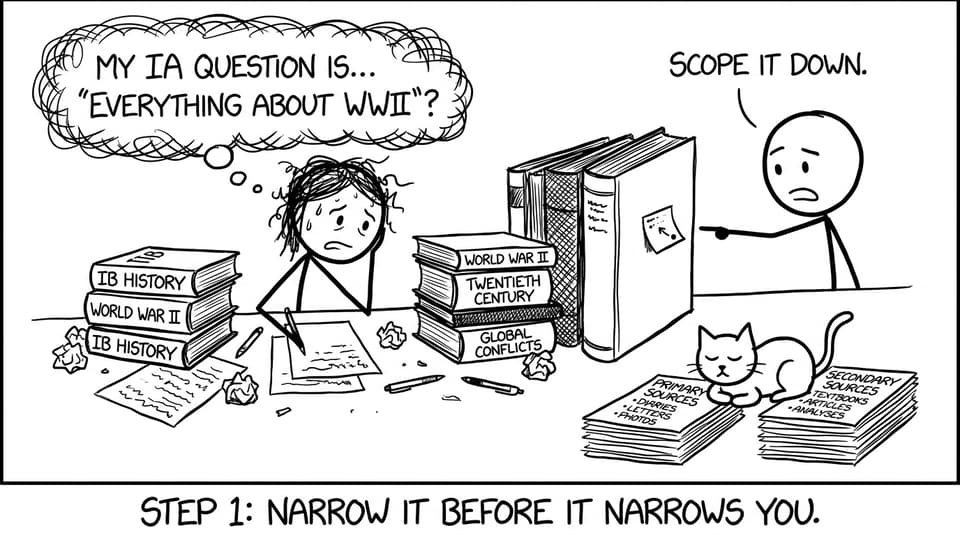
Quick checklist for a strong IB History IA question
Use this as a 5-minute test before you commit.
-
Focused scope: limited time frame, place, and event/policy
-
Debatable: smart historians could disagree on the answer
-
Researchable: you can access credible primary and secondary sources
-
Analytical command terms: “to what extent,” “how significant,” “why,” “compare”
-
Built for evaluation: you can judge causes, consequences, or significance
If you want an examiner-aligned way to sanity-check your draft, run it through the IB History IA rubric grader before you write 2,200 words in the wrong direction.
Why the question matters more in IB History (first assessment 2028)
In IB History, the IA is not a mini textbook chapter. It’s a controlled investigation. Under first assessment 2028, that idea is even clearer: you are rewarded for historical inquiry, not for how many facts you can fit into the word count.
A strong question does three quiet things at once. First, it tells you what not to include. Second, it makes your sources useful rather than decorative. Third, it creates a natural shape for your argument, so your analysis section doesn’t become a timeline with footnotes.
If you’re still unsure how the IA fits into the bigger course, this overview helps: IB History assessment explained: Papers and IA (FA 2028).
What examiners want from an IB History IA question
Examiners aren’t hunting for obscure topics. They’re hunting for clarity and control.
A high-scoring IB History IA question usually has:
-
A clear boundary (dates, location, policy/event)
-
An arguable focus (where evidence can support multiple positions)
-
A direct link to sources (so OPVL isn’t forced)
-
A question that demands judgment (not just explanation)
If your question could be answered well with a single encyclopedia article, it’s probably not an IA question yet.
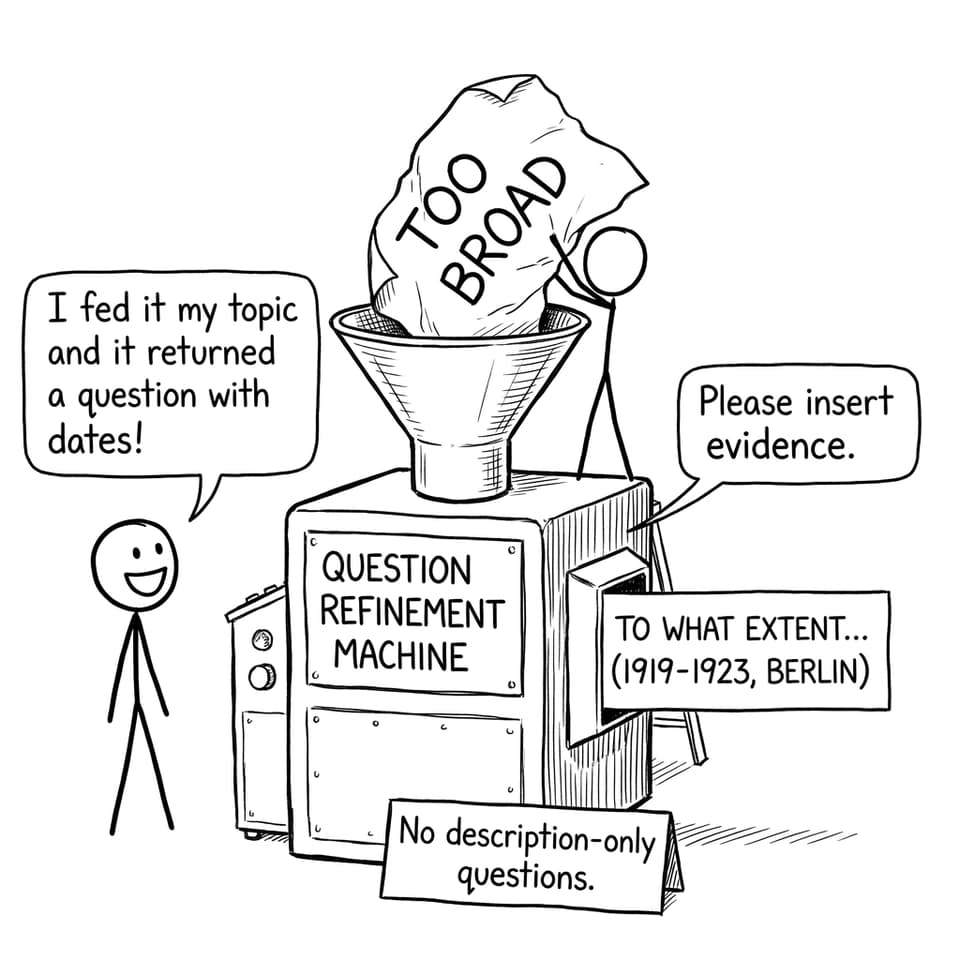
Build an IB History IA question that is analytical, not descriptive
The most common trap in IB History is accidentally writing a question that invites narration.
Descriptive questions (what they cause)
Descriptive questions sound safe because they’re straightforward. But they push you toward “what happened,” which produces paragraphs that summarize events, then summarize sources, then summarize historians. The writing can be fluent and still score lower because the thinking is thin.
Examples of descriptive framing:
-
“What happened during…?”
-
“How did X occur?” (when it becomes a story rather than an argument)
-
“What were the events of…?”
Analytical questions (what they unlock)
Analytical questions force you to take a position. They also create natural paragraphs: each paragraph becomes a claim, supported by evidence, then weighed against another interpretation.
Examples of analytical framing:
-
“To what extent…”
-
“How significant was…”
-
“How far did…”
-
“Which factor was more important…”
When students struggle with the “analysis vs narration” line, they often run into the same predictable mistakes. Keep this bookmarked while you draft: Common IB History IA mistakes (FA 2028).
Scope control: the quiet skill that saves your IA
Scope is where most IB History IA questions break. Too broad, and you end up skimming. Too vague, and you can’t evaluate. Too ambitious, and your conclusion becomes a list of “many factors.”
A practical way to control scope is to choose two of these limits (and preferably three):
-
Time: a tight window (often 3–10 years)
-
Place: one country, city, or region
-
Mechanism: one policy, one decision, one turning point
-
Impact type: political, economic, social, or diplomatic (not all at once)
If you want a wider view of how the new course is structured around inquiry, read: IB DP History explained: the new curriculum structure (FA 2028).
Evidence first: choose a question your sources can answer
A surprisingly honest test for an IB History IA question is this: can your sources “argue back”?
Before you lock your research question, make sure you can find:
-
At least 2 strong sources you can evaluate deeply (your OPVL core)
-
A range of supporting sources that don’t all repeat the same viewpoint
-
Historian interpretations (or clear secondary analyses) you can compare
If you already have a topic but no reliable evidence, don’t force it. Swap the angle, narrow the time frame, or shift location until sources become plentiful.
For practical writing workflow once your question is set, this guide connects the steps clearly: How to write an outstanding IB History IA.

A simple refinement loop that works (and feels realistic)
Most strong IB History questions aren’t invented. They’re revised.
Start with a topic sentence, not a perfect question
Write: “I want to investigate…” Then add the event, timeframe, and place.
Convert it into a debatable judgment
Replace “what” with an evaluative frame: “to what extent” or “how significant.”
Add the missing boundary
If the question doesn’t include dates or a specific case study, add them. This is where good IAs become manageable IAs.
Stress-test it against the rubric
Ask: will this force me to evaluate sources and weigh interpretations? If yes, you’re close. If not, adjust.
To strengthen your Section B writing once the question is set, use: 10 proven tips to write a strong IB History IA analysis.
How RevisionDojo helps you choose a strong IB History IA question
RevisionDojo is built for the moments when you’re not stuck on motivation, but on direction.
-
The IB History resources hub helps you anchor your topic in the course content and concepts.
-
The IB Internal Assessment guides give you structure when your draft feels messy.
-
The Coursework Grader and the IB History IA rubric grader help you check whether your question leads to rubric-rewarded thinking.
-
When you’re looking for model investigations, use IB History IA examples to see what “focused and analytical” looks like on the page.
And if referencing starts to sprawl, this saves hours of cleanup: How to reference properly in your IB History IA.
Final thoughts: the IB History IA question is your advantage
In IB History, the strongest students aren’t always the ones who read the most. They’re the ones who choose a question that makes analysis inevitable. Under first assessment 2028, that advantage grows: inquiry-based writing is the point, and your IA question decides whether you’re investigating or just reporting.
If you want your next step to feel concrete, draft two versions of your research question tonight: one “safe,” one “sharp.” Then use RevisionDojo to test them, refine them, and commit to the one that creates the clearest path to evaluation in IB History.
