

If you have ever revised IB History by making a bigger and bigger timeline, you already know the feeling: the more you add, the less confident you become.
Focused Studies (first assessment 2028) are where that pressure often peaks. Students hear “case study” and assume the goal is total coverage: every event, every date, every name. But the course is built for something quieter and harder: selecting evidence on purpose.
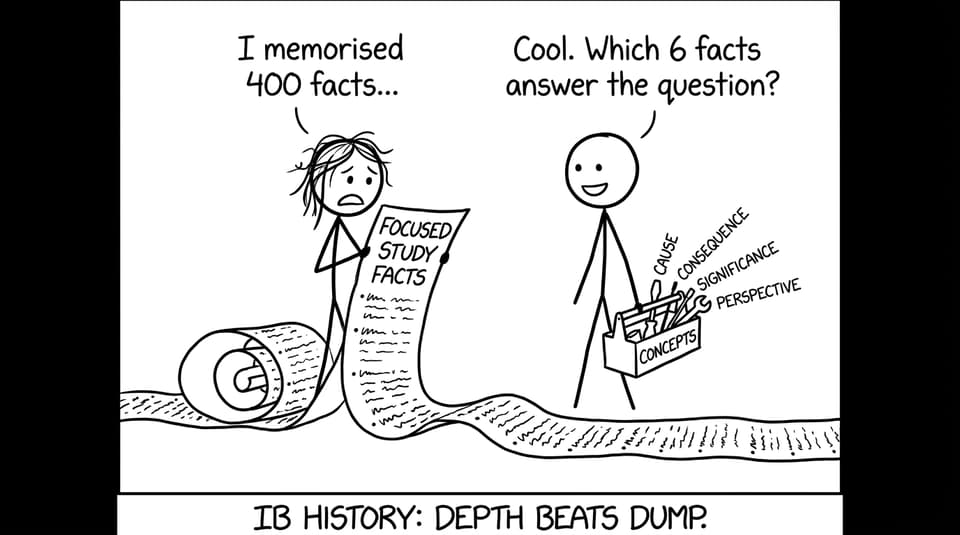
In IB History, Focused Studies are not trivia containers. They are frameworks for thinking. When you treat them like toolkits rather than topics, you stop revising to “know everything” and start revising to answer questions.
Quick checklist: the Focused Study mindset
Use this before every revision session for IB History Focused Studies:
-
Can I explain the case study through cause, consequence, significance, and perspective?
-
Do I have 6--10 flexible examples I can adapt to different questions?
-
Can I name one debate or interpretation (even briefly) that upgrades evaluation?
-
Can I write a one-sentence claim before I reach for more facts?
-
Can I practice under exam conditions at least once a week?
If you need a home base while you build this, keep the IB History Resources hub open in another tab.
What Focused Studies are in IB History (FA 2028)
Focused Studies in IB History are in-depth case studies chosen by schools to bring the course’s concepts to life. Think of them as deliberately bounded worlds: small enough to study in detail, rich enough to argue about.
A good Focused Study lets you do four things consistently:
-
Anchor concepts in real events and decisions
-
Build depth (not just coverage)
-
Practice comparison and evaluation
-
Create a reliable evidence bank for essay writing
The hidden benefit is psychological. A bounded case study gives you permission to stop collecting and start selecting.
To understand how this fits the broader redesign, pair this article with IB History: Understanding the New Course (FA 2028) and IB DP History Explained: The New Curriculum Structure.
Why IB History uses Focused Studies
The FA 2028 direction is clear: depth beats breadth. The IB would rather you make a defensible judgment with well-chosen evidence than recite a crowded narrative.
Focused Studies make that possible because they push you into historian habits:
-
tracing multi-causal explanations
-
weighing short-term vs long-term consequences
-
judging significance with criteria (not vibes)
-
recognizing that perspective changes conclusions
If you want the concept lens in one place, read IB History: The 4 Key Concepts for FA 2028. It turns Focused Studies from “content” into reusable thinking patterns.
How Focused Studies are assessed (and how marks are really won)
Focused Studies are not assessed as isolated memory tests. In IB History, you earn marks for what your evidence does.
Examiners reward:
-
relevance: evidence chosen because it answers this question
-
explanation: clear links between evidence and argument
-
evaluation: judgment about importance, success, failure, or impact
-
control: you can adapt the same case study to different prompts
That is why endless note-taking can feel productive but score poorly. It trains storage, not use.
For paper-specific technique, keep these guides close:
-
HL students: IB History Paper 3 Strategies for HL Success
Common mistakes students make with Focused Studies in IB History
Most Focused Study mistakes are not “lack of work.” They are working in the wrong direction.
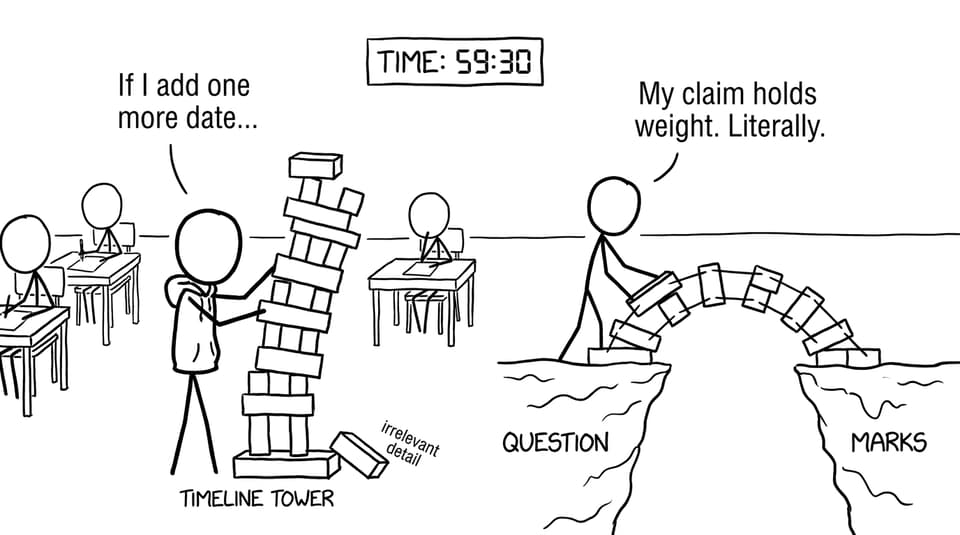
Memorising chronology instead of building judgments
Timelines help you orient yourself. But the exam rarely asks you to retell. It asks you to argue.
Using the same example in every essay
Reusing evidence is smart. Repeating it unchanged is not. Strong IB History students reuse evidence differently by changing the concept lens.
Confusing detail with relevance
One sharp example explained well beats five loosely connected facts.
Forgetting perspective and debate
Even a single line of interpretation can upgrade an answer from descriptive to evaluative.
If these feel familiar, you will relate to IB History Struggles (FA 2028) -- Fix Them Fast.
A smarter way to revise Focused Studies (the “evidence bank” method)
Here is a repeatable approach that fits how IB History is assessed.
Build an evidence bank by concept
Create four folders (or pages): Cause, Consequence, Significance, Perspective.
For each folder, collect:
-
6--10 high-utility examples
-
one sentence: what the evidence proves
-
one sentence: a limitation or counterpoint
Convert notes into active recall
Use Flashcards for your evidence bank prompts: “Example for long-term consequence?” “Example that challenges success?” This is where RevisionDojo’s Flashcards and Study Notes work together.
Practice application with exam-style prompts
This is the step most students skip. Use the IB History Topic Paper 2 Questionbank to practise selecting evidence under pressure. If your class does Paper 1 options, these pages are great for structured practice too:
Tighten with feedback loops
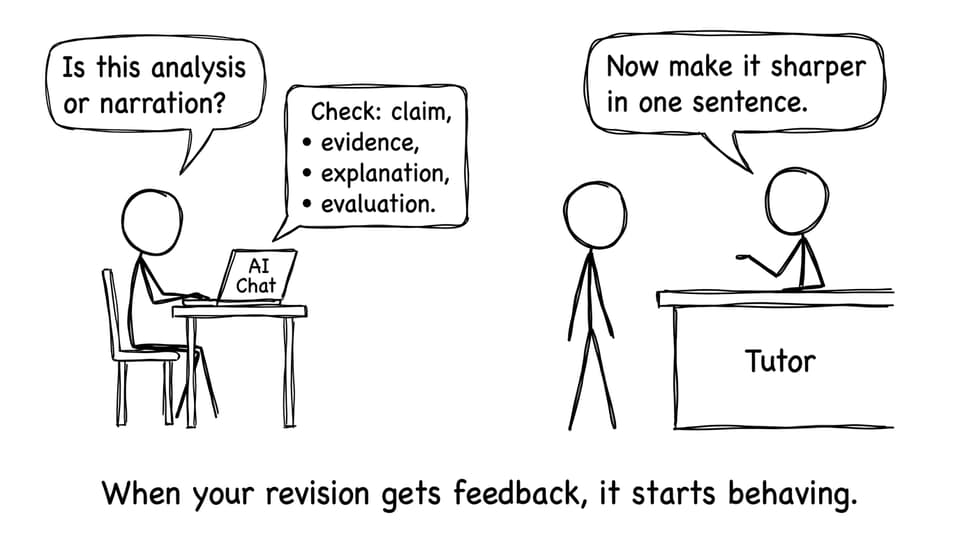
RevisionDojo is most powerful when you treat revision as a loop: Study Notes for clarity, Flashcards for retention, Questionbank for application, then AI Chat and Grading tools to diagnose what your writing is actually doing. Add Mock Exams and IB Predicted Papers when you need timing, stamina, and realism.
For a full system, see RevisionDojo App: The Smarter Way to Prep for IB Exams.
FAQ
Do I need to memorise everything in an IB History Focused Study?
No, and trying usually backfires. In IB History, the goal is not total recall but controlled selection. You need enough knowledge to explain what happened, but more importantly you need to explain why it mattered in relation to the question. That means building a small set of examples you can deploy flexibly, with clear cause-and-effect links. It also means learning a few debates or perspectives so you can evaluate rather than narrate. If you are unsure what to keep, use your practice essays and Questionbank results to identify which evidence consistently earns marks.
Can I use one Focused Study for multiple IB History questions?
Yes, and the best students do it constantly. The trick is to reuse evidence while changing the concept lens: the same event can support causation in one essay, significance in another, and perspective in a third. This is why Focused Studies are frameworks rather than fact lists. When you plan, start with a one-sentence claim, then pick 2--3 examples that directly support that claim. After writing, ask: did each example earn its place, or was it there because you memorised it? RevisionDojo’s AI Chat and Grading tools help you spot when your writing slips into generic narrative.
Are Focused Studies more important than thematic or comparative work in IB History?
They serve different jobs, and you need both. Focused Studies give you depth: the close-up detail that makes your argument credible and specific. Thematic and comparative thinking gives you range: the ability to connect patterns, weigh similarities and differences, and make stronger judgments. In FA 2028, the safest strategy is to let Focused Studies supply your best evidence while concepts guide your structure. If you revise only themes, your essays become vague. If you revise only case details, your essays become descriptive. Balance comes from practising questions that force you to select and evaluate.
Closing: make Focused Studies your advantage
Focused Studies can feel like an extra burden until you see what they really are: a disciplined way to train exam thinking. In IB History, the student who wins is rarely the one who knows the most. It is the one who can choose, explain, and evaluate the right evidence on demand.
If you want that advantage to be repeatable, build your Focused Study evidence bank inside RevisionDojo using Study Notes, Flashcards, and the Questionbank, then pressure-test it with Predicted Papers, Mock Exams, AI Chat, and Tutors. Your revision will stop expanding outward and start getting sharper -- and your marks will follow.