

IB History Paper 1 Explained: why it suddenly feels different
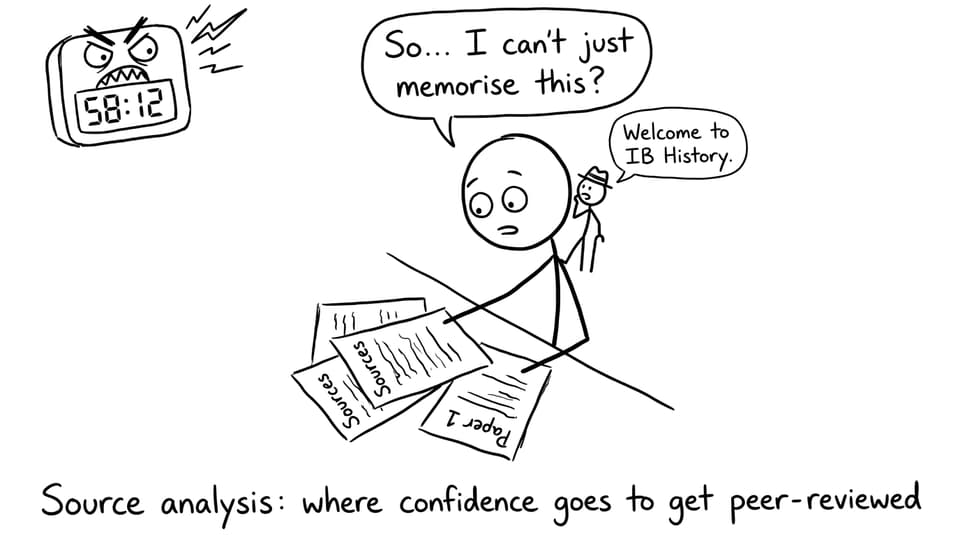
There’s a specific moment most IB History students recognise: you open Paper 1, read the first source, and your brain starts hunting for the “right” paragraph you memorised. Except Paper 1 doesn’t reward that instinct. It rewards something quieter and harder: noticing what the source is doing, why it exists, and how far you can responsibly use it.
Under the new course (first assessment 2028), IB History Paper 1 leans even more into historical inquiry. Not “tell me what happened,” but “show me how you know.” If you can learn that mindset early, Paper 1 stops feeling like a trap and starts feeling like a system.
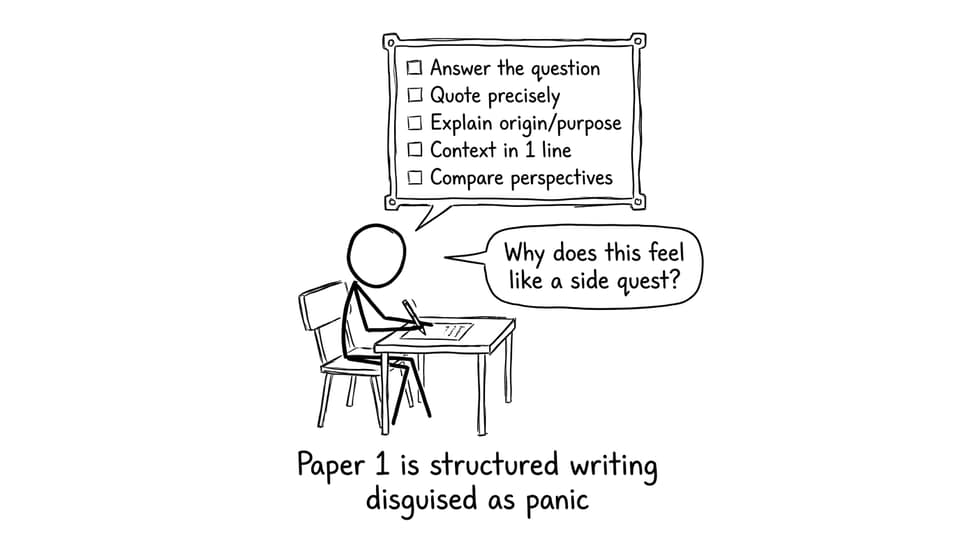
Quick checklist for IB History Paper 1 (save this)
-
Read the question first, then read the source like you’re hunting evidence
-
Use precise quotes (short, targeted) instead of long paraphrases
-
Explain origin and purpose only when it changes meaning or usefulness
-
Add context in one line (not a mini-essay)
-
Compare sources by reason, not by vibes
-
Evaluate usefulness with a clear “useful for X, limited for Y” line
If you want a home base for the new course, start at the IB History resources hub.
What is IB History Paper 1 in the new course (FA 2028)?
IB History Paper 1 is the source-based exam sat by both SL and HL students. You get a small set of sources and structured questions, all under tight timing.
The key point is simple: Paper 1 mostly tests skills. Background knowledge helps you avoid misunderstandings and add context, but it cannot replace source analysis. That’s why Paper 1 can feel “unfair” until you realise it is incredibly predictable.
To practise with syllabus-aligned Paper 1 material, RevisionDojo keeps topic pages structured around the same skill loop: learn, recall, apply. For example, you can work through IB History Paper 1: Rights and Protest or IB History Paper 1: Conflict and Intervention.
What examiners are actually rewarding in IB History Paper 1
In IB History, examiners don’t award marks for sounding like a historian. They award marks for doing historian thinking on the page.
That usually means you are demonstrating you can:
-
Understand what the source says (accurately, not vaguely)
-
Interpret meaning using origin, purpose, audience, and context
-
Compare sources as arguments and perspectives, not just topics
-
Evaluate usefulness and limitations with specific reasoning
-
Use the source as evidence that answers the exact question
A good Paper 1 answer feels like a clean chain: claim, evidence from the source, explanation of significance. No filler.
IB History Paper 1 question types (and what to do for each)
Comprehension and inference
These questions look “easy,” so students rush them. In IB History, that’s often where the marks leak.
Do this instead: make one clear point, then prove it with a micro-quote (a few words) and a one-sentence explanation of what that quote shows.
Origin, purpose, and context (but not as a checklist)
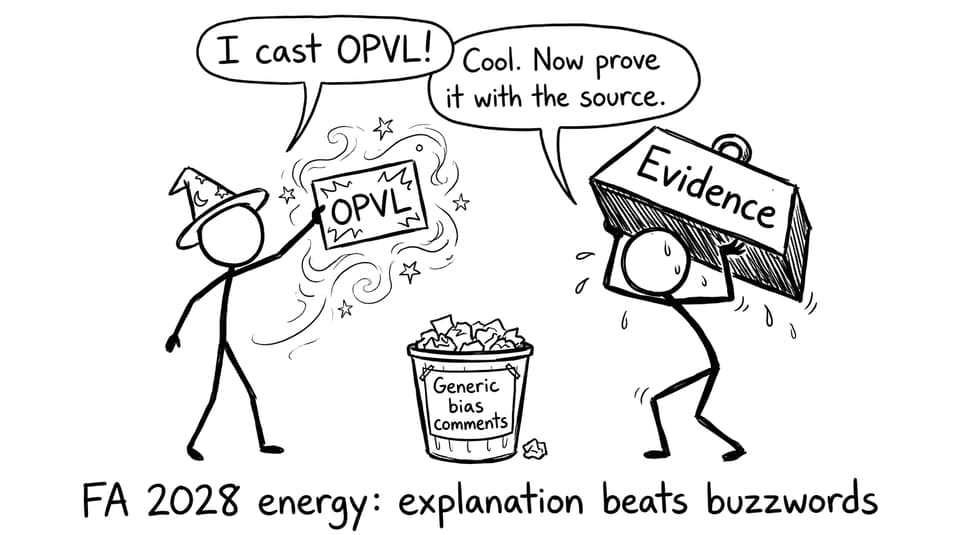
Under FA 2028, writing OPVL like a ritual doesn’t help unless you connect it to meaning.
Try this phrasing:
-
“Because the author is __, they likely emphasise __ to persuade __.”
-
“This is useful for understanding __, but limited for __ because __.”
Comparison
Comparison is not “they agree/disagree.” Comparison is “they agree because they share X aim / context / audience” or “they disagree because they represent different interests.”
A reliable structure for IB History comparisons:
-
One similarity + why it exists
-
One difference + why it exists
-
One line on what that implies about perspective
Evaluation (usefulness / limitations)
Evaluation marks come from specificity. Avoid generic lines like “it’s biased.” Everything is biased; the question is how that bias shapes what the source can tell you.
A strong evaluation sentence often looks like:
- “Useful for __ because it reveals __ (quote). Limited for __ because it omits/ distorts __ due to __.”
To drill evaluation quickly, RevisionDojo’s Paper 1: Conflict and Intervention Questionbank is built for repetition with feedback.
What changed in IB History Paper 1 for first assessment 2028?
The biggest shift is the explicit emphasis on historical inquiry: sources are not decorations. They are the core.
In practice, FA 2028 rewards students who:
-
Contextualise without dumping background knowledge
-
Explain perspective rather than just identifying it
-
Justify evaluation (why useful, why limited) with reasoning
-
Stay tightly linked to the command term and question focus
If you want a broader sense of how IB History is evolving, this overview helps: IB History: The 4 Key Concepts for FA 2028.
Common IB History Paper 1 mistakes (that feel smart in the moment)
-
Paraphrasing large chunks of a source instead of selecting evidence
-
Listing OPVL bullets without linking them to the question
-
Saying “biased” as a conclusion instead of an explanation
-
Writing everything you know about the topic (and forgetting to answer)
-
Spending too long early and rushing evaluation/comparison later
One of the fastest fixes is timing practice. Use Paper 1 sets from your topic pages (like Paper 1: Rights and Protest) and treat each attempt like a lab report: your goal is to diagnose the mistake pattern, not just finish.
A simple practice routine for IB History Paper 1 (RevisionDojo-friendly)
Here’s a routine many IB History students can actually sustain:
-
Study Notes (10--15 min): clarify the topic context so sources make sense (use the IB History notes view)
-
Flashcards (5--10 min): lock in key context terms and definitions (RevisionDojo Flashcards)
-
Questionbank (20--30 min): drill one question type repeatedly (RevisionDojo Questionbank)
-
AI Chat (as needed): ask “What would a top mark explanation look like for this origin/purpose?” (RevisionDojo AI Chat)
-
Mock-style sit (weekly): run a timed set and get feedback using Grading tools and exam-mode habits (RevisionDojo Mock Exams)
To make full-paper rehearsal feel realistic later, build stamina with IB Predicted Papers by IB Examiners and learn how to use them wisely via IB Predicted vs Specimen Papers: What They Mean.
FAQ
Do I need lots of background knowledge for IB History Paper 1?
Background knowledge helps, but it’s support, not the engine. In IB History Paper 1, marks come from what you can prove using the sources and how well you explain their meaning. Context is most powerful when it is short and targeted: one line that clarifies why a claim matters or why a perspective exists. If you write three paragraphs of background, you usually lose time and drift away from the question focus. The best approach is to learn “just enough” context, then practise applying it under timing. RevisionDojo Study Notes and Flashcards are designed for that exact balance: clarity without overload.
Can I memorise OPVL phrases for IB History?
You can memorise a structure, but memorising phrases is risky. Examiners can feel when an IB History answer is running on autopilot, because it stops being specific to the source. OPVL is not a checklist to recite; it’s a toolkit you use only when it helps explain meaning, reliability, or usefulness. A better goal is to memorise flexible sentence stems that force you to include reasoning, like “This is useful for __ because __.” Then you fill the blanks with evidence from the source. Practise that skill with a Questionbank set and you’ll improve faster than collecting fancy wording.
Is IB History Paper 1 harder than essay papers?
It’s different, and that difference can feel like difficulty at first. Essays reward planning, breadth, and argument development across your own knowledge. IB History Paper 1 rewards precision, speed, and controlled interpretation of unfamiliar material. Some students actually score higher in Paper 1 once they learn the rhythm, because the task is more repeatable. The trick is to practise question types in isolation, then combine them under time pressure. RevisionDojo’s topic pages and Questionbank make that progression straightforward.
Closing: make IB History Paper 1 predictable
IB History Paper 1 in the FA 2028 course is basically a test of disciplined thinking under pressure. If you stop treating sources like obstacles and start treating them like evidence you can control, your answers become sharper, shorter, and easier to mark highly.
If you want a single place to build that skill loop, RevisionDojo ties it together: Study Notes for context, Flashcards for recall, Questionbank for repetition, AI Chat for quick clarification, Grading tools for feedback, Predicted Papers and Mock Exams for timing, plus a Coursework Library and Tutors when you need deeper support. Start with the IB History resources hub and make Paper 1 feel familiar long before exam day.