


Confidence in IB rarely arrives like a lightning strike.
It shows up quietly, almost annoyingly, after the 14th time you've done the same question type and realized your hands didn't shake this time. After you finished a timed section and didn't collapse into panic. After you looked at an examiner-style mark breakdown and thought, "Oh. That's all they wanted."
If you're an IB student preparing for exams, that's good news: confidence isn't a personality trait. It's evidence. And evidence can be manufactured, on purpose, with the right system.
This guide will show you how to build confidence during IB in a way that feels realistic, measurable, and repeatable. Along the way, you'll see how RevisionDojo's Questionbank, Study Notes, Flashcards, AI Chat, Grading tools, Predicted Papers, Mock Exams, Coursework Library, and Tutors fit into a single calm loop.
The IB confidence checklist (simple, repeatable)
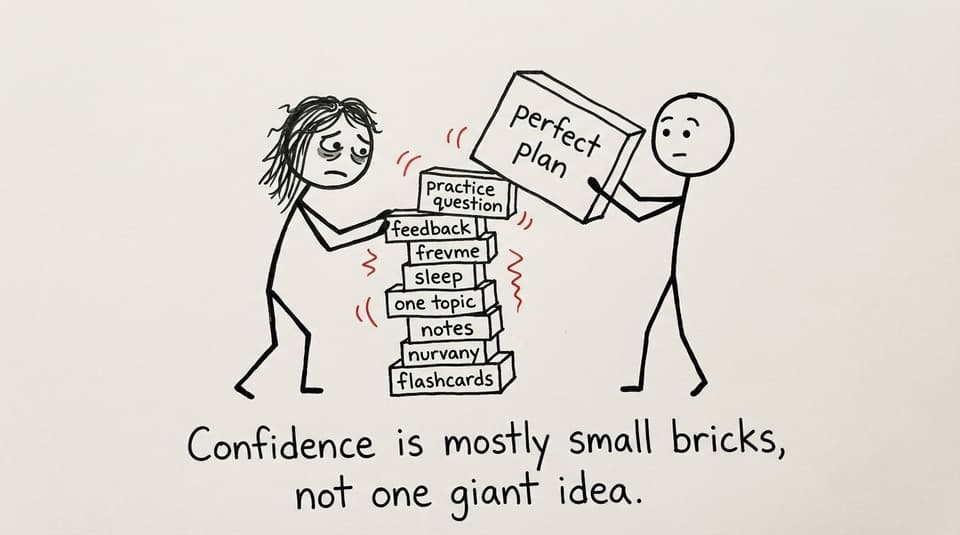
Before we go deeper, here's a quick checklist you can return to whenever IB starts feeling heavy.
- Pick one paper and one topic (not "revise the whole subject").
- Learn the idea quickly with Study Notes.
- Lock recall with Flashcards (daily, short sessions).
- Prove understanding with Questionbank practice.
- Train calm under pressure with Mock Exams and Predicted Papers.
- Review errors like a scientist, then loop.
If you want a bigger structure for the same process, keep this open in another tab: How to Study for IB Exams: Step-by-Step Guide.
Why confidence collapses during IB (even for good students)
Most IB students don't lose confidence because they're lazy or "not smart enough." They lose it because the program makes uncertainty feel personal.
IB has many moving parts: papers, command terms, rubric language, coursework deadlines, and the awkward reality that you can understand something on Tuesday and forget it by Friday. When your study method is vague, your brain fills the gaps with stories: "I'm behind," "I'm not a science person," "I always mess up Paper 2."
Confidence returns when you replace stories with specifics.
A vague plan sounds like: "Revise Chemistry."
A confidence-building plan sounds like: "Do 15 equilibrium questions, review mistakes, and retest the two error patterns tomorrow."
That's why RevisionDojo is structured around an evidence loop: Questionbank for practice, Flashcards for daily recall, and timed practice through exams and paper sets.
Build confidence in IB by shrinking the target
The fastest way to feel overwhelmed in IB is to think in subjects.
"Math." "History." "Biology."
Subjects are too big for the nervous system. Your brain can't relax around something infinite.
Instead, think in targets:
- One paper
- One question type
- One topic
- One command term
This is the hidden advantage of focused practice platforms: they force you to be small and concrete. You can start from the International Baccalaureate (IB) hub and choose exactly what you're training for today.
Here's a calm rule for IB: If you can't finish the plan in 45 minutes, it's not a plan. It's a wish.
Use "exposure reps" to make IB exams feel familiar
Confidence in IB is mostly familiarity with discomfort.
That sounds dramatic, but it's practical. The exam hall feels scary when your brain tags it as "rare." The easiest way to make it less scary is to make it less rare.
Try this exposure ladder:
Start with tiny timed blocks
Do 10-15 minutes of timed questions. Stop while you still have energy. The goal is not mastery; it's normalizing the feeling of the clock.
RevisionDojo helps because you can pull targeted sets from the Questionbank and keep the difficulty and topic narrow.
Move to timed sections
Do 30-60 minutes. Mixed topics. You are training transitions: the moment you switch from a comfortable topic to one you avoid.
Graduate to Mock Exams and Predicted Papers
This is where IB confidence becomes undeniable, because you get proof: pacing, stamina, and strategy.
Use these pages when you're ready:
And if you want a detailed walk-through for running your practice like a real sitting, read: How to Run Timed IB Mock Exams in RevisionDojo (Exam Mode + Test Builder).
The IB confidence loop: learn, recall, apply, review
You can be hardworking in IB and still feel unsure, if your work doesn't create feedback.
A calm loop always has four parts:
Learn (fast clarity, not rewriting)
Use syllabus-aligned notes to understand the point, then stop.
If you tend to rewrite everything, replace it with a shorter input: read one section, then immediately test yourself.
RevisionDojo's ecosystem is built for this type of studying: start with Notes + Flashcards + Question Bank (Free) to keep your IB work active.
Recall (short daily proof)
Flashcards are confidence training because they remove the "I think I know it" illusion. You either retrieve it, or you don't.
If you need a flashcard strategy that actually fits real IB weeks, use: Interactive IB Flashcards: Engaging Memory Practice.
Apply (exam-style practice)
In IB, understanding is not the finish line. Production is.
Do questions. Check why marks are awarded. Tag patterns.
A strong place to anchor this habit is the Questionbank, because it reduces decision fatigue: you can filter by topic and level (SL/HL) and just begin.
Review (turn mistakes into rules)
Most students "review" by rereading the solution and moving on.
Confident students review by extracting a rule:
- What went wrong?
- What decision caused it?
- What will I do next time?
This is also where RevisionDojo's AI Chat and Grading tools help: they shorten the distance between confusion and clarity, especially when you're stuck on why an answer loses marks or how to improve structure.
Build confidence during IB by learning how marks are awarded
Here's a weird truth: a lot of IB fear is really fear of invisible grading.
When you don't understand how marks are allocated, every question feels like a trap. When you do, the paper starts to feel like a set of instructions.
Do this once per week:
- Choose 5 questions you got wrong.
- For each one, write what the examiner wanted in one sentence.
- Then write what you actually did.
- Identify the mismatch.
This is why feedback tools matter. RevisionDojo doesn't just hand you more content. It gives you a way to see the exam more clearly, so confidence grows from realism, not hope.
If you want to understand how top scorers run this loop, read: How 45-Point IB Students Prepare for Exams.

Protect your IB confidence with "minimum viable days"
Some days in IB are not built for brilliance.
You're tired. Coursework is due. You did a timed paper and it went badly. Your brain wants to label the whole week "a failure."
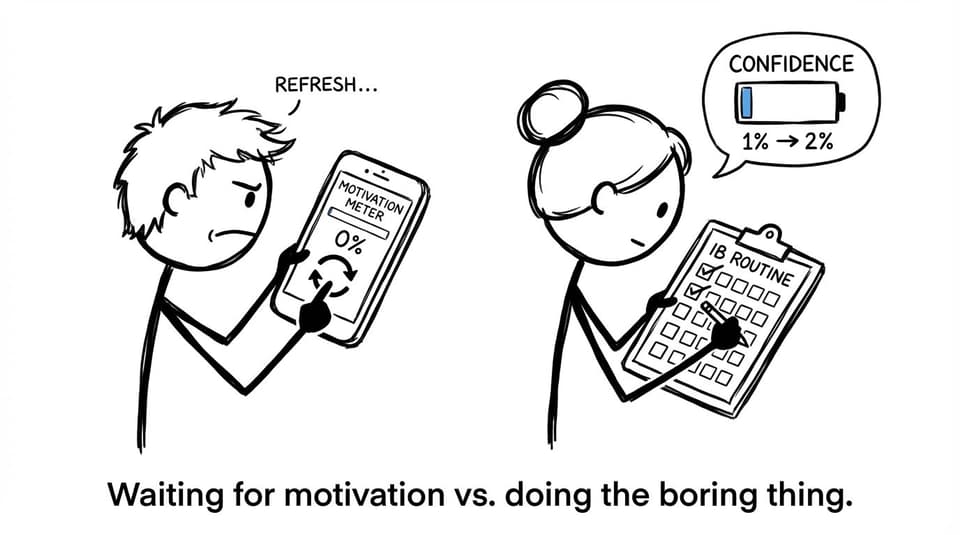
This is where confident students do something boring and strategic: they keep the streak alive with a minimum viable day.
Example minimum viable day (20 minutes total):
- 7 minutes Flashcards
- 10 minutes Questionbank on one subtopic
- 3 minutes error log: one mistake pattern, one fix
It's not heroic. That's the point. It keeps your identity intact: "I'm the kind of IB student who shows up."
When coursework knocks your confidence, borrow structure
IB confidence also gets hit outside exams: IAs, the EE, TOK writing, drafts that feel messy.
A quiet fix is to borrow structure rather than invent it under pressure.
That's where RevisionDojo's Coursework Library and Grading tools are most valuable: you see what strong work looks like, then you get feedback that is specific enough to act on. If you've been avoiding a draft because you fear it's "not good," the fastest confidence move is to submit it for feedback and convert vague dread into a list.
If anxiety is your main blocker right now, this piece pairs well with today's guide: How to Beat IB Exam Anxiety (Without Burning Out).
Closing: Confidence in IB is a system you can run
The most comforting thing about IB confidence is that it's not mysterious.
It's built from small, repeated moments where you do the thing that scares you a little: one timed section, one honest review, one retest, one set of flashcards when you'd rather scroll.
If you want that process to feel simpler, put your study in a system designed for it. RevisionDojo gives IB students one calm place to run the full loop: Study Notes for clarity, Flashcards for daily recall, Questionbank for exam-style practice, AI Chat and Grading tools for fast feedback, Mock Exams and Predicted Papers for timing and realism, plus a Coursework Library and Tutors when you need examples or a human voice.
Build evidence. Then let the evidence build you.