
If you have ever opened your laptop to revise and felt your brain refuse to cooperate until the conditions are “just right,” you already understand the mood of a bacterium.
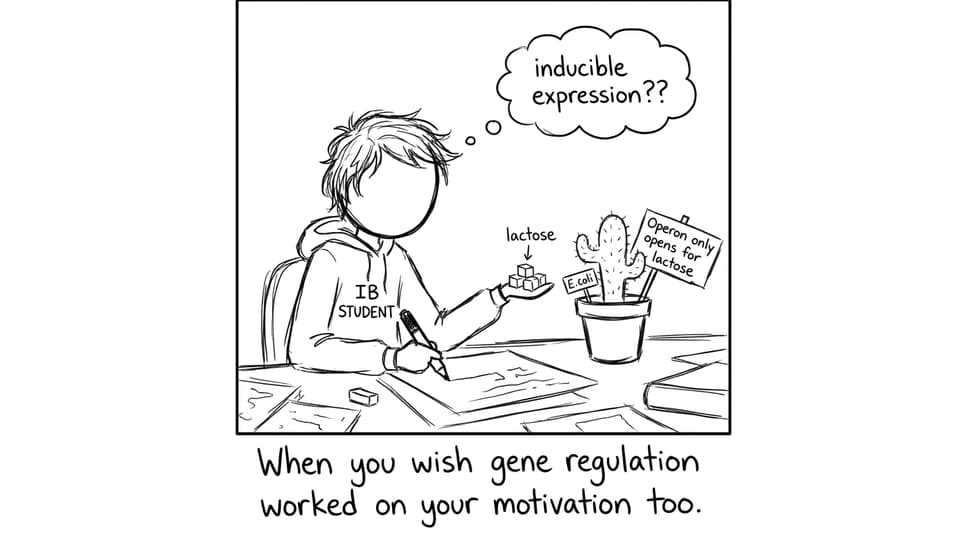
In IB Biology, the lac operon is the classic example of inducible expression: genes that stay off until a specific molecule shows up. It is not just a diagram to memorize. It is a story about efficiency, priorities, and how cells avoid spending energy on proteins they do not need.
IB Biology quick checklist: what to remember
-
The lac operon is in E. coli and controls lactose metabolism.
-
It is inducible because it is usually off, and turns on when lactose is available.
-
Key parts: promoter, operator, lacZ, lacY, lacA, plus the separate regulatory gene lacI.
-
Lactose (via allolactose) removes the repressor.
-
Glucose levels tune transcription through CAP-cAMP.
For the wider gene-expression context, anchor this topic inside your revision of D2.2 Gene expression (HL) and the supporting D2.2.1 Gene expression notes.
The lac operon in IB Biology: why it is inducible
In IB Biology, inducible expression means “default off.” When lactose is absent, the bacterium should not waste resources making enzymes for lactose breakdown.
Here is the control logic:
-
The regulatory gene lacI (located elsewhere in the genome) is expressed to produce a lac repressor.
-
The repressor binds to the operator.
-
That physical block prevents RNA polymerase from transcribing the structural genes.
So the operon is silent not because the genes are missing, but because access is denied. If you want a broader operon overview, pair this with How Operons Regulate Prokaryotic Genes.
Lactose flips the switch: allolactose as the inducer
When lactose enters the environment, a small amount is converted into allolactose. In IB Biology, this detail matters because allolactose is the true inducer.
-
Allolactose binds to the repressor.
-
The repressor changes shape (conformational change).
-
It can no longer bind the operator.
-
RNA polymerase now transcribes lacZ, lacY, and lacA.
Exam-friendly protein links:
-
lacZ codes for β-galactosidase (breaks lactose into glucose + galactose).
-
lacY codes for permease (brings lactose into the cell).
-
lacA codes for transacetylase (often described as a helper enzyme; its role is less emphasized).
If promoter binding and transcription initiation feel fuzzy, revise it alongside How Promoters Control Transcription Start.
The second layer: glucose, CAP-cAMP, and prioritizing energy
The lac operon is not only about lactose. It also shows hierarchy.
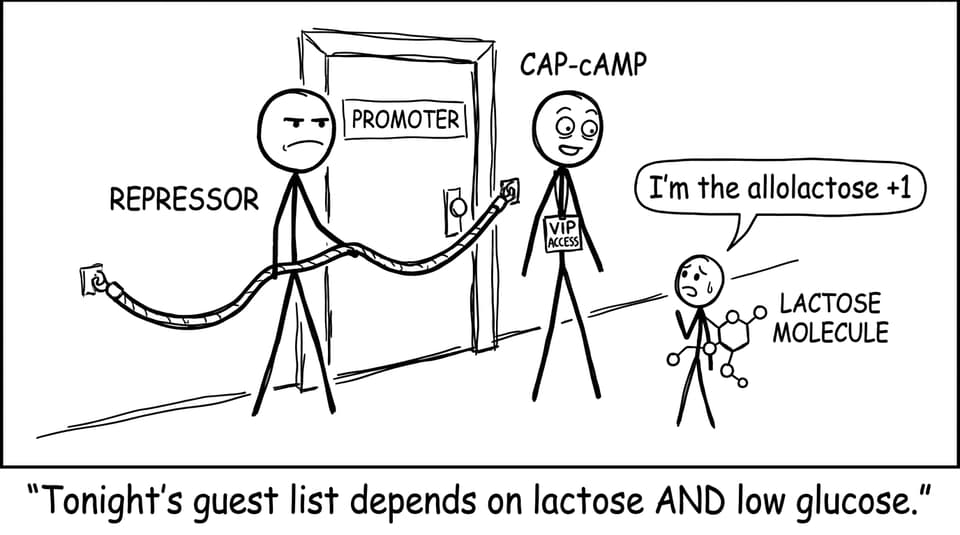
When glucose is low, cAMP increases and binds to CAP (catabolite activator protein). The CAP-cAMP complex binds near the promoter and helps RNA polymerase bind more effectively, increasing transcription.
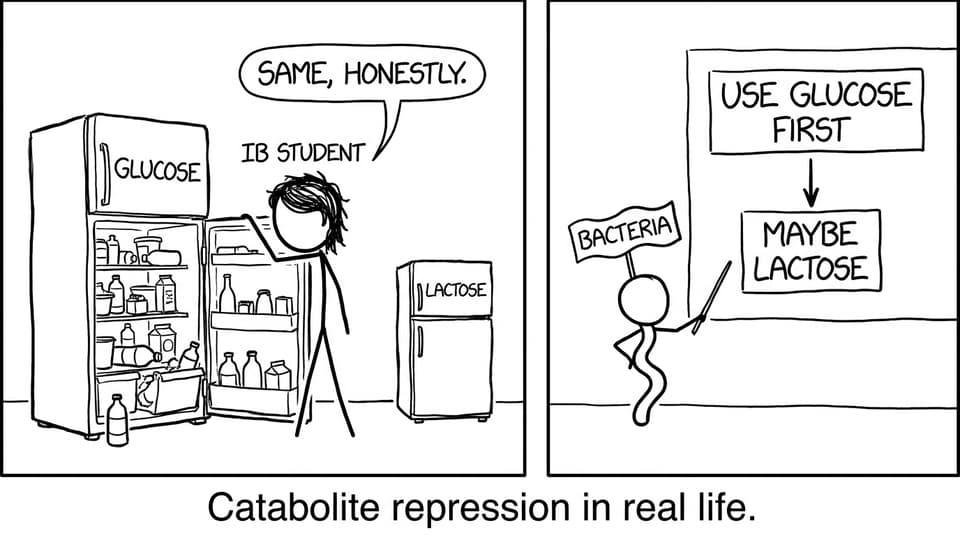
When glucose is high, cAMP is low, CAP is inactive, and transcription stays relatively low even if lactose is around. In IB Biology, this is often summarized as “glucose is preferred.” To strengthen your regulation language (activators vs repressors), read IB Biology: How Activators & Repressors Control Genes.
How to turn this into exam marks (fast)
A reliable IB Biology short-answer structure is:
-
State that lac operon is inducible and normally off.
-
Explain repressor binds operator, blocking RNA polymerase.
-
Add lactose present -- allolactose binds repressor -- repressor detaches.
-
Mention transcription of lacZ lacY lacA.
-
Add glucose control via CAP-cAMP when glucose is low.
Then practise it under time pressure with the D2.2 Gene expression (HL) Questionbank and reinforce definitions using the D2.2 Gene expression (HL) Flashcards.
Study it like a system, not a diagram
The lac operon sticks in your memory when you treat it as a decision-making circuit: “No lactose? off. Lactose present? remove the block. Low glucose too? amplify the output.” That is inducible expression in IB Biology in one clean storyline.
If you want to turn that storyline into points, RevisionDojo is built for it: syllabus-aligned Study Notes, Flashcards for active recall, a Questionbank with instant feedback, plus AI Chat and grading tools to polish your explanations. When exam week gets close, you can also build Mock Exams and use Predicted Papers for realistic practice on RevisionDojo. Keep IB Biology revision simple: understand the switch, practise the wording, repeat until it is automatic.
