

If gene expression feels like a perfectly timed playlist, the promoter is the moment your phone decides which song to play--and whether it plays at full volume or whispers in the background. In IB Biology, that “decision point” shows up everywhere: short-answer questions, data-based prompts, and those diagrams where proteins crowd around DNA like it’s a celebrity.
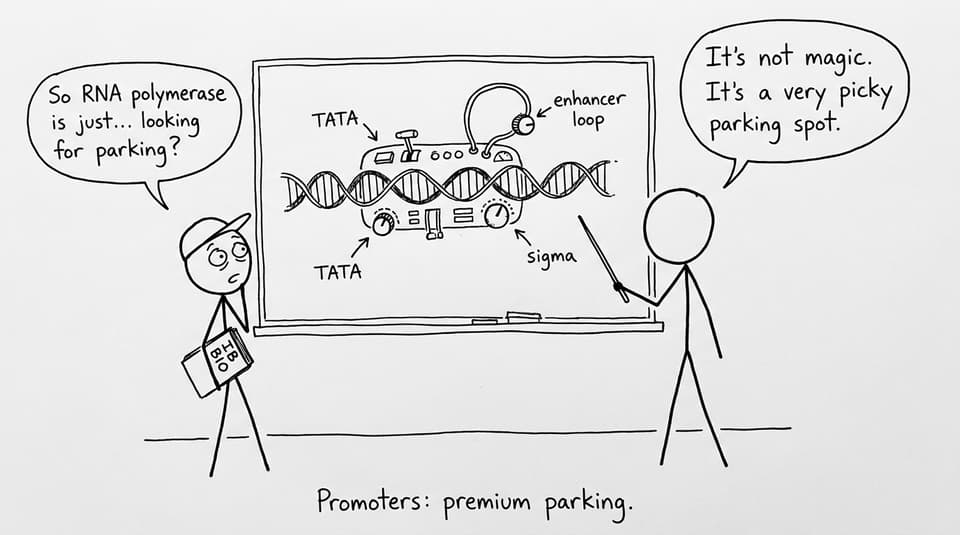
Promoters control transcription start because they mark where RNA polymerase should begin and how easily the initiation machinery assembles. Once you see promoters as a “picky parking spot” for polymerase, a lot of regulation questions stop feeling like memorization and start feeling like logic.
IB Biology quick checklist: what examiners want you to say
-
A promoter is an upstream DNA region where RNA polymerase binds to start transcription.
-
Promoters contain recognition sequences (e.g., TATA box in many eukaryotes; -10/-35 regions in prokaryotes).
-
Transcription factors (eukaryotes) or sigma factors (prokaryotes) help polymerase locate and bind the promoter.
-
Activators can increase transcription by helping recruit the initiation complex (often via enhancers and DNA looping).
-
Repressors can decrease transcription by blocking binding or making chromatin less accessible.
-
Promoter strength affects transcription rate--strong promoters recruit polymerase more readily than weak promoters.
For syllabus-aligned support, pair this with RevisionDojo’s gene expression notes: D2.2.1 Gene expression Study Notes.
What a promoter actually does in IB Biology
A promoter is a non-coding DNA sequence located upstream of a gene. Its job is to define the transcription start site and provide binding sites for proteins that build the initiation complex.
In IB Biology, it helps to describe the promoter as a control region rather than a single “on switch.” The promoter doesn’t work alone--it works as a meeting point where multiple molecules decide whether transcription happens now, later, or barely at all.
If you want a wider unit overview, keep D2.2 Gene expression (HL) open while you revise.
Eukaryotes: TATA box, transcription factors, and initiation
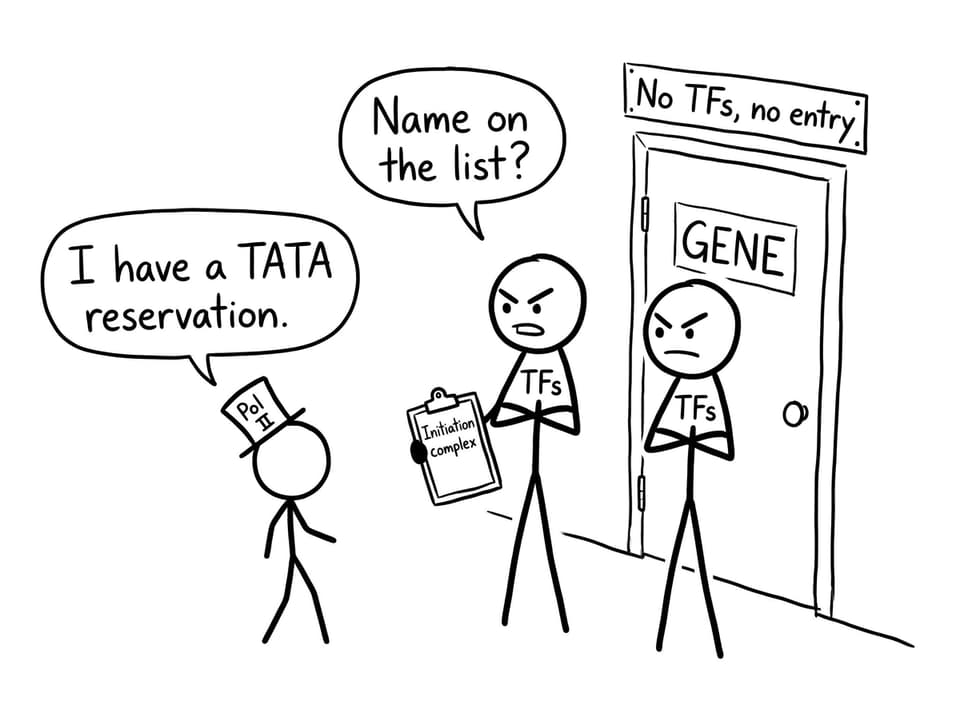
Many eukaryotic promoters include a TATA box, a short A/T-rich motif that helps position the transcription machinery. The key exam idea isn’t the exact sequence--it’s the function: it helps proteins recognize where transcription should begin and supports efficient assembly.
Here’s the typical story examiners reward:
-
Transcription factors bind promoter DNA first.
-
They recruit and correctly position RNA polymerase II.
-
The DNA is locally unwound so the template strand is accessible.
That “TFs first” detail matters because it explains why eukaryotic transcription is often slower and more regulated than in bacteria. For regulation by proteins specifically, see D2.2.2 Regulation of transcription by proteins Notes.
Prokaryotes: -10/-35 sequences and sigma factors
Prokaryotic promoters are built for speed. They often include -10 and -35 consensus sequences that are recognized by sigma factors. A sigma factor guides RNA polymerase to specific promoter sequences, helping bacteria switch gene sets quickly when conditions change.
In an IB Biology response, you don’t need every protein name. You do need the comparison: prokaryotes rely on sigma factors and simpler promoter architecture; eukaryotes rely on many transcription factors and chromatin context.
Promoter strength: why some genes are “loud” and others “quiet”
Not all promoters are equally attractive to RNA polymerase.
-
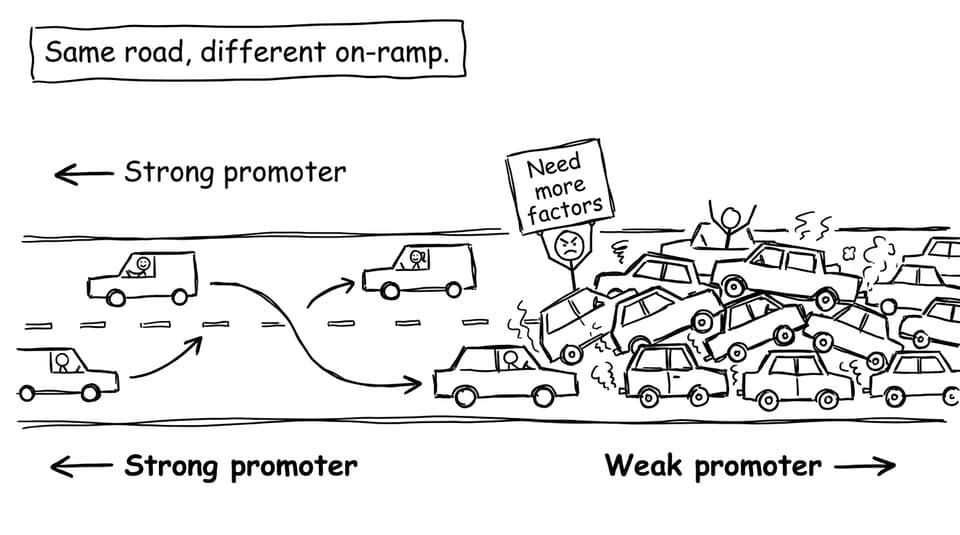
Strong promoters match the preferred binding motifs well, so polymerase binds easily and transcription happens frequently.
-
Weak promoters match less well, so they often require more help (additional transcription factors and activators) to get reliable initiation.
In IB Biology, promoter strength is a clean way to explain different expression levels without drifting into vague statements like “the cell wants more protein.” It’s mechanics: binding probability, initiation frequency, and recruitment efficiency.
How activators, repressors, and enhancers connect back to the promoter
A common exam trap is mixing up promoters and enhancers. Promoters sit near the start site; enhancers can be far away but still influence transcription by DNA looping.
-
Activators bound to enhancers can increase transcription by stabilizing the promoter-bound initiation complex.
-
Repressors can reduce transcription by blocking promoter access or recruiting proteins that tighten chromatin.
RevisionDojo breaks this into exam-ready language here: How Activators and Repressors Control Genes and How Transcription Factors Regulate Gene Expression.
Bring promoter questions under control with RevisionDojo
Promoters are small DNA regions with big consequences, and in IB Biology they’re a reliable source of marks when you explain them with precision: binding site, initiation complex, transcription factors/sigma factors, and promoter strength.
To turn that understanding into exam performance, use RevisionDojo’s D2.2 Gene expression (HL) Questionbank for exam-style practice, then reinforce with 2.7 DNA replication, transcription and translation Notes. When you’re ready, mix in RevisionDojo’s Flashcards, Study Notes, AI Chat, Grading tools, Predicted Papers, Mock Exams, Coursework Library, and Tutors to keep your revision structured and calm--even when transcription regulation gets crowded.