


Most IB students don’t lose marks because they “didn’t work hard.”
They lose marks because their effort doesn’t leave evidence.
Not evidence in the school-accreditation sense (though that matters for coordinators), but evidence in the student sense: proof that you can answer command terms under time pressure, proof that you understand the topic you revised yesterday, proof that your weaknesses are shrinking instead of moving around.
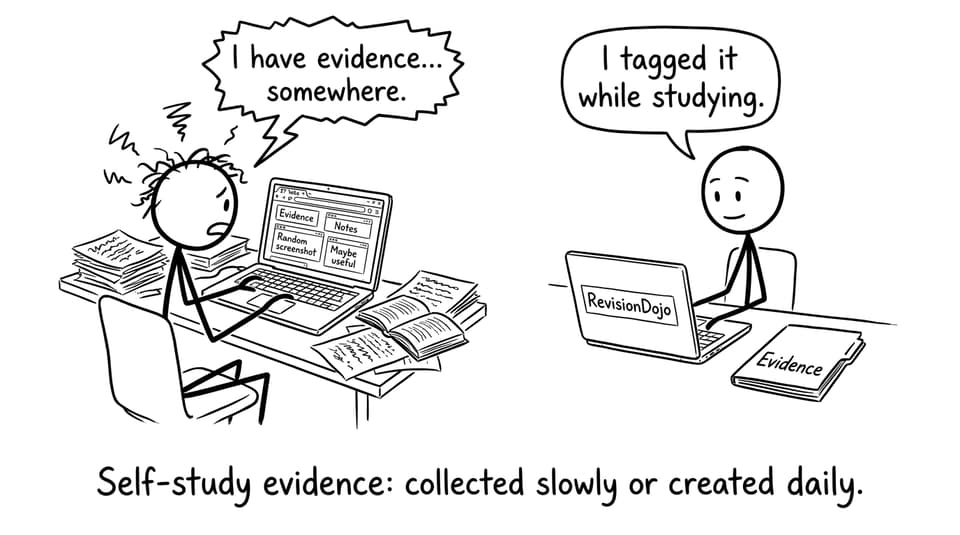
That’s the hidden stress of IB self-study: you can spend hours “doing revision” and still feel strangely unsure. Your brain has been busy, but your system hasn’t been collecting evidence.
RevisionDojo fixes that by turning normal IB study into a trail of usable proof. Every question you answer, every mistake you tag, every concept you revisit becomes evidence you can act on. It’s less about studying more, and more about studying in a way that leaves receipts.
The fast checklist: evidence collection for IB self-study
If you want the simplest version of “evidence collection” as an IB self-study student, run this loop:
-
Pick one IB subject and one topic for today.
-
Learn the core ideas quickly with RevisionDojo Study Notes.
-
Convert fragile memory into daily recall using IB Flashcards with spaced repetition.
-
Prove understanding with the RevisionDojo Questionbank.
-
Use AI Chat to resolve confusion while it’s still small.
-
Do one timed session weekly (Mock Exams or Predicted Papers) to collect timing evidence.
-
Review analytics to decide what to do next (not what you “feel like” doing).
This is what RevisionDojo is quietly good at: it turns IB self-study into a sequence of small decisions backed by evidence.
Why evidence collection is hard when you self-study IB
In a school setting, evidence is constantly generated for you. Teachers set quizzes. You get feedback. You sit timed papers. Someone else decides what “counts.”
In IB self-study, you’re the teacher and the student at once. That creates three predictable problems:
You confuse exposure with mastery
Reading notes feels productive. Watching videos feels productive. Even rewriting notes can feel productive.
But IB exams don’t reward exposure. They reward performance: accurate recall, correct method, and clear explanation under time constraints.
You store your progress in your mood
If revision went well, you feel confident. If it went badly, you feel behind.
Mood is a terrible database. Evidence is better.
Your “proof” is scattered
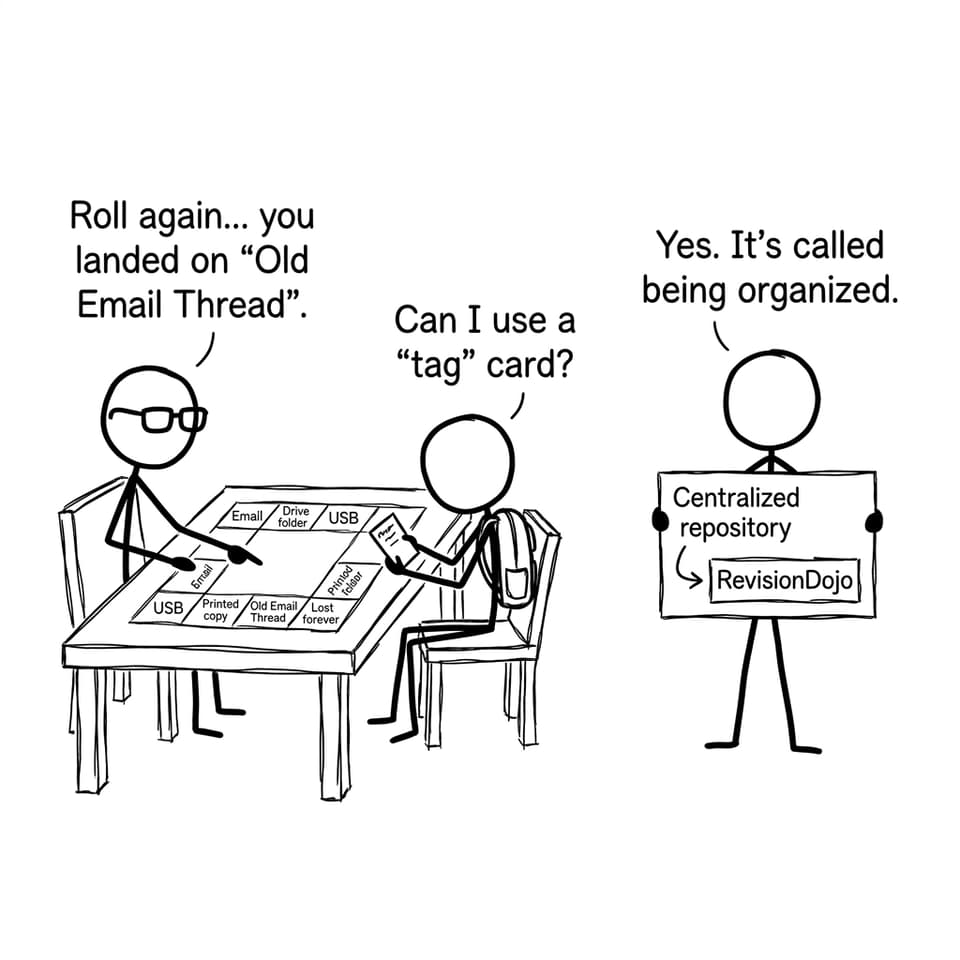
A bit in a notebook. A bit in a doc. A bit in screenshots. A bit in random sets you did weeks ago.
RevisionDojo’s advantage is simple: it centralizes your work into one system that naturally captures evidence as you study.
For a broader self-study reality check (and how to make it sustainable), this is worth reading: Can You Self-Study the IB Diploma Programme?.
How RevisionDojo improves evidence collection for IB self-study
When students hear “evidence collection,” they often imagine paperwork. But for IB self-study, evidence is something more personal: a clear record of what you can do, what you can’t do yet, and what changed after feedback.
A system that connects learning to proof (not just content)
RevisionDojo isn’t just one tool. It’s a loop.
-
Study Notes give you fast, syllabus-aligned understanding.
-
Flashcards convert that understanding into retrievable memory.
-
Questionbank converts memory into marks.
-
AI Chat removes the “stuck for an hour” problem.
-
Grading tools give rubric-aware feedback for written work.
-
Predicted Papers and Mock Exams add realism and timing evidence.
-
Coursework Library reduces background uncertainty from IA/EE/TOK.
-
Tutors give human guidance when you need a plan, not more content.
If you want a big-picture walkthrough of how the full stack fits together, start here: RevisionDojo App: The Smarter Way to Prep for IB Exams.
Evidence you can actually use: tagged mistakes and targeted sets
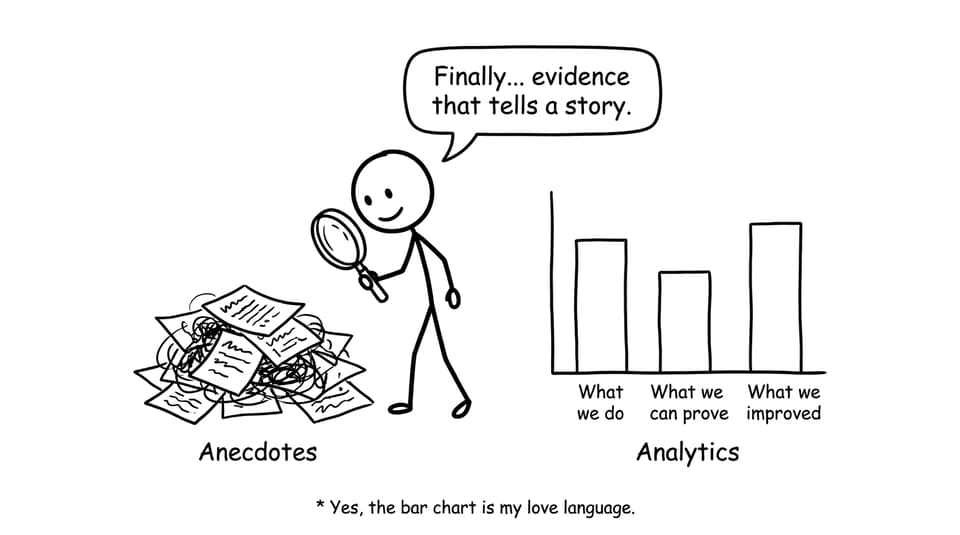
The fastest way to improve in IB is to stop treating mistakes as embarrassment and start treating them as data.
In RevisionDojo’s Questionbank, your practice isn’t just “done.” It becomes a searchable record:
-
Which topics keep leaking marks
-
Which question styles slow you down
-
Which command terms you misread
-
Whether your fixes held up 48 hours later
This is why a question bank should be a decision-making tool, not a pile of questions. If you want a clean method, use: IB Question Bank: Thousands of Practice Questions and the more tactical guide IB Question Bank | How to Use It Effectively.
Notes that behave like evidence, not decoration
A good IB note is not the one with the best handwriting.
A good IB note is the one that makes tomorrow’s practice session easier.
RevisionDojo’s notes ecosystem is built to support that. You learn a concept, then immediately convert it into something testable (Flashcards, then Questionbank). That creates evidence that you understood it in a way the exam will recognize.
If notes are currently eating your time, these two guides help you shift into evidence-first studying:
Flashcards as micro-evidence (daily, small, compounding)
In IB self-study, consistency beats intensity.
RevisionDojo’s IB Flashcards work as tiny, daily evidence checks: can you recall the definition, the process, the case study detail, the formula condition?
And because spaced repetition schedules reviews when forgetting starts, your evidence stays current. You’re not just “reviewing.” You’re repeatedly proving retention.
To use flashcards strategically (instead of endlessly), compare them to practice questions here: IB Flashcards vs Practice Questions.
Timed practice that produces the evidence you actually need
There’s a specific kind of IB panic that shows up late in the year:
“I understand the content, but I can’t finish on time.”
That’s an evidence problem. You need timed proof.
RevisionDojo’s Mock Exams and Predicted Papers are designed to create that evidence with realistic rehearsal. Not to scare you, but to make exam day familiar.
Helpful companion reads:
A simple “evidence file” mindset for IB students
Here’s a calm way to think about IB self-study.
You are building an evidence file about yourself.
Not for someone else. For you.
After every RevisionDojo study block, you should be able to answer:
-
What did I practice?
-
What did I get wrong?
-
Why did I get it wrong?
-
What will I do differently next time?
-
When will I re-test this?
That’s evidence collection. And it’s exactly what RevisionDojo helps you do without turning your life into spreadsheets.
If you want a one-page structure you can repeat during the final stretch, keep this bookmarked: The Ultimate Checklist for IB Revision.
FAQ: evidence collection for IB self-study with RevisionDojo
What does “evidence collection” mean for an IB student (not a school)?
Evidence collection for an IB student means keeping proof of learning that is tied to exam performance, not just time spent. That includes your accuracy by topic, the kinds of mistakes you repeat, and whether your fixes hold over time. In RevisionDojo, evidence collection shows up as your Questionbank results, your Flashcards review consistency, and your timed practice outcomes. The goal is to make your next study decision based on what the evidence says, not on what your anxiety suggests. Over a few weeks, this becomes a calmer routine because the proof accumulates. You stop asking “Am I doing enough?” and start asking “What does the data say I should do next?”
How does RevisionDojo help if I’m self-studying IB without a teacher?
Self-studying IB is hard because feedback loops are slow or missing. RevisionDojo speeds up those loops by giving you immediate practice opportunities and clearer next steps. The Questionbank provides exam-style questions so you can test understanding, and the platform helps you track which topics need more work. Flashcards help you maintain daily recall without having to design an entire system yourself. AI Chat can unblock confusion quickly, which matters when you don’t have a teacher available after class. And when you need deeper guidance, Tutors and the Coursework Library can add structure so you’re not guessing what “good” looks like.
How should I combine Study Notes, Flashcards, and the Questionbank to collect better IB evidence?
Use Study Notes to get fast clarity, but keep them time-boxed so they don’t become your whole day. Then convert what felt uncertain into Flashcards, because recall is the most honest form of evidence. After that, use the Questionbank to turn recall into application, since IB questions usually test concepts through structure and command terms. The key is to keep the loop tight: notes lead to flashcards, flashcards lead to questions, questions lead to a short error log. Evidence collection improves when you re-test the same weaknesses after 24-48 hours and confirm the fix. This is also where RevisionDojo’s analytics mindset matters: you want to see patterns, not just scores.
I’m close to exams. What evidence should I prioritize collecting?
Close to exams, prioritize evidence that predicts performance under pressure. That means timed evidence (can you finish), command term evidence (are you answering what is asked), and consistency evidence (are your mistakes repeating). Weekly Mock Exams or Predicted Papers help you collect timing and stamina proof without guessing. The Questionbank helps you quickly patch the topics that are still leaking marks. Flashcards keep recall sharp so you don’t blank on definitions, processes, or formulas mid-paper. If you’re short on time, focus on the evidence that changes behavior fastest: your error patterns and your timing breakdowns.
Closing: make your IB studying leave proof
IB self-study gets lighter the moment you stop trying to remember everything you did, and start building a system that remembers for you.
That’s what RevisionDojo improves: evidence collection.
Not evidence as paperwork, but evidence as progress you can see. Evidence that turns revision into decisions. Evidence that makes confidence feel earned.
If you want your IB study hours to produce clearer outcomes, start by making RevisionDojo your default loop: Study Notes for clarity, Flashcards for retention, Questionbank for marks, AI Chat for momentum, Grading tools and Coursework Library for deeper feedback, and Mock Exams plus Predicted Papers for timed proof.
When your studying leaves evidence, you don’t need to rely on hope. You can rely on your system.