


The first weeks of the IB Diploma can feel manageable. Then November arrives with several tests, a TOK task, a CAS commitment, and a draft you remember hearing about in September.
Understanding your school's IB assessment calendar prevents that surprise. For incoming students, the essential task is to collect every confirmed assessment date, distinguish checkpoints from final submissions, and place everything in one calendar. Do this during the IB DP1 fall term, ideally before the end of September, and review it weekly through November.
Your school's calendar is not identical to a universal IB calendar. The IB determines examination sessions and communicates submission requirements to schools, but schools and teachers commonly set earlier internal dates for coursework, drafts, tests, and programme milestones. Your coordinator's calendar is therefore the practical source of truth.
Your September calendar checklist
Before building an elaborate productivity system, collect the following:
- Every announced test, essay, oral, practical, and presentation date
- Whether each date is tentative or confirmed
- Whether a coursework deadline is for a proposal, outline, draft, or final version
- TOK, Extended Essay, and CAS milestones
- School events, holidays, and activity commitments
- The marking period connected to predicted or term grades
- One weekly time for reviewing changes
A calendar cannot make the work disappear, but it can make the workload visible while there is still time to respond.
Why your school's IB assessment calendar is unique
The IB Diploma includes external examinations and internally assessed work. Official examination timetables apply to particular sessions, but many dates experienced by DP1 students are created locally.
Teachers schedule topic tests around completed units, while schools establish their own checkpoints for TOK, the Extended Essay, CAS, and subject coursework. Dates may differ between schools and even between subjects at the same school.
A date found in an online discussion should never override instructions from your teacher or DP coordinator. RevisionDojo's guide to when IAs are due explains the same distinction for internal assessment: students must follow the deadline communicated by their school.
Ask for the calendar in writing. If dates are scattered across email, a student portal, classroom posts, and verbal announcements, transfer them into one master view. You are giving existing deadlines a place where they can no longer hide.
Learn the four kinds of dates
A date becomes useful only when you know what it means. Most early Diploma Programme deadlines fit into four categories.
| Date type | What it usually means | What to confirm |
|---|---|---|
| Assessment date | A test, essay, oral, presentation, or practical | Content covered, format, duration, and weighting |
| Coursework checkpoint | A topic proposal, research question, plan, draft, or conference | Required output and whether feedback follows |
| Final school deadline | The version your school expects to receive as complete | Submission method, file format, and exact time |
| Programme milestone | A TOK, Extended Essay, CAS, reporting, or administrative requirement | Responsible teacher and evidence required |
Do not record only "History due." Write "History essay plan, 500 words, classroom upload, 4:00 p.m." Ambiguity encourages procrastination because the task has not been defined.
If an instruction is unclear, ask: What exactly must exist by this date? That question separates a planning meeting from a full draft and a draft from a final submission.
Look for collisions, not just deadlines
One deadline rarely causes chaos. Clusters do.
A chemistry test on Thursday, English oral preparation due Friday, and a TOK task closing Sunday may each look reasonable in isolation. Together, they create a demanding week.
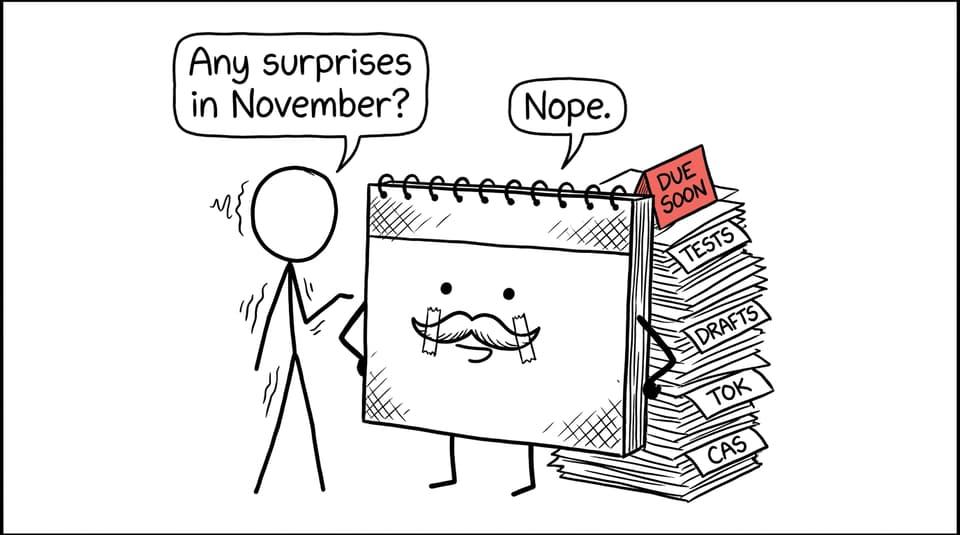
Scan your calendar two weeks at a time. Mark any seven-day period containing several substantial tasks. Then create earlier personal checkpoints, such as finishing chemistry content review four days before the test.
A useful system has three layers:
- Fixed date: when the assessment or submission occurs
- Preparation date: when serious work begins
- Buffer date: when the task should be substantially complete
RevisionDojo's guide to time management in IB recommends one master calendar and a short weekly review. The app matters less than the principle: collisions should become visible before they become emergencies.
Turn September-to-November dates into weekly actions
A calendar tells you when something happens. A plan tells you what to do next.
For every assessment, work backwards. A test two weeks away might produce these actions:
- Confirm the assessed topics
- Review a weak concept using IB Study Notes
- Retrieve definitions or formulas with Flashcards
- Complete a focused set in the IB Questionbank
- Analyse errors and ask AI Chat about one unresolved misconception
- Complete a short timed attempt
Coursework needs a different sequence: interpret the task, choose a direction, gather evidence, outline, draft, seek permitted feedback, revise, and confirm submission details. The IA time-management guide turns a large assignment into visible weekly outputs.
Use the RevisionDojo IB Study Planner to translate a confirmed test date into topic-level revision tasks. Keep the school calendar as your record of fixed commitments, then use the planner to decide what preparation belongs on each available day.
Build a weekly review habit in DP1 fall
The IB DP1 fall term changes quickly. Teachers finish units at different speeds, activities move, and provisional dates become confirmed. Your calendar needs maintenance.
Choose one consistent review time and spend 10-15 minutes asking:
- What changed this week?
- What is due in the next 14 days?
- Which week contains the next serious collision?
- What preparation should begin now?
- Which instruction remains unclear?
- Where is one buffer block for unexpected work?
Do not fill every empty hour. A calendar with no spare capacity is already late, because ordinary life will eventually interrupt it. The balanced IB study schedule guide can help you protect subject practice, core work, sleep, and recovery.
Match RevisionDojo tools to the calendar stage
New DP students often open every available resource at once. A better approach is to let the next assessment determine the tool.
Use Study Notes and AI Chat when a concept is unclear. Use Flashcards for retrieval and the Questionbank to apply what you learned. Use Grading tools to identify weaknesses in eligible responses while following your school's academic-integrity rules. The Coursework Library and Tutors can help you understand standards and receive appropriate support for larger projects.
Mock Exams and Predicted Papers become more valuable after you have covered enough content for broad timed practice. In September of DP1, topic-level questions and short timed sections are usually more relevant. The guide to starting strong with RevisionDojo in DP1 presents a practical cycle of understanding, retrieval, application, diagnosis, and revisiting mistakes.
Make the calendar boring before November becomes exciting
A good assessment calendar should feel uneventful. Dates are labelled, instructions are clear, busy weeks are visible, and preparation begins before urgency takes control.
Ask your coordinator and teachers for the current schedule. Consolidate it, identify collisions through November, and convert each major date into smaller weekly actions. Then review the calendar once a week.
RevisionDojo becomes most useful inside that system. Its Study Notes, Flashcards, Questionbank, AI Chat, Grading tools, Predicted Papers, Mock Exams, Coursework Library, and Tutors give you practical ways to act on the dates you identify. The calendar provides direction. RevisionDojo provides the connected IB resources that help you move forward before a deadline can surprise you.