

It is difficult to watch your child work hard while wondering whether you should step in or step back. IB parents often see the late evenings and looming deadlines, but not the academic detail behind them. That uncertainty can make every question about revision sound more anxious than intended.
The clearest answer is simple: parents can use RevisionDojo to help their child establish one organized revision system, review progress together once a week, and find additional support when school resources are not enough. You do not need to relearn six subjects or monitor every study session. Your role is to make effective work easier while allowing your child to remain responsible for it.
This guide explains how parents can use RevisionDojo practically, from setting up an account and choosing subjects to checking progress without creating pressure. The aim is not more supervision. It is calmer, better-informed support.
A quick RevisionDojo setup checklist for parents
Start with one short conversation and one shared setup session:
- Ask your child what kind of support would feel helpful.
- Create or open their RevisionDojo account together.
- Select the correct IB subjects and confirm SL or HL where applicable.
- Identify one or two topics causing the most difficulty.
- Choose a simple weekly routine using Study Notes, Flashcards, and the Questionbank.
- Agree on a ten-minute weekly progress conversation.
- Record school coursework deadlines, mock dates, and the applicable IB examination schedule separately.
- Escalate to AI feedback or a tutor when a problem remains unresolved.
RevisionDojo provides a dedicated IB support page for parents and families, which is a useful starting point if you want to understand the available tools before sitting down with your child.
Begin with permission, not a performance review
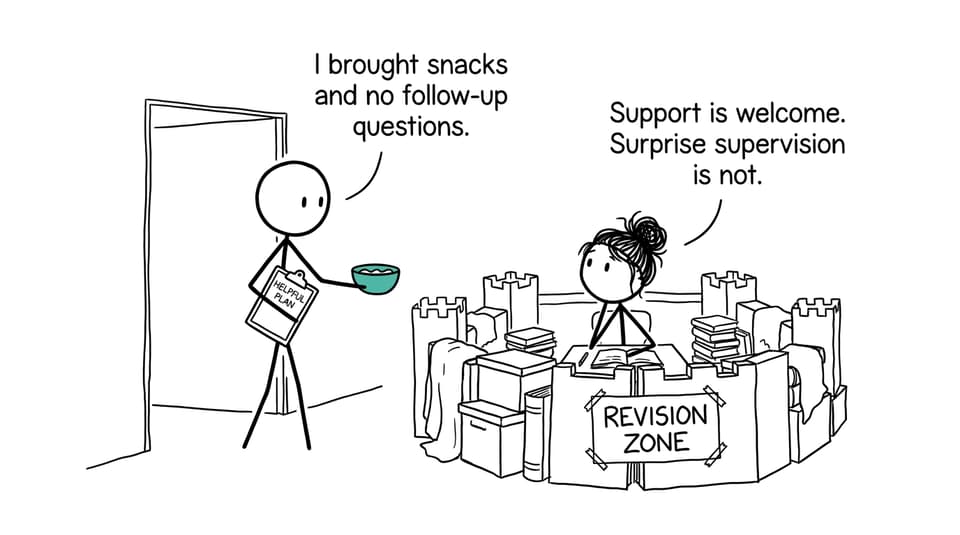
Before opening the platform, ask one question: “Would you like me to help you organize the system, review progress with you, or simply give you space?”
Those are three different forms of support. A student who wants help building a timetable may not want a parent checking every answer. Another may be comfortable showing topic progress but prefer to discuss coursework only with a teacher. Agreeing on the boundary first prevents a useful tool from becoming another source of tension.
A good arrangement is usually student-led. Your child controls the work and explains what they are trying to improve. You help protect time, remove practical obstacles, and notice when the plan is no longer working.
This matches the broader purpose of the Diploma Programme: students are expected to develop as independent learners. Parental support matters, but independence is not built by transferring responsibility from the student to the adult.
Set up RevisionDojo around the subjects they actually take
Once expectations are clear, open RevisionDojo together and build a focused starting point.
First, confirm the child’s six subjects, their levels, and the syllabus being taught by the school. Then choose one subject for the first session rather than exploring every feature at once. Beginning narrowly reduces friction and produces useful evidence quickly.
For that subject, follow this sequence:
- Choose a weak or uncertain topic.
- Read the relevant Study Notes.
- Use Flashcards to test essential knowledge without looking at the answer.
- Complete a small Questionbank set on the same topic.
- Review the feedback and record the main error.
The RevisionDojo Questionbank lets students practise curriculum-aligned questions and mark items for completion or review. The point is not to produce an impressive total. It is to reveal what your child can retrieve and apply independently.
Parents do not need to interpret every mark scheme. Ask your child to describe the error in plain language: Was the knowledge missing? Was the command term misunderstood? Was the method correct but incomplete? That explanation is often more valuable than the score itself.
Build one repeatable study loop
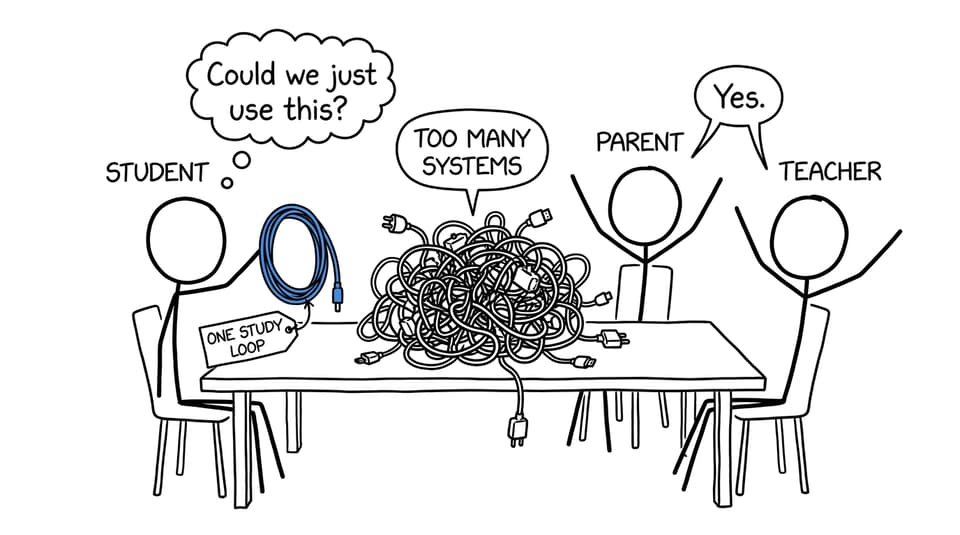
IB revision becomes overwhelming when every subject has a different collection of documents, websites, videos, and unfinished plans. A repeatable loop makes the next action obvious.
A manageable RevisionDojo session might look like this:
| Stage | Student action | Parent support |
|---|---|---|
| Understand | Read one section of Study Notes | Protect a quiet study block |
| Recall | Review Flashcards without notes | Avoid interrupting the session |
| Apply | Complete a targeted Questionbank set | Treat mistakes as information |
| Correct | Review feedback and write one fix | Ask what the next attempt will change |
| Retest | Return to the topic later | Help keep the routine consistent |
Students who need a fuller structure can use this step-by-step guide to studying for IB exams. If competing deadlines are the main difficulty, the balanced IB study schedule guide can help turn broad intentions into realistic blocks.
The parent’s contribution is mostly environmental. Help preserve the agreed time, reduce avoidable household demands during intense periods, and keep revision materials accessible. Consistency is easier when beginning does not require twenty minutes of searching and planning.
Check progress without turning home into school
Progress checks work best when they are brief, predictable, and based on patterns rather than isolated scores. Set one weekly conversation, ideally at a neutral time rather than immediately after a difficult session.
Ask four questions:
- What became clearer this week?
- Which topic is still causing difficulty?
- What did practice reveal about technique or timing?
- What is the smallest useful goal for next week?
If your child is comfortable sharing their dashboard or activity, look together. Let them navigate and explain what the information means. RevisionDojo resources can help students identify completed work, items requiring review, feedback history, and recurring weaknesses. The purpose is reflection, not surveillance.
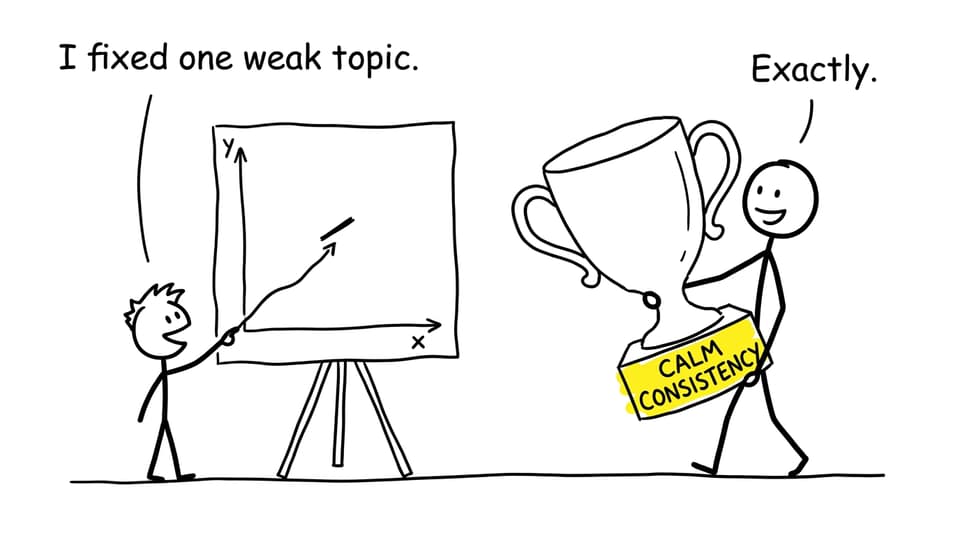
A small improvement deserves recognition. Completing a difficult question set, correcting a repeated mistake, or following the plan for a week may not change a predicted grade immediately, but each is evidence of a stronger process. RevisionDojo’s guide to helping students take ownership of their learning offers further context for keeping that responsibility with the student.
Avoid comparisons with classmates, siblings, or online claims about ideal study hours. Different subject combinations, school calendars, and learning needs produce different workloads. Compare the current week with the previous one instead.
Use RevisionDojo alongside school, not instead of it
RevisionDojo should reinforce the curriculum and feedback your child receives at school. Teachers and the IB coordinator remain the authoritative contacts for internal deadlines, subject requirements, approved accommodations, and local examination arrangements.
Create a family calendar using dates supplied by the school. The IB publishes official examination schedules, but the relevant session, examination zone, reporting time, and school procedures must be confirmed with the coordinator. Coursework checkpoints are also set and managed through the school, so do not assume a date found online applies locally.
When a teacher identifies a weak topic, use RevisionDojo to build a targeted response: Study Notes for clarification, Flashcards for retrieval, and Questionbank practice for application. When a RevisionDojo session reveals persistent confusion, your child can bring a specific question back to the teacher.
This creates a useful cycle between school instruction and independent practice. It avoids the tangled situation where home revision follows one plan, classroom teaching follows another, and the student spends energy reconciling both.
Know when your child needs a different kind of help
Not every problem is solved by adding more questions. The right RevisionDojo tool depends on the obstacle.
When understanding is weak
Start with Study Notes, then ask a focused question through Jojo AI Chat. Encourage prompts that identify the exact point of confusion rather than requesting an entire topic summary. The student should then test the explanation by attempting a related question independently.
When knowledge disappears under pressure
Use short Flashcard sessions followed by timed Questionbank practice. Later, Mock Exams and Predicted Papers can help your child practise pacing and decision-making under more realistic conditions. The RevisionDojo exam preparation workflow explains how these resources fit together.
When coursework feedback is needed
Grading tools can provide an additional feedback loop, while the Coursework Library helps students examine examples and criteria. These tools should support original work and teacher guidance, never replace either. Your child remains responsible for following the school’s academic integrity requirements and acknowledging permitted assistance.
When the student remains stuck
A Tutor may be appropriate when repeated independent attempts are not resolving a conceptual gap, when accountability is difficult, or when the student needs personalized strategy. Tutoring should have a defined goal, such as correcting one recurring technique problem, rather than adding another general weekly obligation.
Protect wellbeing as carefully as the revision plan
Parents often notice strain before they understand its academic cause. Changes in sleep, appetite, mood, concentration, or willingness to engage may indicate that the current workload or approach needs attention. Respond with curiosity rather than immediately prescribing more study.
The IB itself emphasizes student wellbeing and the value of a supportive home environment during examinations. Regular meals, sleep, movement, breaks, and perspective are not rewards earned after revision. They make sustained learning possible.
If your child appears persistently overwhelmed or their wellbeing is deteriorating, contact the school’s pastoral team, counsellor, or an appropriate health professional. RevisionDojo can organize academic support, but it is not a substitute for mental health care. The parent guide to supporting teens with IB burnout can help you begin that conversation carefully.
During the final stretch, reduce novelty. The last two weeks before IB exams guide focuses on targeted practice, mistake review, recall, and protected sleep rather than dramatic last-minute changes.
A calm next step for your family
The most useful parental support is rarely a perfect schedule or a daily interrogation about grades. It is a stable system, a short weekly conversation, and the confidence to seek help when evidence says it is needed.
Start today by opening the RevisionDojo parent onboarding page with your child. Select the correct subjects, choose one weak topic, and complete one Study Notes-to-Questionbank loop. Then agree on when you will review the week together.
RevisionDojo brings the Questionbank, Study Notes, Flashcards, AI Chat, Grading tools, Predicted Papers, Mock Exams, Coursework Library, and Tutors into one IB-focused resource. Your child still owns the journey. You simply help make the next step clear, achievable, and a little less lonely.