The day the IB stops being “school”
There’s a quiet moment most IB students recognize.
You open your notebook (or your laptop) and realize the scary part isn’t the workload. It’s the vagueness. You’ve “studied,” but you can’t prove you’re improving. You’ve “revised,” but you can’t tell if it will translate into marks. And when exams get closer, the calendar starts to feel like a countdown instead of a plan.
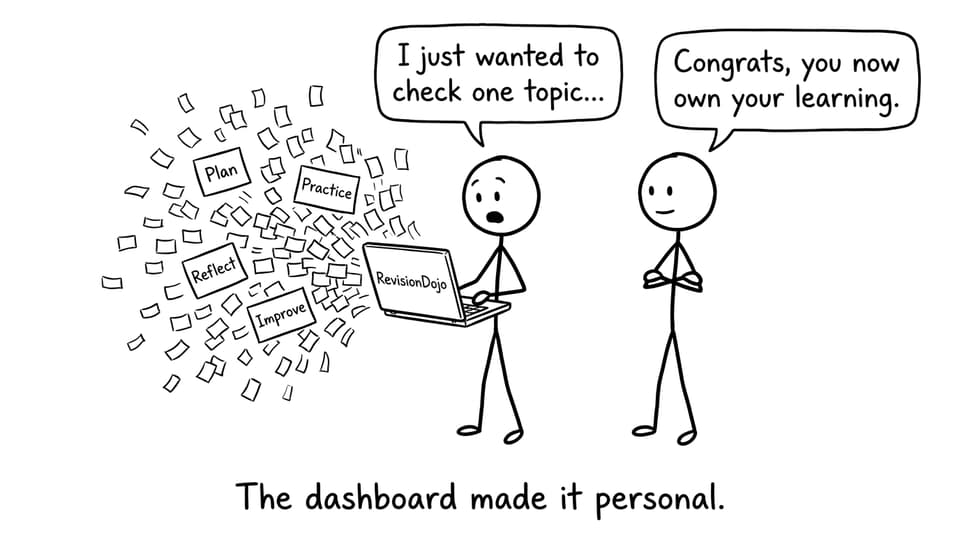
Taking ownership in the IB isn’t about becoming a perfect student. It’s about replacing vague effort with visible progress. That shift is exactly what RevisionDojo is built for: a clear system that helps you decide what to do next, check if it worked, and repeat.
A quick IB ownership checklist (save this)
If you want the shortest path to more control in the IB, start here:
-
Pick one subject and one topic (narrow beats heroic).
-
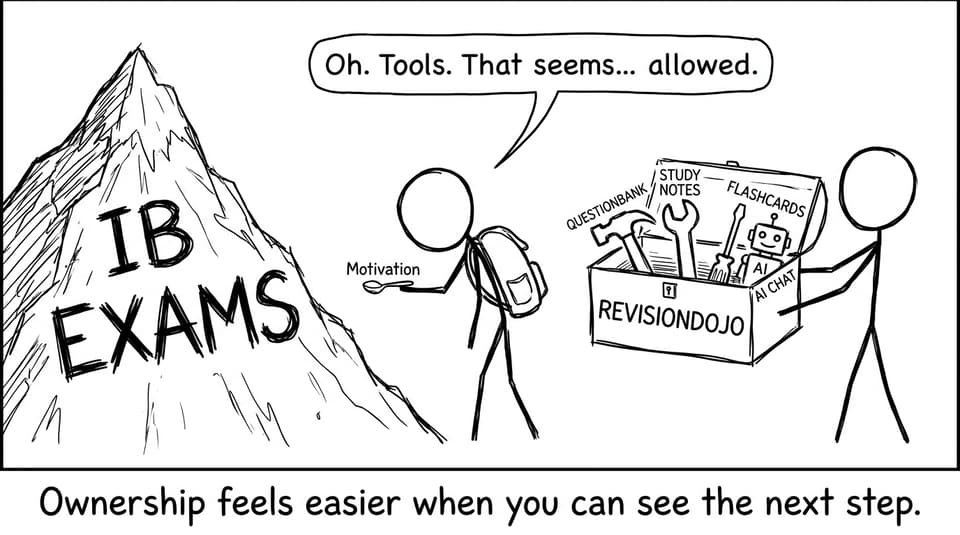
Learn the idea quickly with Study Notes.
-
Test recall with Flashcards (short, daily).
-
Convert knowledge into marks using the Questionbank.
-
Use AI Chat and Grading tools to tighten feedback fast.
-
Simulate pressure using Predicted Papers and Mock Exams.
-
Track what changed (not how hard you tried).
RevisionDojo is powerful because it keeps that loop in one place, so your IB prep becomes a repeatable routine, not an endless search for resources.
Why ownership matters in the IB (and why it feels hard)
The IB isn’t designed for memorization alone. It rewards how you think: command terms, structure, justification, evaluation, and calm decision-making under time.
That’s why “working hard” can still feel like spinning your wheels. Without a feedback loop, you can’t tell whether you’re improving content, exam technique, or just your ability to reread the same pages faster.
Ownership is the antidote. When you own your learning in the IB, you:
-
Study with a purpose, not just a deadline.
-
Use evidence (scores, mistakes, patterns) to choose your next step.
-
Treat feedback as something you act on, not something you receive.
-
Build confidence because progress becomes measurable.
How RevisionDojo empowers IB students to take ownership
Build clarity first: Study Notes that reduce “resource hunting”
Most IB stress starts as a simple question: “What exactly am I meant to know?” When that’s unclear, you over-study, under-practice, and waste time.
RevisionDojo’s notes are structured so you can learn by topic and move on. They’re designed for exam preparation, not for rewriting a textbook. If your current system is scattered, start with IB Subject Note Collections and build a single reference spine.
Then, make your notes usable. Many students take beautiful notes that never get tested. If that sounds familiar, borrow a better method from The Best Note-Taking Systems for IB Students and treat notes as a launchpad for practice.
Make memory automatic: IB Flashcards that serve the plan
Ownership in the IB isn’t just choosing what to study. It’s ensuring yesterday’s work still exists in your brain next week.
Spaced repetition helps because it turns memory into a schedule instead of a mood. RevisionDojo’s IB Flashcards with Spaced Repetition (SRS) make daily recall manageable, especially when your week is full.
And if you’re unsure when flashcards help vs when practice questions help, read IB Flashcards vs Practice Questions. That distinction is a hidden ownership skill: knowing whether you need recall, or whether you need marks.
Turn effort into marks: the Questionbank as a decision tool
In the IB, ownership becomes real the moment you stop asking “Did I study?” and start asking “What changed after I studied?”
That’s why targeted practice is non-negotiable. RevisionDojo’s Questionbank gives you a way to practice by topic, see what you missed, and repeat with intention.
If you want a clean starting point, use IB Question Bank: Thousands of Practice Questions. And if your biggest stress is math, the workflow in IB Math: Targeted Revision Using the Questionbank shows how to keep sessions focused.
A simple ownership habit: after every set, write one sentence:
-
“I lost marks because I misunderstood __.” or
-
“I lost marks because I didn’t show __.”
That single sentence turns practice into a plan.
Shorten the feedback loop: AI Chat and Grading tools
A lot of IB learning fails at the same point: you try a question, you get it wrong, and you don’t know why. Or you write an answer, and the teacher feedback arrives later, when your brain has moved on.
RevisionDojo’s AI Chat is best used like a study partner that keeps momentum alive: clarify a concept in the language of the syllabus, ask for a worked example, or request a quick mini-quiz to confirm you’ve fixed the gap.
For written work (especially coursework), feedback must be timely and criterion-aware. That’s where the IB Coursework Grader helps you take ownership without guessing what “improve analysis” is supposed to mean in practice.
Train realism: Predicted Papers and Mock Exams (without the spiral)
Ownership in the IB eventually becomes the ability to sit down, timed, and execute.
RevisionDojo’s IB Predicted Papers and platform-based Mock Exams make it easier to rehearse timing, stamina, and question selection. If you’ve never been taught how to use these resources without panicking, IB Predicted vs Specimen Papers: What They Mean lays out a sane approach.
A practical rule: simulations are not verdicts. They are data.
After any timed paper, don’t just review “wrong answers.” Review patterns:
-
Which command terms cost you marks?
-
Which topics collapse under time?
-
Which mistakes repeat even when you “know the content”?
That’s ownership: turning pressure into information.
Add human support when it matters: Tutors and structure
Sometimes ownership is knowing when you need help. Not because you’re behind, but because the next improvement requires an outside eye.
RevisionDojo’s Tutors can convert confusion into a plan, especially when you’re stuck on exam technique, written responses, or how to prioritize across multiple IB subjects. Used well, tutoring isn’t dependency. It’s acceleration.
A simple weekly system that feels like ownership
If you want a routine you can run even during busy weeks of the IB, use this:
-
2 sessions (learning): Study Notes + 15 minutes of Flashcards.
-
3 sessions (practice): Questionbank sets by topic, immediate review.
-
1 session (timed): Predicted Papers or Mock Exams, then a mistake-pattern review.
-
Daily (5 minutes): Flashcards, plus one micro-goal for tomorrow.
If burnout is already creeping in, use the calmer approach in How to Study for IB Exams Without Burning Out. Ownership grows fastest when your system is sustainable.
The IB Learner Profile, made practical
The IB Learner Profile can sound like a poster on a wall until you connect it to habits:
-
Inquirers ask better questions in AI Chat and in class.
-
Thinkers use Questionbank results to diagnose patterns.
-
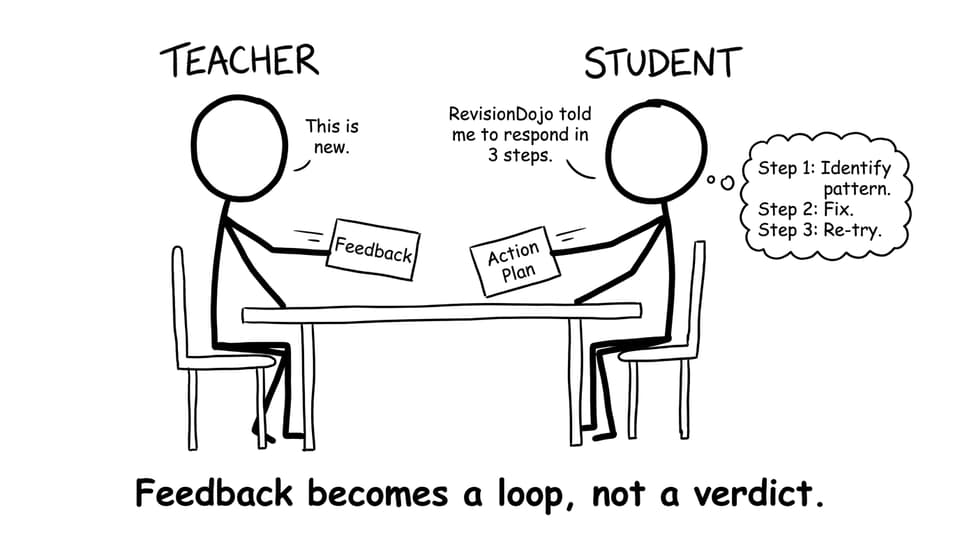
Communicators turn feedback into clear action steps.
-
Reflective students run weekly reviews instead of last-minute cramming.
-
Balanced students build routines they can repeat without breaking.
RevisionDojo supports these traits because it makes the invisible parts of learning visible: what you did, what changed, and what you should do next.
Frequently asked questions
How does RevisionDojo help me take ownership if I’m already overwhelmed in the IB?
Ownership starts by shrinking the task. In the IB, overwhelm usually comes from trying to hold too many subjects and too many resources in your head at once. RevisionDojo helps by turning your study into a small loop: learn one topic, recall it, practice it, and review mistakes. That structure removes the daily decision fatigue of “what should I do tonight?” It also creates proof of progress, which is often what overwhelm is really asking for. When you can see what improved, your workload stops feeling like an ocean and starts feeling like steps.
What if I keep practicing but my IB scores don’t improve?
That usually means you’re practicing without closing the loop. In IB exams, marks often disappear because of command terms, missing working, weak structure, or not using the markscheme logic. RevisionDojo helps you spot patterns through targeted Questionbank practice and faster feedback using AI Chat and Grading tools. The key is to track mistake types, not just topics, and then reattempt after you’ve made a specific change. Improvement often shows up in the second and third cycle, not the first. Ownership is staying with the cycle long enough to make the fix permanent.
Can RevisionDojo support coursework ownership (IA, EE, TOK), not just exam prep?
Yes, and that matters because coursework is where many IB students feel least in control. Drafting can become a loop of guessing what the criteria want and waiting for feedback. With RevisionDojo’s Grading tools, you can get criterion-aware guidance quickly, then revise with a clear target. Pair that with the Coursework Library to compare structure and expectations, and you stop revising blindly. The platform doesn’t replace your teacher’s judgment, but it does help you arrive at meetings with specific questions and a concrete action plan. That’s what ownership looks like in coursework: intentional iterations.
Is it realistic to use flashcards, a questionbank, and mock exams all at once in the IB?
It’s realistic if each tool has a job. Flashcards are for fast recall, Study Notes are for clear understanding, the Questionbank is for converting knowledge into marks, and mock exams are for timing and stamina. The problem is not using many tools; it’s using them without a plan. RevisionDojo makes the combination manageable because everything is connected in one platform, so you’re not constantly switching apps and losing time. Start small: 10 minutes of flashcards a day and two Questionbank sets a week can already change your trajectory. Add mock-style practice only after you’ve built a base of consistent recall and topic-level practice.
Conclusion: ownership is a calm kind of confidence
The IB will always be demanding. But it doesn’t have to be mysterious.
When you can see your progress, understand your weaknesses, and choose your next step with evidence, the programme changes shape. It becomes less like something happening to you and more like something you’re steering.
That’s what RevisionDojo offers IB students preparing for exams: Study Notes for clarity, Flashcards for retention, a Questionbank for marks, AI Chat and Grading tools for fast feedback, Predicted Papers and Mock Exams for realism, plus a Coursework Library and Tutors when you need deeper support.
If you want your next week of IB revision to feel simpler and more controlled, start by building your loop inside RevisionDojo, and let your progress prove the work is working.