Join 650k+ students breezing through the IBReady to breeze through the IB?
Exam rooms have a strange way of turning minutes into something emotional.
Two students can sit under the same clock, in the same silence, with the same paper in front of them, and experience time completely differently. For many IB students with disabilities, medical conditions, or learning differences, the challenge isn’t knowledge. It’s access: reading speed, writing speed, fatigue, sensory overload, processing time.
That’s why the IB allows accommodations. And that’s why this guide is written as Exam Advice you can actually use: what “extra time” usually looks like, how it works in real minutes, what else you can request, and how to prepare so those extra minutes help rather than simply stretch the stress.
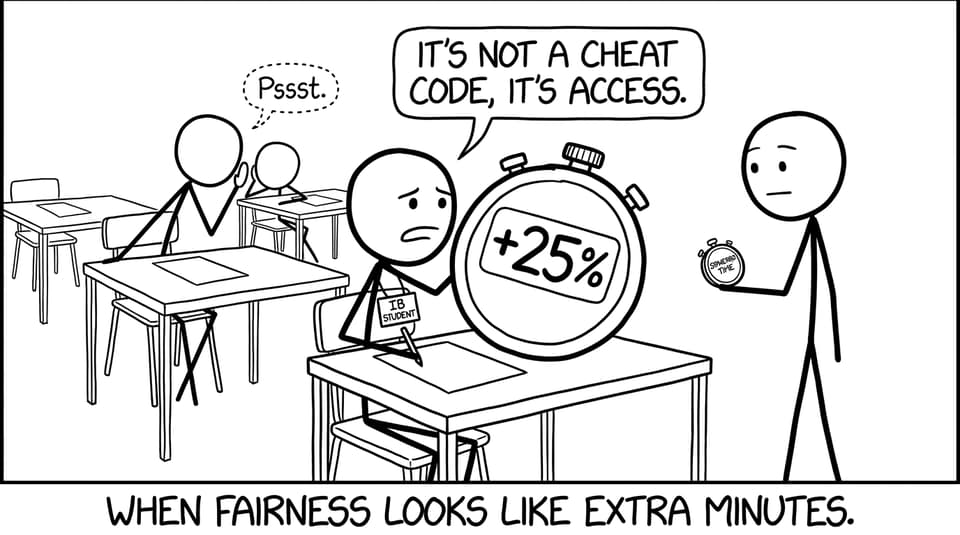
Comic about extra time and fairness
Exam Advice checklist: what to confirm this week
Before you chase the perfect study plan, confirm the basics. This Exam Advice checklist reduces uncertainty fast:
What support is already documented at school (learning support plan, counselor notes, medical plan)?
Who submits requests to the IB (usually your IB coordinator)?
What accommodation are you seeking: extra time, rest breaks, separate room, laptop, modified papers, assistive tech?
What evidence exists (diagnostic report, medical letter, history of support)?
min read
min read
min read
min read
Have you practiced under the accommodation conditions (timed, with breaks, with laptop, etc.)?
If you want extra context on how the IB approaches access and inclusion, browse RevisionDojo’s broader Exam Advice collection: Exam Advice posts.
How extra time works in IB exams (typical allowances)
The most common accommodation students ask about is extended time. In practice, extended time is typically granted in tiers based on documented need:
25% extra time (common for mild to moderate impacts)
50% extra time (for more significant impacts)
100% extra time (rare, exceptional cases with extensive documentation)
Think of it less like a “bonus” and more like a ramp next to stairs. It doesn’t change the destination. It changes whether you can reasonably get there.
What that means in real minutes
Here’s the same Exam Advice students often ask for: translated into simple arithmetic:
If an exam is 2 hours (120 minutes):
25% extra time = +30 minutes (total 150 minutes)
50% extra time = +60 minutes (total 180 minutes)
100% extra time = +120 minutes (total 240 minutes)
The key detail: you still sit the same paper, marked the same way. The accommodation is about access, not advantage.
Other accommodations that often matter as much as extra time
Extra time is popular because it’s easy to picture. But many students improve more from the right combination of supports.
Rest breaks
Rest breaks can be approved for students who experience fatigue, pain, anxiety spikes, or concentration crashes. Break time typically does not count as writing time, which matters if your main issue is stamina rather than speed.
Separate testing room
A separate room can reduce sensory overload and distraction. It can also make breaks easier to manage discreetly. If your focus issues are triggered by noise, movement, or heightened exam stress, this can be as valuable as extra time.
Assistive technology (including a laptop)
For students with dysgraphia, dyslexia, or physical conditions that make handwriting slow or painful, typing can be the difference between showing your thinking and running out of time mid-sentence.
This includes large print, Braille, and other formatting adjustments. If the barrier is visual or sensory, format changes can be the most direct accommodation.
How to apply for extra time (and why “early” is a strategy)
Here’s the most important Exam Advice in this entire post: students don’t submit accommodation requests directly to the IB. Your school does, typically through the IB coordinator, using documentation from licensed professionals.
The basic process looks like this:
Collect documentation that explains the condition and its functional impact in exams.
Your school submits the request to the IB.
The IB reviews and approves (or asks for clarification).
The school implements the approved arrangements on exam day.
What helps your case isn’t drama. It’s clarity. A report that says “student has X” is less helpful than one that says “student has X, which slows reading speed, written output, or sustained attention under timed conditions.”
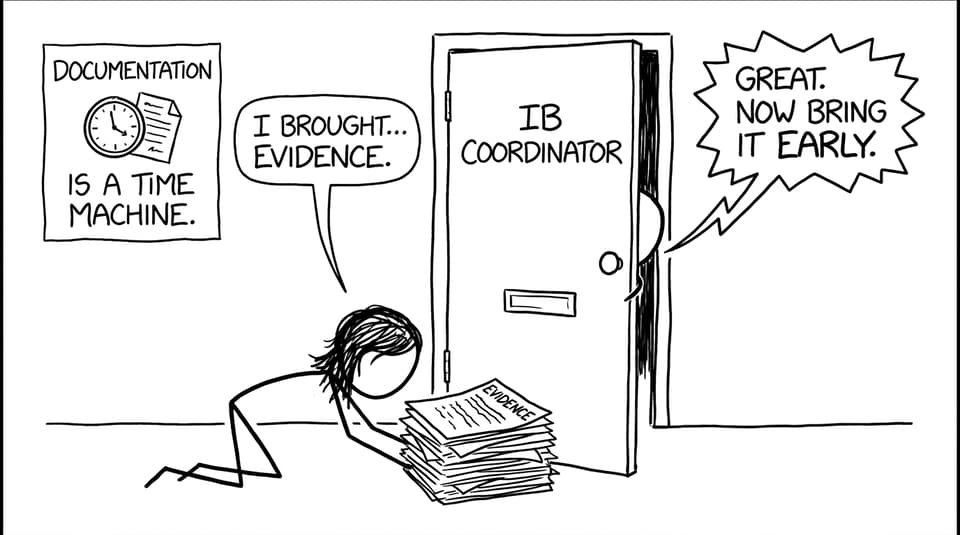
Comic about bringing evidence early
If your situation is mental health related
Mental health can be part of access arrangements, but it usually needs formal documentation and a clear link to exam functioning. If you’re wondering how the IB treats anxiety when it’s undiagnosed, read: Does the IB care if I have undiagnosed extreme anxiety?
Exam Advice: how to actually use extra time (without letting it expand anxiety)
A quiet truth: extra time doesn’t automatically create better answers. Sometimes it creates longer answers, heavier answers, more edited answers, answers that feel safer but score the same.
This is where practice matters.
Build a pacing rule before exam day
Try this in your next timed session:
Use the first 2 minutes to plan (even if it feels “wasteful”).
Spend most of your time earning marks, not rewriting.
Reserve the final 5-10 minutes (or proportionally longer if you have extra time) for checking command terms, units, and structure.
Practice in conditions that match your accommodation
If you’re approved for 25% extra time, practice with that exact time. If you’re approved for rest breaks, rehearse when you’ll take them.
RevisionDojo makes this easier because you can structure practice intentionally: drill weak topics in the Questionbank, tighten understanding with Study Notes, and keep recall alive with Flashcards. When you want feedback without waiting a week, use AI Chat to clarify what went wrong, and the Grading tools to align your writing with criteria.
For end-to-end prep, start from RevisionDojo for IB and build toward Predicted Papers and Mock Exams as your confidence grows.
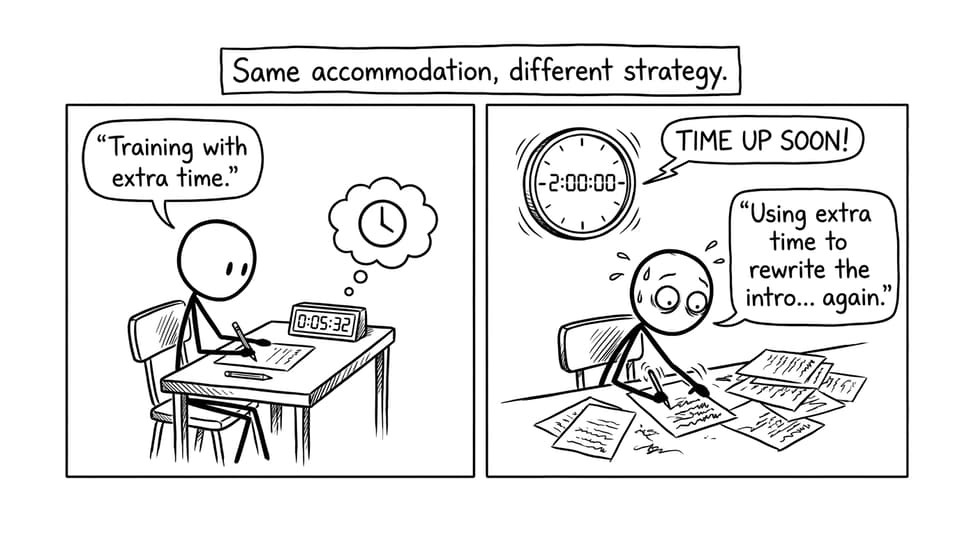
Comic about strategy vs rewriting
When extra time is not the main problem
Some timing issues come from decision fatigue: overthinking, perfectionism, or getting stuck on one question too long. If that’s you, your best Exam Advice might be to train skipping and returning, not just request more minutes.
Closing: extra time is access, but your plan is power
Extra time can change the shape of your exam day. It can turn a sprint into a steady pace. But the real win is combining access with strategy: practicing the timing you’ll actually have, building a calm routine, and using tools that reduce decision fatigue.
If you want one home base, use RevisionDojo as your control panel: Questionbank for targeted practice, Study Notes for fast clarity, Flashcards for recall, AI Chat when you’re stuck, Grading tools to improve exam-style writing, plus Predicted Papers, Mock Exams, the Coursework Library, and Tutors when you need more structure.
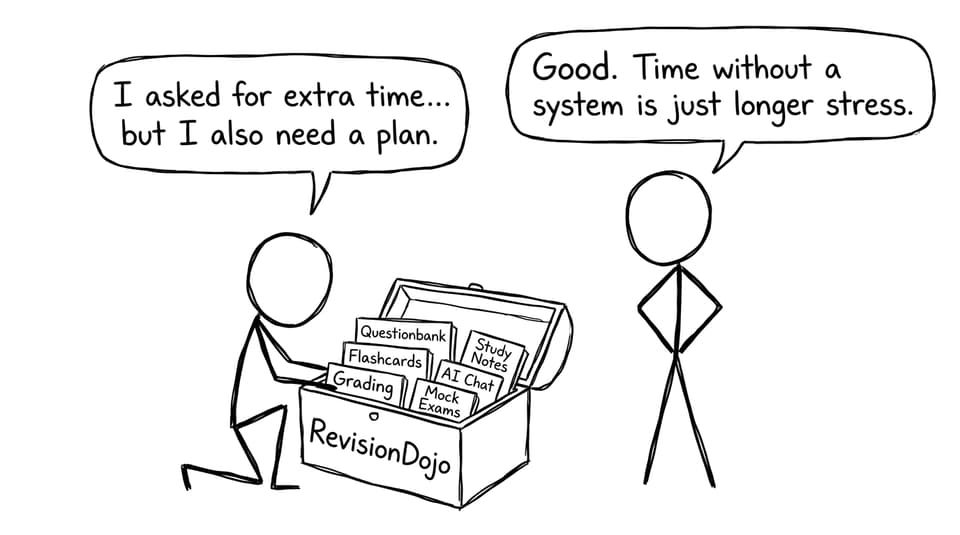
Comic about needing a plan, not just extra time
Take this as your final Exam Advice: ask for the access you need, then train like it’s already approved. When the clock finally starts, you’ll recognize the feeling, and you’ll know what to do with the minutes.