
Some IB World Religions essays look difficult because of the religion named in the question. Often, the deeper difficulty is hidden in the first two words.
Discuss, evaluate and to what extent are not interchangeable instructions. All three are IB command terms associated with assessment objective 3, or AO3, which focuses on synthesis and evaluation. Yet each asks you to build a slightly different kind of argument.
A strong AO3 answer selects relevant evidence, connects ideas, considers competing interpretations and reaches a reasoned conclusion that answers the precise command term. This guide defines each instruction, explains the structure it requires and provides short model answers for IB World Religions SL students.
The AO3 answer checklist
Before writing, reduce the question to five decisions:
- Underline the command term.
- Identify the exact claim you must judge.
- Choose two or three criteria for making that judgment.
- Select specific teachings, practices or internal interpretations as evidence.
- Write a qualified thesis that you can defend throughout the essay.
This process matters because a polished answer can still miss the task. The broader IB exam command terms guide is useful for distinguishing AO3 instructions from lower-order terms such as identify, describe and explain.
Why AO3 answers require more than two sides
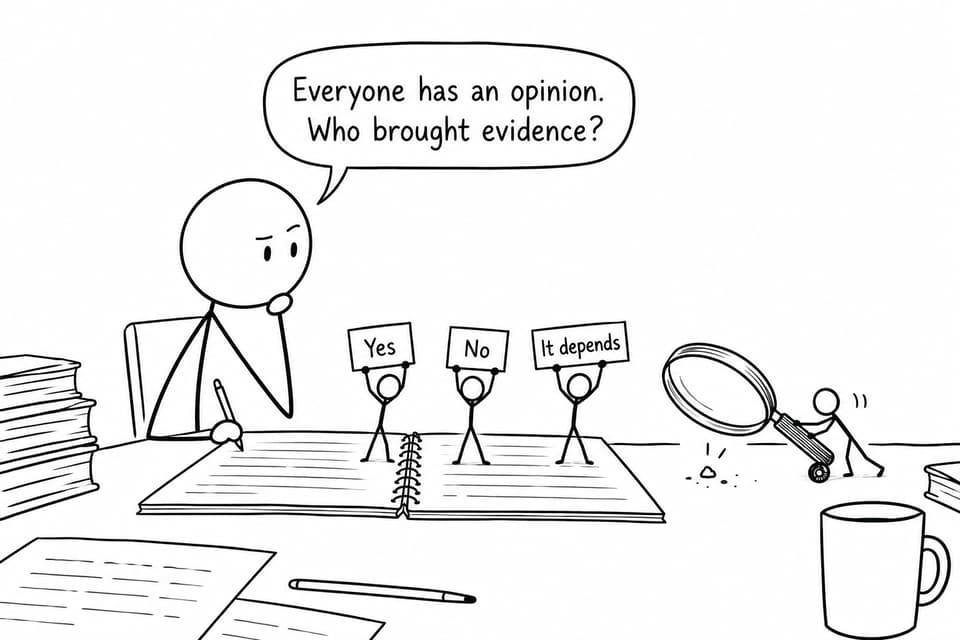
Students sometimes treat evaluation as a debate template: one paragraph for, one paragraph against, followed by “therefore, both sides are valid.” That creates balance, but not necessarily judgment.
AO3 requires synthesis and evaluation. You must bring teachings, practices and interpretations together, then decide what the combined evidence establishes and where its limits lie.
A useful paragraph moves through four stages:
- Make a claim that answers the question.
- Support it with precise religious evidence.
- Introduce a qualification, alternative interpretation or limitation.
- Explain what this means for your overall judgment.
The crucial step is the fourth. Evidence does not evaluate itself. If you mention a teaching but never explain its significance, you remain closer to description than AO3.
Discuss: construct a considered, balanced review
Definition and assessment objective
Discuss means offering a considered and balanced review that includes a range of arguments, factors or interpretations. Opinions and conclusions should be clearly presented and supported by appropriate evidence.
In IB World Religions, discuss is an AO3 synthesis and evaluation command term. It asks you to explore the issue from meaningful perspectives and decide what the comparison reveals. Balance does not mean giving every view the same space. It means treating credible alternatives fairly before reaching a judgment.
A reliable structure for discuss
- Introduce the issue and state a provisional position.
- Develop the strongest argument supporting the claim.
- Examine a contrasting or qualifying perspective.
- Bring the positions together rather than merely listing them.
- Conclude with a balanced judgment tied to the question.
Short example answer
Question: Discuss the view that meditation is the most important part of the Buddhist path.
Example: Meditation is central to many Buddhist traditions because right effort, right mindfulness and right concentration cultivate the discipline needed to overcome attachment and ignorance. It can therefore be considered indispensable to progress toward liberation. However, the Noble Eightfold Path also includes wisdom and ethical conduct. Right view guides practice, while right speech, action and livelihood shape how insight is expressed in daily life. Some traditions may emphasize particular forms of meditation, but this does not make morality or wisdom optional. Meditation is therefore highly important, although it is best understood as one interdependent dimension of the path rather than a complete path by itself.
The response does not merely present two sides. It connects them through the idea of interdependence.
Evaluate: weigh strengths and limitations
Definition and assessment objective
Evaluate means making an appraisal by weighing strengths and limitations. It is also an AO3 synthesis and evaluation term.
The hidden question is: How successfully does this claim withstand examination? Your criteria might include theological authority, consistency with practice, explanatory power or variation within a tradition.
Evaluation becomes vague when students use unsupported labels such as “strong,” “weak” or “important.” Instead, explain why an argument is persuasive. For example, it may account for both authoritative teaching and observable religious practice.
A reliable structure for evaluate
- Define the claim and the criteria used to assess it.
- Explain its strongest supporting evidence.
- Test that evidence against limitations or exceptions.
- Compare the significance of the strengths and weaknesses.
- Reach a direct final appraisal.
Short example answer
Question: Evaluate the claim that langar fully expresses Sikh equality.
Example: Langar powerfully expresses Sikh equality because people share food in a communal setting without distinctions of social status, reinforcing service and human dignity through practice. Its strength is that equality becomes visible and participatory. However, a practice can embody an ideal without proving that the ideal is perfectly realized in every Sikh community or social context. Equality is also expressed through wider teachings about the unity of humanity and through seva. Langar is therefore a compelling practical expression of Sikh equality, but the word “fully” is too absolute because no single practice contains every dimension of the principle.
Absolute words such as fully, only, always and most should usually trigger careful qualification.
To what extent: decide the degree of agreement
Definition and assessment objective
To what extent means considering the merits or otherwise of an argument or concept. Your opinion and conclusion must be clear, supported by appropriate evidence and based on sound reasoning. It belongs to AO3 synthesis and evaluation.
This command term demands a judgment of degree. The answer is rarely just yes or no. You might agree to a great extent, to a limited extent, under particular conditions or only for certain interpretations within a religion.
A reliable structure for to what extent
- State your degree of agreement in the introduction.
- Establish the most persuasive reason for agreement.
- Examine a substantial limitation or counterargument.
- Compare their weight using explicit criteria.
- Return to the degree stated in your thesis and refine it.
Short example answer
Question: To what extent is devotion the most important path to moksha in Hinduism?
Example: Devotion is important to a considerable extent because bhakti offers a personal relationship with the divine and can shape worship, emotion and daily conduct. Within bhakti traditions, it may reasonably be regarded as the primary route to liberation. However, Hinduism includes other paths, including knowledge and selfless action, whose importance varies across schools, texts and practitioners. Calling devotion universally “the most important” would flatten this diversity. The claim is therefore convincing within devotional traditions, but only to a moderate extent when applied to Hinduism as a whole.
The conclusion identifies both where the claim works and where its reach ends.
How the three IB command terms differ
| Command term | Central task | Question your conclusion must answer |
|---|---|---|
| Discuss | Review credible perspectives in a considered and balanced way | What does the balance of arguments suggest? |
| Evaluate | Appraise a claim by weighing strengths and limitations | How well does the claim survive examination? |
| To what extent | Judge the degree to which a claim is convincing | How far, and under what conditions, do I agree? |
The same knowledge can produce three different essays. Discuss maps and connects perspectives. Evaluate tests a claim against criteria. To what extent places the final judgment on a reasoned scale. The command term should control the architecture of the answer.
Build paragraphs that make judgment visible
A practical AO3 paragraph can follow this pattern:
Claim → evidence → interpretation → challenge → judgment
The challenge does not need to contradict your claim completely. It might introduce variation between communities, question whether one example represents an entire tradition or show that a statement is only convincing under particular conditions. What matters is that you explain how the challenge affects your position.
Comparative language can make that reasoning visible:
- “This is persuasive because...”
- “A significant limitation is...”
- “This interpretation has greater explanatory power when...”
- “The claim applies more strongly to...”
- “Although this evidence establishes X, it does not establish Y.”
Use these as thinking prompts, not phrases to repeat mechanically. Your reader should always know what you believe the evidence proves.
For further practice with matching depth to instructions, read how to use command terms effectively.
Revise AO3 by practising decisions
Reading notes can improve knowledge, but AO3 develops through repeated judgment. Start with the IB World Religions resources, then turn one set of Study Notes into three differently worded questions: discuss, evaluate and to what extent.
Use the Questionbank to practise selecting evidence under time pressure. Flashcards can strengthen precise recall of teachings and terminology, while AI Chat can challenge an overgeneralized claim. Grading tools are particularly useful when you ask for feedback on whether each paragraph contains an explicit judgment rather than description alone.
As the exam approaches, World Religions mock exam preparation can help you rehearse complete responses. RevisionDojo’s wider IB study features connect Study Notes, Flashcards, Questionbank practice, AI Chat and Grading tools with Predicted Papers and Mock Exams where available. The Coursework Library supports related research and writing skills, while Tutors can help diagnose persistent problems with argument structure.
The point is not to collect more material than you can use. It is to make better decisions with the material you know.
From knowledge to judgment
An AO3 essay is not a performance of certainty. It is a record of careful judgment.
Discuss asks you to review perspectives and find the balance between them. Evaluate asks you to test strengths against limitations. To what extent asks you to state exactly how far a claim remains convincing. In every case, evidence earns value only when you explain what it establishes.
RevisionDojo brings that process into one place. Learn through Study Notes and Flashcards, test your knowledge in the Questionbank, refine your reasoning with AI Chat and Grading tools, then apply it in Mock Exams. When the command term changes, your thinking should change with it.