
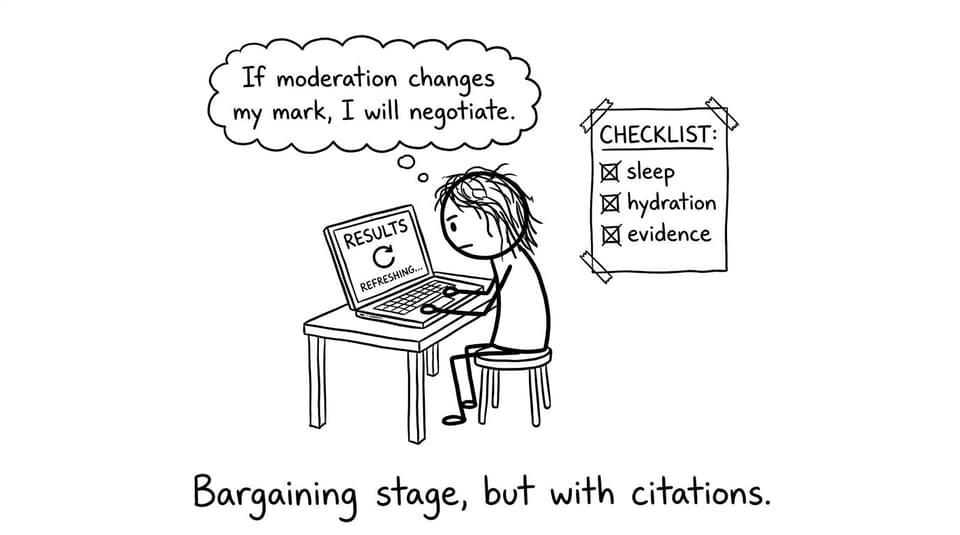
If you've ever watched someone click "submit" on their IA and immediately start doing mental math on grade boundaries, you already understand the emotional shape of moderation.
Not because you're dramatic.
Because the IA is the one part of IB where you've done real work over time, made a thousand tiny decisions, and then handed it over to a process you can't see. It's like building a house and then learning there's a storm test you weren't invited to.
Here's the calm truth: IA moderation is not a trap. It's a quality-control system designed to make grades fair across schools. But it can move marks up or down. And once you understand how IA moderation works, you stop guessing and start building an IA that's difficult to "disagree with."
This guide explains IA moderation in plain language, the parts students can control, and how to use RevisionDojo tools to make your IA as moderation-proof as possible.
IA moderation overview (the 60-second checklist)
Use this checklist when you want the fast picture of IA moderation:
- Your teacher marks your IA using the official criteria.
- Your school submits all IA marks to the IB.
- The IB requests a sample of student work (high, mid, low range).
- An external moderator re-marks the sample using global standards.
- If the teacher's marks don't match the standard, the IB applies an adjustment.
- That adjustment can affect the whole cohort's IA marks (not just sampled students).
If you want the bigger context of what an IA is across subjects, start with What Is an IA? Understanding the Internal Assessment in IB.
What IA moderation is actually trying to fix
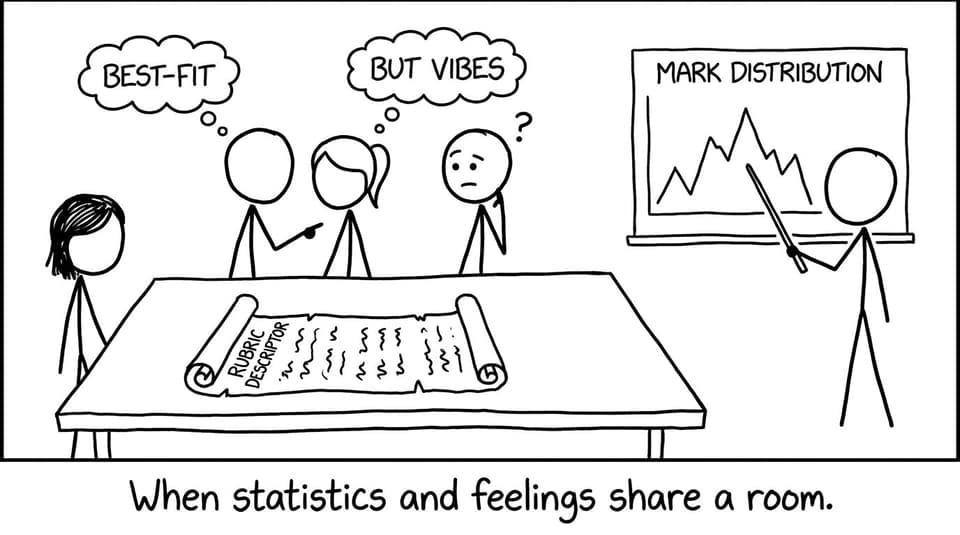
In a perfect world, every teacher in every country would interpret the same rubric in the same way.
In the real world, teachers are human. They have different training, different examples in their heads, different school cultures, and different instincts about what "good analysis" looks like. So the IB uses IA moderation to protect a simple idea: a 17/24 in one school should mean the same thing as a 17/24 in another school.
That's why moderation exists. It's less about catching students out and more about catching drift.
Drift happens quietly:
- One school becomes slightly generous year after year.
- Another becomes slightly strict, trying to "prepare students for harsh marking."
- A new teacher interprets a descriptor differently.
The IB corrects drift by comparing teacher marking to a consistent external standard.
If you want a more direct description of the steps, RevisionDojo also has a dedicated explainer: How IB Internal Assessment (IA) Moderation Works: A Clear Guide.
Step-by-step: how IA moderation works
Teacher marking (your IA score is provisional at first)
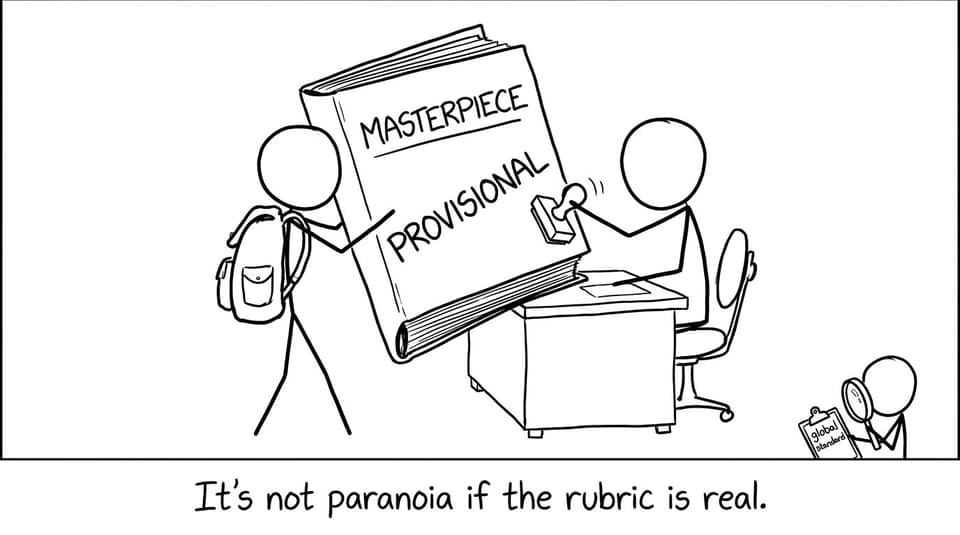
First, your teacher grades your IA using the official IB criteria. This is the mark that gets entered into the system, but it's not "immune." Think of it as a well-informed estimate.
At this stage, the biggest risk isn't that your teacher is "wrong." It's that their interpretation might be slightly different from the moderator's interpretation.
This is where student strategy starts to matter: the strongest IA is the one where your evidence clearly matches the descriptor language. The more your IA reads like the rubric, the less room there is for interpretation.
RevisionDojo makes this easier when you use the Coursework Library and Grading tools to check whether each criterion has visible, explicit evidence. If you're in a subject with a published guide, use the relevant IA guide hub to anchor your structure: IB Internal Assessment Guides.
School submission (marks + sample)
Your school submits all IA marks to the IB. Then the IB requests a sample of IAs representing the cohort range (high, middle, low). Students typically do not choose the sample.
A common misconception is: "Only sampled students can be affected."
In many cases, the opposite is true. If moderation triggers an adjustment, it often applies across the cohort.
So even if you're not sampled, IA moderation still matters to you.
External moderation (the sample is re-marked)
An IB-appointed moderator reviews the sample and decides whether the teacher's marking aligns with the standard.
Moderators are trained to apply the same criteria, but with a global reference point. They're not trying to rewrite your work. They're trying to answer: Were these marks justified?
This is why "it looks impressive" is not a safe strategy for an IA. Moderation responds to evidence.
In practice, moderators tend to reward:
- clear alignment to criterion requirements
- explicit method and justification (where relevant)
- precise analysis rather than long description
- honest evaluation (not performative confidence)
And they tend to penalize:
- missing explanation of choices
- claims without evidence
- unaddressed limitations
- writing that sounds polished but doesn't show thinking
Adjustment (how your IA mark can move)
If the moderator's marks are close to the teacher's marks, nothing changes.
If there's a consistent gap, the IB can apply an adjustment. Students usually experience this as: "Our whole class got moved up/down a little."
That adjustment can feel unfair if you thought your IA was "safe." But the logic is cohort-level fairness: if teacher marking is systematically lenient or strict, the IB corrects the scale.
If you want to understand this in context, see Who grades the IAs?.
The hidden skill: writing an IA that is hard to mis-mark
Here's a useful mindset shift: moderation doesn't punish creativity; it punishes ambiguity.
Ambiguity is when the reader has to guess whether you met the criterion.
A moderation-proof IA is built like a good map:
- it shows where you are going (aim / research question)
- it shows why you chose the route (justification)
- it documents what you did (method/process)
- it shows what happened (data/results)
- it explains what it means (analysis)
- it admits what could be wrong (evaluation)
This is why high scorers often look "simple" on first read. Their IA is not a magic trick. It's a clear argument with visible evidence.
RevisionDojo's AI Chat helps here in a practical way: you can paste a paragraph and ask, "Which criterion is this serving, and what evidence is missing?" That question alone saves students from writing pages that don't earn marks.
Common myths about IA moderation (that waste student energy)
Myth: "If my IA is sampled, I'm doomed."
Sampled work isn't selected because it's suspicious. It's selected because the IB needs a range to compare teacher judgement to the global standard.
If anything, being sampled can be neutral. The real risk is having an IA that depends on teacher generosity rather than rubric evidence.
Myth: "Moderation is random."
Moderation can feel unpredictable because students don't see the comparison process. But it's not random. It's a consistency check.
If you want to remove the feeling of randomness, use a rubric-driven workflow: draft, self-assess, get feedback, revise. RevisionDojo's Grading tools and Tutors support that loop so you don't rely on one last round of comments.
Myth: "My teacher's mark is final."
Your teacher's mark is the mark that gets submitted, but IA moderation exists specifically because teacher marking varies.
The practical takeaway isn't "panic." It's: write so that two different markers would land close to the same score.
What to do if you're worried about IA moderation
Worry becomes useful when it turns into action. Here's the action list that actually helps.
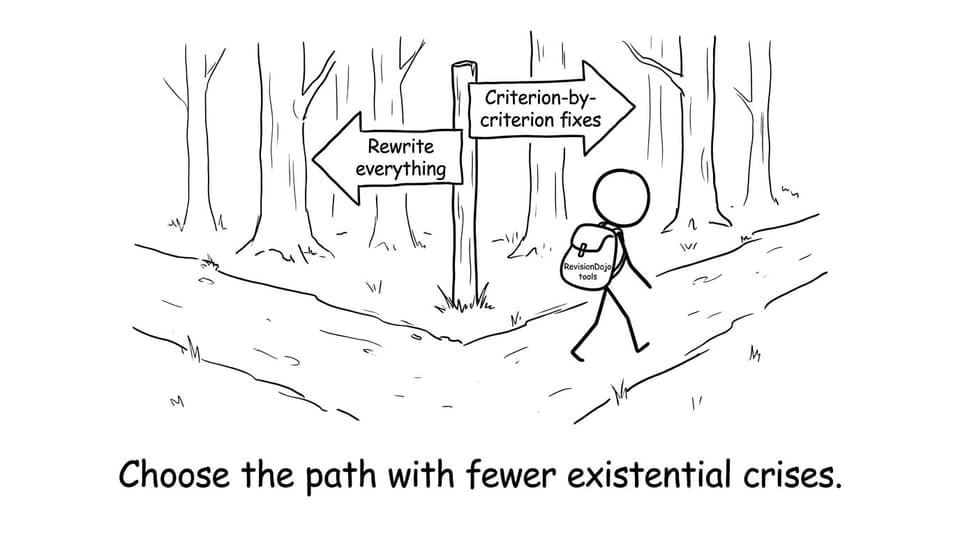
Build a criterion-by-criterion evidence table
Before your final submission, create a tiny table for yourself:
- Criterion A: what exact evidence shows I meet the top descriptor?
- Criterion B: where is that evidence located?
- What would a skeptic say is missing?
This is the difference between "I think it's good" and "I can prove it's good."
If you're unsure what strong evidence looks like in different subjects, compare formats using Comparing IA Expectations Across Different IB Subjects.
Use exemplars to copy structure, not content
The fastest way to learn what moderation rewards is to look at high-scoring work and notice how it earns marks.
RevisionDojo's Coursework Library is built for this. You can also browse subject exemplars like Chemistry IA Exemplars or IB ESS IA Exemplars.
The point is not to imitate someone else's topic. It's to learn patterns:
- how introductions create focus
- how method choices are justified
- how analysis is written with precision
- how evaluation is honest and specific
Run your own "mini-moderation" before submission
This is simple and powerful:
- Grade your IA against the rubric as if you were strict.
- Ask a friend to grade one criterion (only one) and explain why.
- Compare your interpretations.
If two students can't agree on what your paragraph is doing, a moderator might also struggle.
RevisionDojo's Grading tools accelerate this by giving rubric-aligned feedback quickly. For deeper iteration, the IB IA/EE/TOK Grader can highlight where your evidence is thin or where you've written "around" the criterion.
How IA moderation connects to exam prep (and why it matters now)
Most students treat the IA and exams like two separate lives.
But moderation teaches a transferable exam skill: writing for marks, not for vibes.
When you learn to:
- interpret criterion language
- prove claims with evidence
- evaluate limitations without collapsing
…you get better at structured responses and essays too.
This is why RevisionDojo is designed as one system, not scattered resources: Study Notes to learn, Flashcards to retain, Questionbank to apply, AI Chat to unblock, and Mock Exams plus Predicted Papers to simulate pressure. When coursework anxiety rises, Grading tools and the Coursework Library keep your IA moving so it doesn't steal your exam season.
If you want to build the full loop, start with RevisionDojo App: The Smarter Way to Prep for IB Exams.
Closing: treat IA moderation like a design constraint, not a threat
The students who suffer most from IA moderation are usually the ones who treated their IA like a personal project and hoped the rubric would "see it."
The students who gain confidence are the ones who treated their IA like a clear argument built for an unknown reader.
That's the point: IA moderation rewards clarity, evidence, and rubric alignment. If you build those into your IA early, moderation becomes boring. And boring is good.
If you want to make your next draft tougher, clearer, and faster to improve, use RevisionDojo as your control panel: learn the requirements with the IA guides, compare to Coursework Library exemplars, run quick checks with AI Chat, and tighten weak criteria with the Grading tools. Your IA will still be yours, but it will also be built to hold up when moderation arrives.