

RevisionDojo logoRevisionDojo logo
PricingSchools
  1. Home
  2. /Blog
  3. /IB Design Technology: Choosing a Strong IA Topic

IB Design Technology: Choosing a Strong IA Topic

IB Design Technology
RevisionDojo Team
•Last updated: 19 Jul 2026•8 min read
Jojo holding a cookie

This site uses cookie tracking technologies. Learn more in our Cookie Policy.

The moment your IA gets decided (before you build anything)

There’s a quiet moment in every IB Design Technology class where the room splits in two. One group starts sketching something impressive: a “smart” device, an ambitious mechanism, a product that looks like it belongs in a Kickstarter video. The other group does something less exciting but far more powerful: they write down a real person’s problem and how they’ll prove they solved it.

That second choice is where high scores usually begin in IB Design Technology. Not because examiners love “simple” projects, but because a good IA topic creates evidence. Evidence is what the rubric can reward.
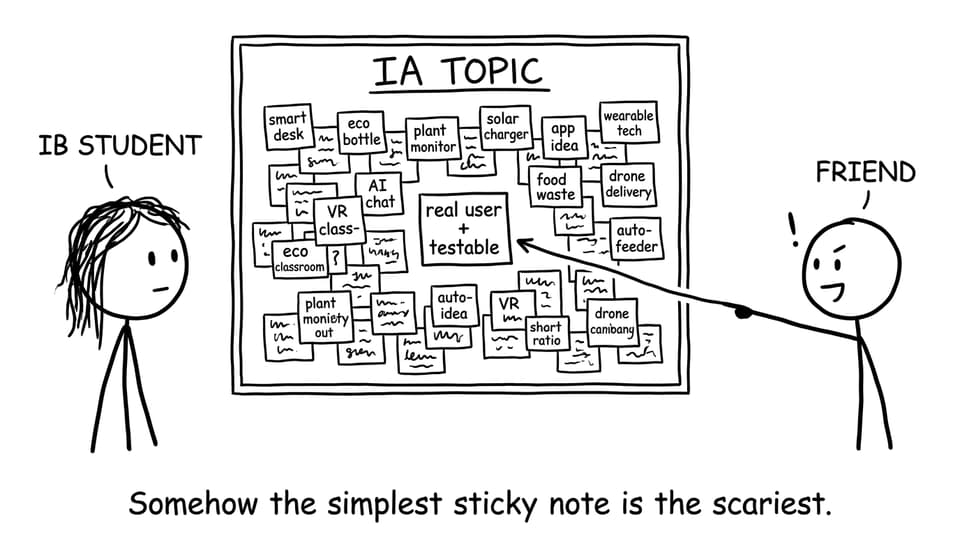
Sticky-note IA chaos

If you’re trying to choose an IA topic while also preparing for exams, your best strategy is to pick a topic that is clear, testable, and realistic. Then you can keep revision moving using the IB Design Technology hub and tools like Questionbank, Study Notes, Flashcards, AI Chat, and Mock Exams.

For your central home base, start here: IB Design Technology Resources.

IB Design Technology IA topic checklist (quick and ruthless)

Before you commit, run your idea through this fast checklist:

  • A specific user you can actually access

  • A single, ongoing problem (not five problems in a trench coat)

  • Evidence you can collect (observations, measurements, feedback)

Share on
Share on
Share on
4.6/5 from students worldwide
Share
Share on X
  • Clear tests tied to measurable design requirements

  • Time and tools you genuinely have

  • Iteration you can show without faking it

  • If you want a bigger picture of what top work looks like in IB Design Technology, compare your plan with: IB Design Technology IA Examples: What Top Projects Look Like.

    Start with the user problem, not the product

    The most common trap in IB Design Technology is starting with a product you feel like making.

    “Desk organiser.” “Smart bottle.” “Phone stand but cooler.”

    Those are objects, not design opportunities.

    A stronger start sounds like this:

    • “My user is a left-handed student who smears ink when writing quickly. Current solutions don’t fit their desk setup. I can test smudge reduction and comfort.”

    • “My user has limited grip strength. Existing jar openers require twisting force they can’t apply. I can measure torque needed before and after.”

    Notice what’s happening: the topic is already writing your evaluation section for you. That’s the hidden advantage in IB Design Technology: when the problem is well framed, your research, requirements, testing, and reflection become easier to justify.

    Need a reminder of what examiners actually reward? Read: How Is the IB Design Technology IA Graded?.

    Choose a user you can reach (and who will tell the truth)

    A “good user” in IB Design Technology is specific and available. Ideally, you can meet them multiple times, ask follow-up questions, and run real testing sessions.

    Good user options:

    • A family member with a repetitive daily task

    • A teacher with a classroom routine problem

    • A sports teammate with equipment frustration

    • A specific group with shared constraints (one club, one class, one workplace)

    Avoid vague users like “students” or “people who like fitness.” Vague users lead to vague requirements, and vague requirements lead to weak testing.
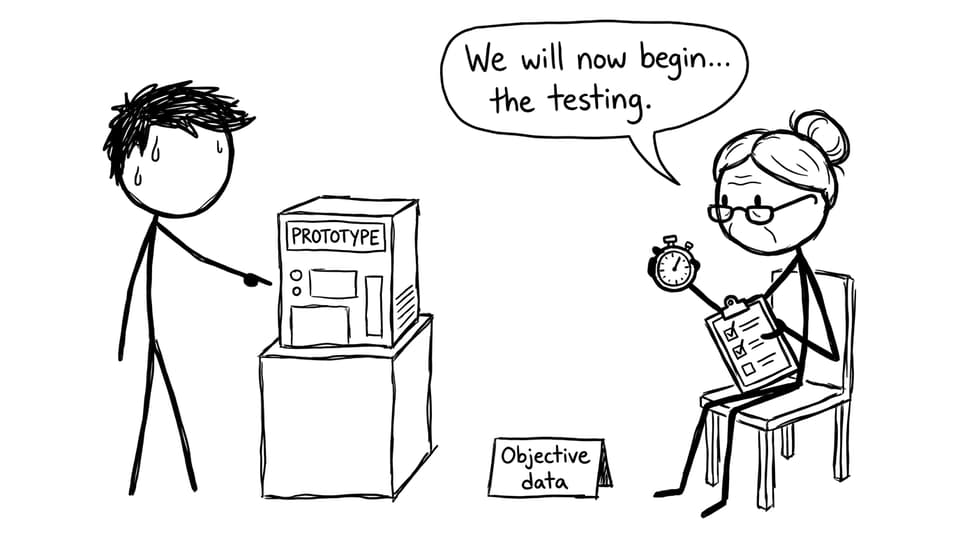
    User testing interrogation
    User testing interrogation

    If you want user-centred design ideas that connect cleanly to the syllabus, explore the newer DT map here: IB Design Technology (First Exam 2027) Resources.

    The best IB Design Technology topics are easy to test

    In IB Design Technology, “testable” beats “cool” almost every time.

    When you pick a topic, ask:

    • What would success look like in numbers?

    • What can I compare against (existing product, baseline measurement, before/after)?

    • Can my user repeat the test more than once?

    Examples of testable evidence:

    • Time to complete a task (seconds)

    • Force/tension/torque required (simple spring scale setups can work)

    • Accuracy (misalignment, spillage rate, error counts)

    • Comfort ratings with a consistent scale plus short interviews

    A topic that forces you into “It feels better” without structure is risky in IB Design Technology. You can still include user feelings, but anchor them to measurable design requirements.

    If you want to avoid the most common traps, keep this open while brainstorming: Most Common IB Design Technology IA Mistakes.

    Simplicity is not boring, it’s scalable

    A simple project gives you room to do the real work: iteration, testing, and honest evaluation. A complex project often steals that time.

    Think of IB Design Technology like this: the prototype is not the point. The decision-making is.
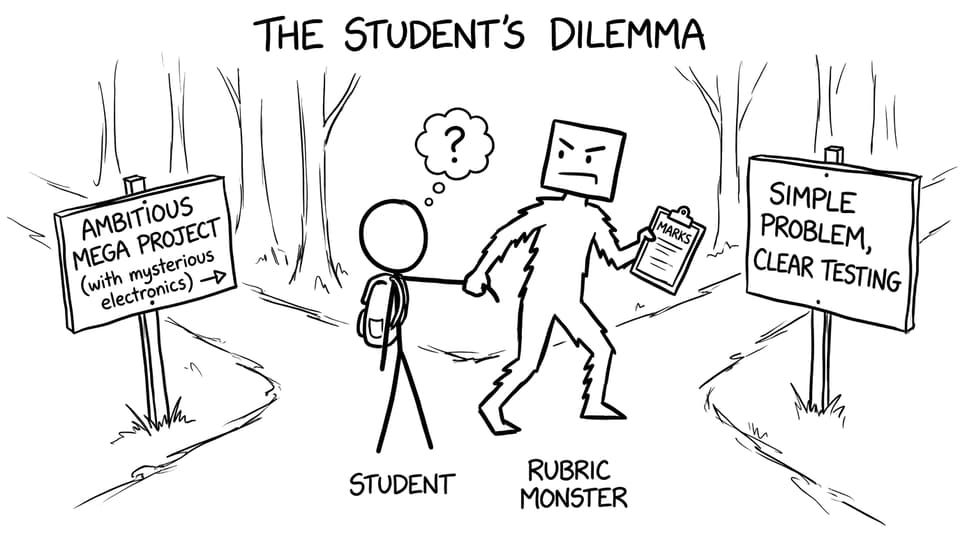
    Rubric monster chooses the simple path
    Rubric monster chooses the simple path

    If your topic requires advanced electronics or coding you don’t understand, your documentation becomes a story of guesswork. If your materials are hard to source, your timeline collapses. A “manageable” IA is usually the one that lets you show repeatable evidence.

    For planning and keeping the IA moving alongside exam revision, this guide helps: How to Use RevisionDojo for IB Design Technology Success.

    Use existing products as benchmarks, not templates

    You’re allowed to use existing products in IB Design Technology. In fact, it can strengthen your justification because you can show what already exists and why it fails your user.

    A strong approach:

    • Identify a specific weakness in the current solution

    • Link it to user data (quotes, observations, measurements)

    • Improve function or performance, not just appearance

    This also makes testing easier, because you can compare your solution against the benchmark product.

    A final way to choose: pick the topic that generates proof

    A good IB Design Technology IA topic doesn’t need to be flashy. It needs to be defendable. Choose a real user, define one clear problem, and build a solution you can test honestly.

    If you want an unfair advantage, use RevisionDojo as your workflow: start with the IB Design Technology Resources hub, pull in Study Notes, convert key terms into Flashcards, pressure-test your reasoning with AI Chat, and keep your writing aligned to the rubric using the grader tools like the Design Technology HL IA Grader. For finishing cleanly (without last-minute panic), bookmark: How to Finalise and Submit the IB Design Technology IA.
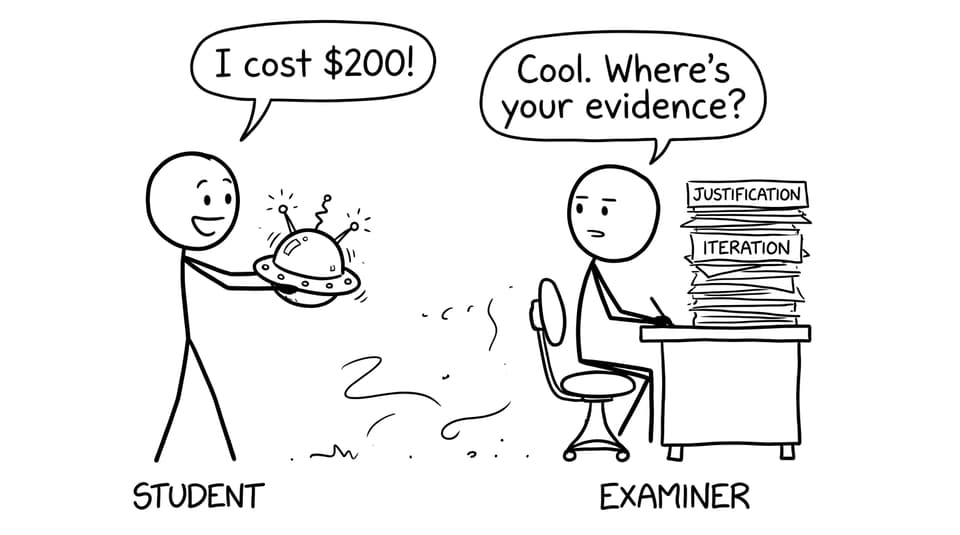
    Examiner wants evidence, not a shiny gadget
    Examiner wants evidence, not a shiny gadget
    How helpful was this article?
    Add as a preferred source on Google

    Continue studying with RevisionDojo

    • IB Coursework GraderCheck an IA, EE, or TOK draft against IB assessment criteria.
    • IB Coursework ExamplesLearn from high-scoring coursework across IB subjects.
    • IB Grade CalculatorEstimate an IB grade using session-specific boundaries.
    • IB Grade BoundariesExplore historical grade boundaries by subject and session.

    Frequently Asked Questions

    Join 650k+ students breezing through the IBReady to breeze through the IB?

    Footer

    General

    • For parents
    • For schools
    • Pricing
    • Gift RevisionDojo
    • Tutoring
    • IB syllabus
    • MYP syllabus
    • Blog
    • Research

    Features

    • Jojo AI
    • Questionbank
    • Notes
    • Flashcards
    • Test builder
    • Exam mode
    • Coursework
    • Coursework grader
    • Coursework examples
    • Predicted papers
    • IB grade calculator
    • Grade boundaries

    Research

    • State of learning survey
    • IB Moderation Analysis
    • Jojo AI vs ChatGPT
    • Jojo AI vs Gemini
    • Jojo AI vs Perplexity
    • Jojo AI vs Claude
    • Jojo AI vs Poe

    Platform

    • RevisionDojo vs Others
    • Content philosophy
    • Trustpilot
    • Join usWe're hiring
    • Terms and conditions
    • Privacy policy
    • Cookie policy
    • Trust Center

    MYP Subjects

    • MYP Biology
    • MYP Chemistry
    • MYP English Lang & Lit
    • MYP Extended Mathematics
    • MYP History
    • MYP Individuals & Societies
    • MYP Physics
    • MYP Standard Mathematics
    • MYP Biology
    • MYP Chemistry
    • MYP English Lang & Lit
    RevisionDojo logo

    © 2022 - 2026 RevisionDojo (MyDojo Inc)

    RevisionDojo was developed independently of the IBO and as such is not endorsed by it in any way.

    IB Design Technology · 4

    What Extra Topics Are Covered in IB Design Technology HL?

    Learn what extra topics IB Design Technology HL students study, how HL content is deeper than SL, and what this means for exams and coursework.

    IB Design Technology · 7

    IB Design Technology IA: How to Show Real Iteration

    IB Design Technology iteration made simple: learn what counts, where to show it in your IA, and how to document changes for higher marks.

    WhatsApp
    LinkedIn
    Facebook
    IB Design Technology · 8 min read

    IB Design Technology Problem Statement: Write It Strong

    IB Design Technology problem statement guide: learn the user-first formula, avoid solution language, add evidence, and set up high-scoring IA work.

    IB Design Technology · 8 min read

    IB Design Technology IA Referencing: A Simple Guide

    IB Design Technology IA referencing made simple: what to cite, how to format in-text citations, and how to avoid plagiarism with consistent sources.

    IB Design Technology · 7 min read

    IB Design Technology Without Creativity: Can You Still Excel?

    IB Design Technology success isn’t about being artistic. Learn what examiners reward, how to score higher, and how RevisionDojo helps.

    IB Design Technology · 7 min read

    Common IB Design Technology Exam Mistakes (and Fixes)

    IB Design Technology exam mistakes are predictable. Learn the most common errors and quick fixes for command terms, evaluation, timing, and structure.

    Related Articles
    min read
    min read
  • MYP Extended Mathematics
    • MYP History
    • MYP Individuals & Societies
    • MYP Physics
    • MYP Standard Mathematics

    IB Subjects

    • Arabic ab initio
    • Arabic B
    • Biology
    • Business Management
    • Chemistry
    • Chinese A Lang & Lit
    • Chinese B
    • Computer Science (CS)
    • Computer Science (First Exam 2027)
    • Design Technology (DT)
    • Design Technology (First Exam 2027)
    • Digital Society (DS)
    • Economics
    • English A Lang & Lit
    • English A Lit
    • English B
    • Environmental systems and societies (ESS)
    • French A
    • French ab initio
    • French B
    • Geography
    • German A
    • German ab initio
    • German B
    • Global Politics
    • History
    • Mathematics Analysis and Approaches (AA)
    • Mathematics Applications & Interpretation (AI)
    • Philosophy
    • Physics
    • Psychology
    • Psychology (First Exam 2027)
    • Arabic ab initio
    • Arabic B
    • Biology
    • Business Management
    • Chemistry
    • Chinese A Lang & Lit
    • Chinese B
    • Computer Science (CS)
    • Computer Science (First Exam 2027)
    • Design Technology (DT)
    • Design Technology (First Exam 2027)
    • Digital Society (DS)
    GDPR compliant
    Download on the App Store
  • Spanish A
  • Spanish ab initio
  • Spanish B
  • Sports, exercise and health science (SEHS)
  • Theory of Knowledge (TOK)
  • Economics
  • English A Lang & Lit
  • English A Lit
  • English B
  • Environmental systems and societies (ESS)
  • French A
  • French ab initio
  • French B
    • Geography
    • German A
    • German ab initio
    • German B
    • Global Politics
    • History
    • Mathematics Analysis and Approaches (AA)
    • Mathematics Applications & Interpretation (AI)
    • Philosophy
    • Physics
    • Psychology
    • Psychology (First Exam 2027)
    • Spanish A
    • Spanish ab initio
    • Spanish B
    • Sports, exercise and health science (SEHS)
    • Theory of Knowledge (TOK)