

A week into the IA, it happens: your browser has 27 tabs, your notes app looks like a novel, and your “background research” folder has become a museum of PDFs you will never open again.
If you’re doing IB Design Technology, you’ve probably asked the same anxious question every cohort asks: how much research do I need in the IA?
The calm answer is also the most useful one: in IB Design Technology, research is not rewarded for volume. It’s rewarded for what it does to your decisions.
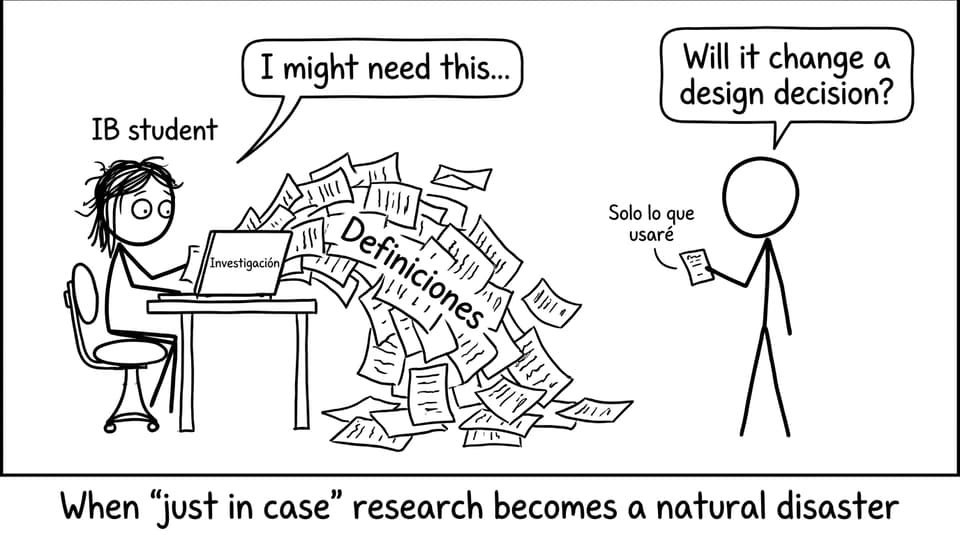
The 30-second rule: research only counts if it changes something
In a strong IB Design Technology IA, research is a tool. It is not a literature review.
A simple test:
-
If a research point leads to a design requirement, keep it.
-
If it leads to a material choice, keep it.
-
If it leads to a clear change during iteration, keep it.
-
If it sits there “just in case,” it’s probably costing you clarity.
This aligns with how marking actually works. Your project needs evidence of thinking, not evidence of scrolling.
If you’re still orienting yourself, start with RevisionDojo’s IB Design Technology hub for a clear map of the syllabus and design cycle language.
A practical checklist: what “enough research” looks like
“Enough” is the point where your research:
-
Defines a specific user and a measurable need
-
Explains the context of the problem in a focused way
-
Compares existing solutions and extracts weaknesses worth solving
-
Produces design requirements you can test later
-
Gets referenced again during ideation, prototyping, and evaluation
Notice what’s missing: a target number of pages, sources, or diagrams.
For topic framing, the guide How to Choose a Strong IB Design Technology IA Topic helps you narrow the problem so your research stays tight.
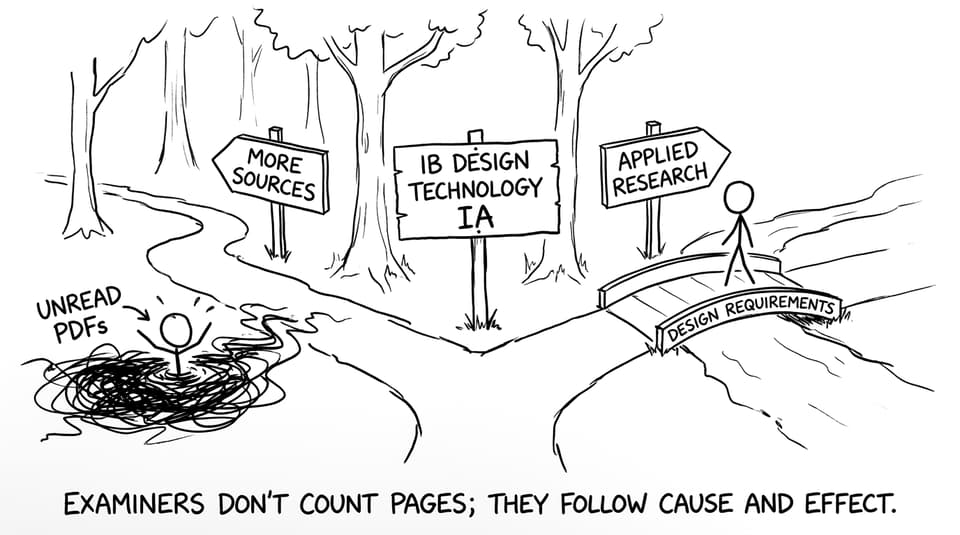
What high-quality IB Design Technology research actually is
High-quality IB Design Technology research has three traits: relevant, specific, applied.
Relevant: it answers the real problem
A page explaining generic sustainability is weak if your product choices never mention carbon footprint, lifecycle, or disposal. Research must match your problem, not the textbook’s.
If your project foundation is shaky, fix that first with What Is the Best Way to Start the IB Design Technology IA?.
Specific: it focuses on your user, not “people”
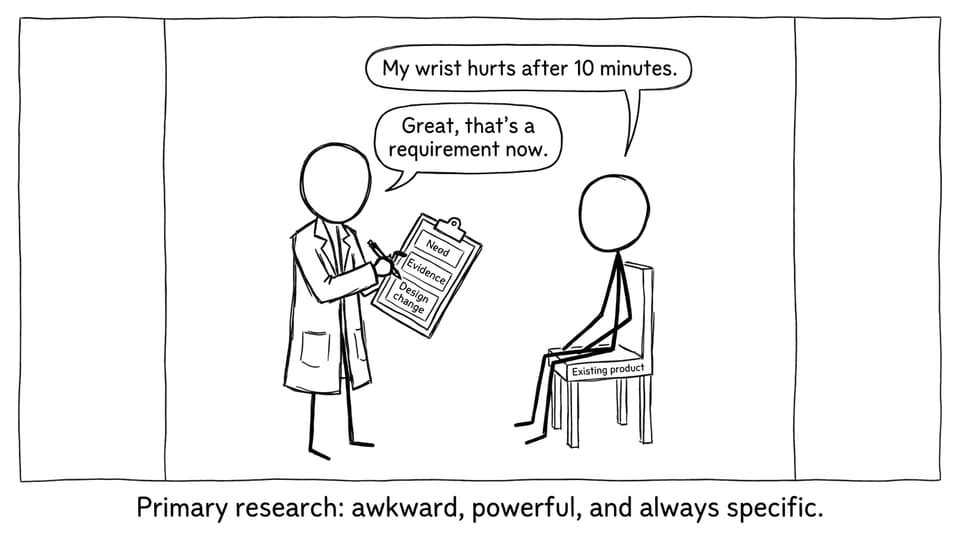
The strongest research often comes from primary methods: interviews, questionnaires, observation, quick field tests. It can feel awkward, but it gives you leverage. A real user statement becomes a requirement you can defend.
Applied: it visibly drives decisions
Applied research leaves a trail: finding -- requirement -- design choice -- test -- iteration.
A good way to build this trail is to create a small “evidence table” in your process notes:
-
Finding: user reports wrist pain after 10 minutes
-
Implication: reduce wrist extension angle
-
Requirement: handle angle between X and Y degrees
-
Design choice: angled grip + softer interface
-
Test: comfort rating + angle measurement
That is research doing work.
What to cut: research that inflates pages but shrinks marks
In IB Design Technology, low-value research often looks “academic” but performs poorly:
-
Long definitions copied from a textbook
-
Generic explanations of ergonomics, sustainability, or manufacturing with no link to your product
-
Technical theory you never mention again
-
Repeated points written in slightly different wording
If you want a fast way to spot bloat, open your draft and highlight every sentence you never reference later. That highlighted text is usually what needs trimming.
For a broader cleanup mindset, see How Do You Finalise and Submit the IB Design Technology IA?.
The easiest way to prove research value: tie it to requirements
Design requirements are where research becomes visible to the examiner.
Examples:
-
User interview -- “strap digs into shoulder” -- comfort/pressure requirement
-
Existing product teardown -- buckle slips under load -- durability requirement
-
Material investigation -- absorbs water -- moisture resistance requirement
When you do this consistently, your IA becomes shorter, clearer, and easier to mark.
If you’re unsure how teachers interpret evidence, How Do Teachers Mark IB Design Technology Internal Assessments? explains what actually earns credit.
Where RevisionDojo fits (especially during exam season)
One underrated advantage of doing research properly in IB Design Technology is that it improves exam performance. You practice justification, trade-offs, and evaluation -- the same thinking exam questions reward.
RevisionDojo makes that connection easier:
-
Use the Questionbank to practice decision-based DT questions with feedback
-
Reinforce theory with Study Notes and Flashcards inside the DT hub
-
Pressure-test your rationale with AI Chat (and tighten vague claims)
-
Use Grading tools to spot weak justification before your teacher does
-
Train timing with Mock Exams and Predicted Papers
-
If you need exemplars, the Coursework Library and Tutors help you sanity-check structure without adding fluff
To balance IA work with exams, How Do You Balance the IA and Exams in IB Design Technology? is a strong companion read.
The real answer: do less research, but make it unavoidable
The goal in IB Design Technology is not to prove you can collect information. It’s to prove you can use information to design, justify, and improve.
So ask the examiner’s silent question as you work: “What changed because you learned this?” If you can answer it, your research is enough.
When you’re ready to tighten your IA and prepare for exams at the same time, start in RevisionDojo’s IB Design Technology resources and use the Questionbank, notes, flashcards, AI Chat, and marking support to turn research into marks -- not pages.