In a tall tree, water climbs farther than most elevators ever will. No heart. No pump. Just physics, quietly working in plant tissue while you walk past it on the way to class.
For IB Biology, that quiet miracle is a reliable exam favorite: adhesion helps water stick to xylem walls, enabling capillary action and stabilizing the water column so transpiration can do the heavy lifting.
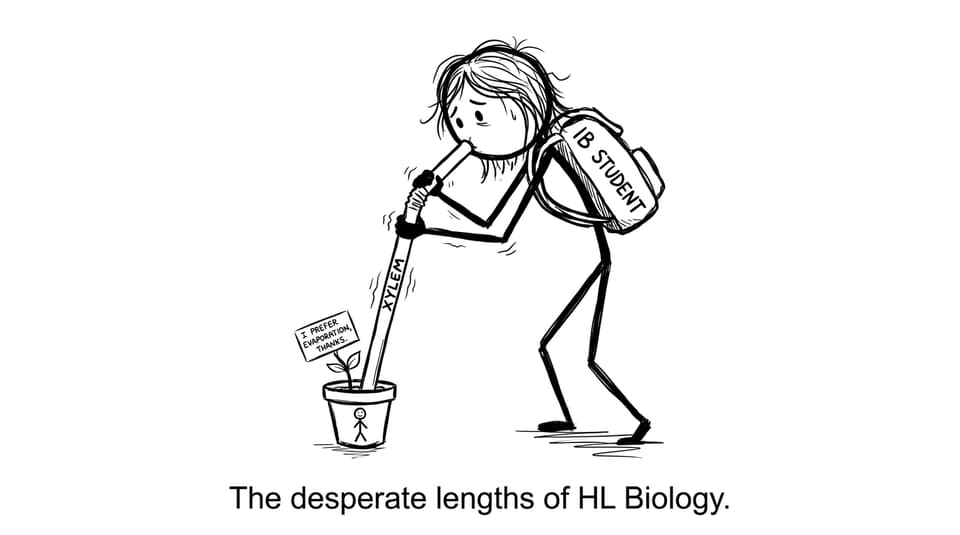
IB Biology snapshot: what to remember
Use this checklist when you revise IB Biology plant transport:
-
Adhesion = attraction between water and polar/charged surfaces (like cellulose in xylem walls).
-
Cohesion = attraction between water molecules via hydrogen bonding.
-
Capillary action = water rises in narrow spaces due to adhesion + cohesion.
-
Capillary action supports transport, but in tall plants it mainly stabilizes the column while transpiration pull drives long-distance flow.
-
Adhesion also matters in soil, helping water cling to particles so roots can access it.
If you want the syllabus-aligned wording, keep the definitions tight using the IB Biology Key Definitions glossary.
How adhesion enables capillary action in plants
Picture the xylem as a long series of microscopic tubes. In IB Biology, the key detail is that xylem walls are hydrophilic because of materials like cellulose (and lignin strengthening). When water enters these narrow vessels, adhesion causes water molecules to cling to the vessel walls.
That sticking matters because it creates a thin film of water that resists slipping downward under gravity. In narrow tubes, a large proportion of water molecules are close to the wall, so adhesive forces have a bigger influence. This is why capillary rise is more noticeable in thinner tubes.
For a deeper dive into how the curriculum frames this, RevisionDojo’s note on Adhesion of water to polar or charged materials matches the exam phrasing well.
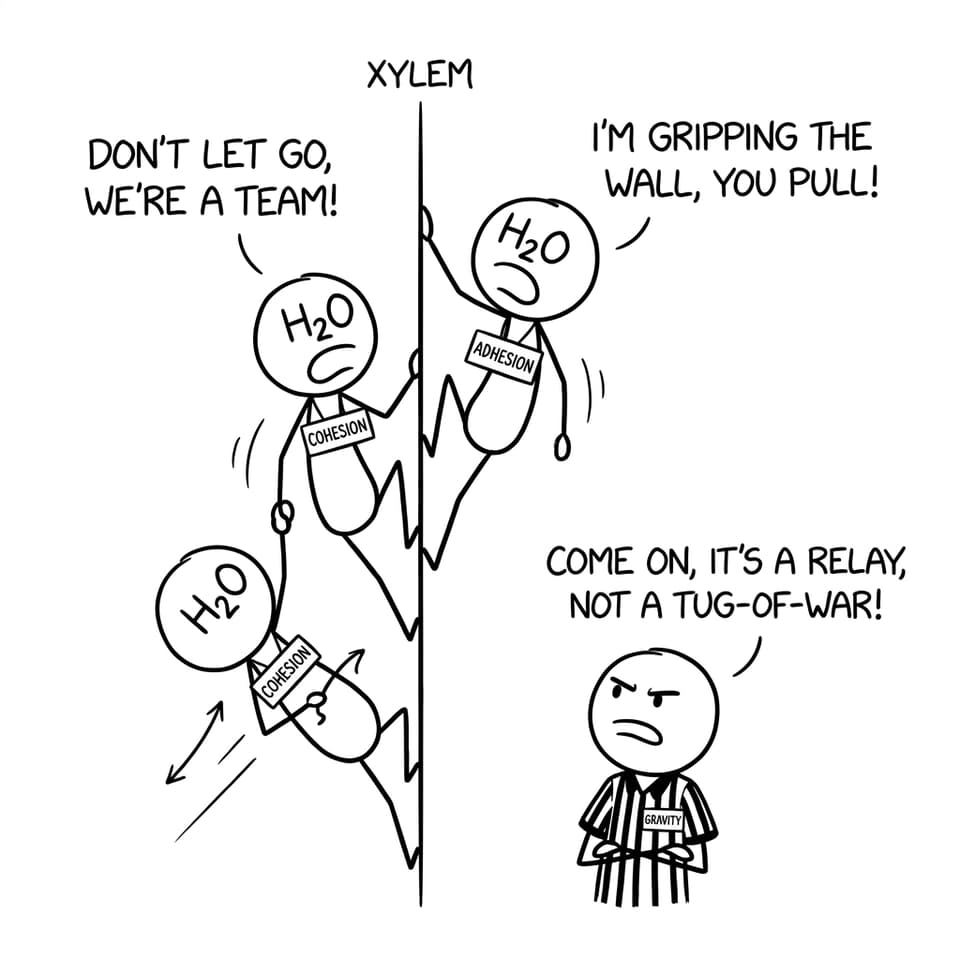
Adhesion + cohesion: the teamwork behind the water column
Capillary action is not a solo act in IB Biology. Adhesion gets the story started by holding water against the xylem wall, but cohesion makes the movement continuous. Because water molecules hydrogen-bond to each other, when one section shifts upward, it can pull neighboring molecules along.
This is why the xylem functions like a connected column rather than isolated droplets. You can reinforce this connection by revising hydrogen bonding first: see How hydrogen bonds form in water and the core water properties in 2.2 Water notes.
In an exam response, you can often earn marks by explicitly linking: hydrogen bonding, then cohesion/adhesion, then capillary action, and finally stabilized transpiration stream.
Why capillary action helps (but transpiration does the heavy lifting)
A common trap in IB Biology is claiming capillary action alone pulls water to the top of tall trees. It helps, but it is not usually strong enough by itself over long distances.
Instead, think of capillary action as the mechanism that makes the xylem column more stable and less likely to detach from the wall. That stability matters because the main driver is transpiration pull: water evaporates from leaf surfaces, creating negative pressure (tension) that draws water upward.
To revise the full pathway, connect this article to:
Adhesion in soil: the quiet bonus point
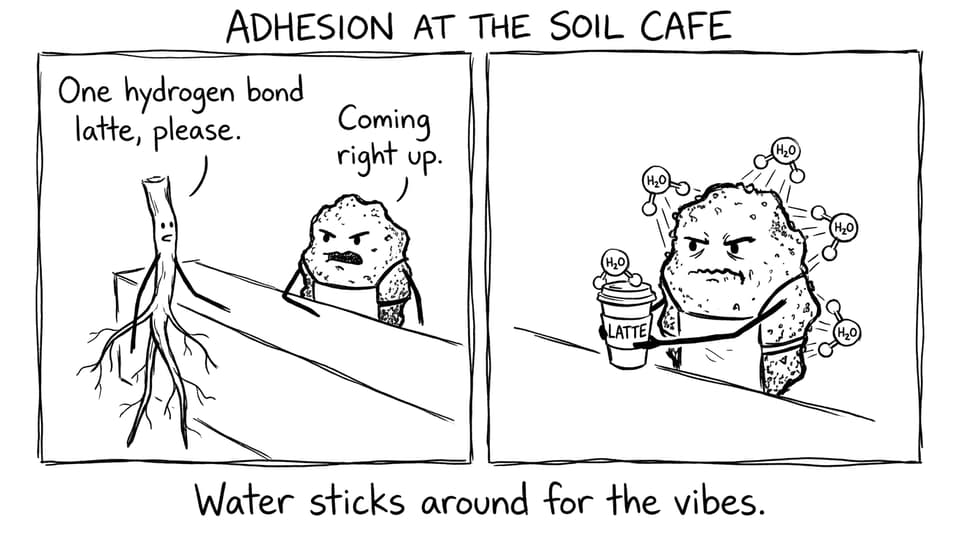
Adhesion is not only an “inside the plant” idea in IB Biology. Water also adheres to soil particles, especially in fine-textured soils with small pores and lots of surface area. That adhesive hold helps retain moisture and influences how easily water is available to roots.
This is a great place to add one crisp sentence in longer answers: adhesion to soil particles helps keep water accessible in pores, especially when conditions are dry.
Quick exam-answer template (IB Biology)
If you need a fast, mark-friendly structure:
-
Define adhesion (water sticks to polar/charged surfaces).
-
Apply to xylem (water adheres to hydrophilic vessel walls).
-
Link to capillary action (water rises in narrow tubes).
-
Add cohesion (water molecules stick together, forming a column).
-
Finish with transpiration (evaporation creates tension; adhesion helps prevent the column slipping).
Then test yourself with exam-style practice in the A1.1 Water Questionbank or the 9.1 Transport in the xylem Questionbank.
Bring it home with RevisionDojo
The best IB Biology answers feel calm because they are structured: define, apply, link, conclude. RevisionDojo is built to help you do that on repeat with Study Notes, Flashcards, AI Chat, and mark-focused Grading tools that show you what examiners reward. When you are ready to go beyond understanding and into scoring, use the Questionbank, Mock Exams, Predicted Papers, and the Tutors feature to close gaps fast. Adhesion and capillary action might be “small” forces, but in IB Biology they often decide the difference between a vague answer and a top-mark one.

