


Water climbing a tree feels like a magic trick. No pump. No heart. Just a silent column of liquid rising meters into the air because a leaf is losing moisture to the atmosphere.
That surprise is exactly why IB Biology keeps coming back to xylem transport. It is one of the cleanest examples of how microscopic forces (hydrogen bonds) scale up into a macroscopic outcome (a tall plant staying alive). If you can explain it clearly, you are not just memorising a definition; you are thinking like the examiner.
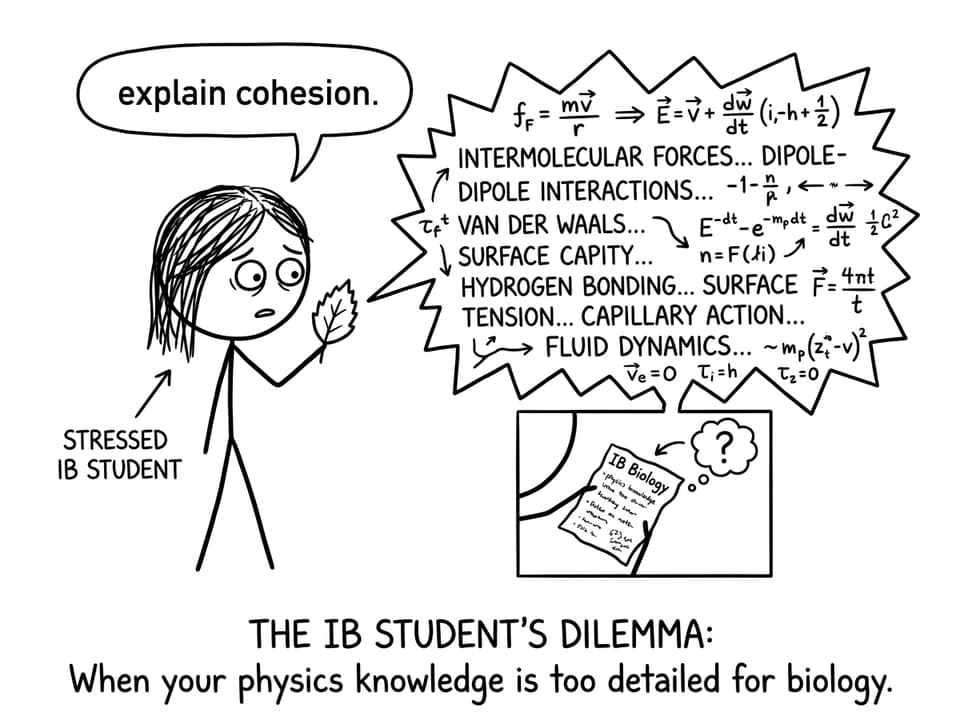
The exam checklist (what you must say)
Use this mini-checklist whenever you answer a xylem question in IB Biology:
-
Cohesion = attraction between water molecules due to hydrogen bonding.
-
Transpiration (evaporation from leaves) creates tension (negative pressure) at the top of the xylem.
-
Because of cohesion, tension is transmitted down an unbroken column of water in xylem.
-
Adhesion helps water stick to hydrophilic xylem walls, supporting the column against gravity.
-
Xylem adaptations (narrow tubes, lignified walls, dead hollow cells) reduce resistance and prevent collapse.
-
Breaks in the column can cause cavitation/embolism.
To consolidate the wording, keep the RevisionDojo notes open while you practise: 9.1 Transport in the xylem of plants Notes.
Cohesion in xylem: the quiet force doing the heavy lifting
Cohesion is not a “plant idea” at all. It is a water idea.
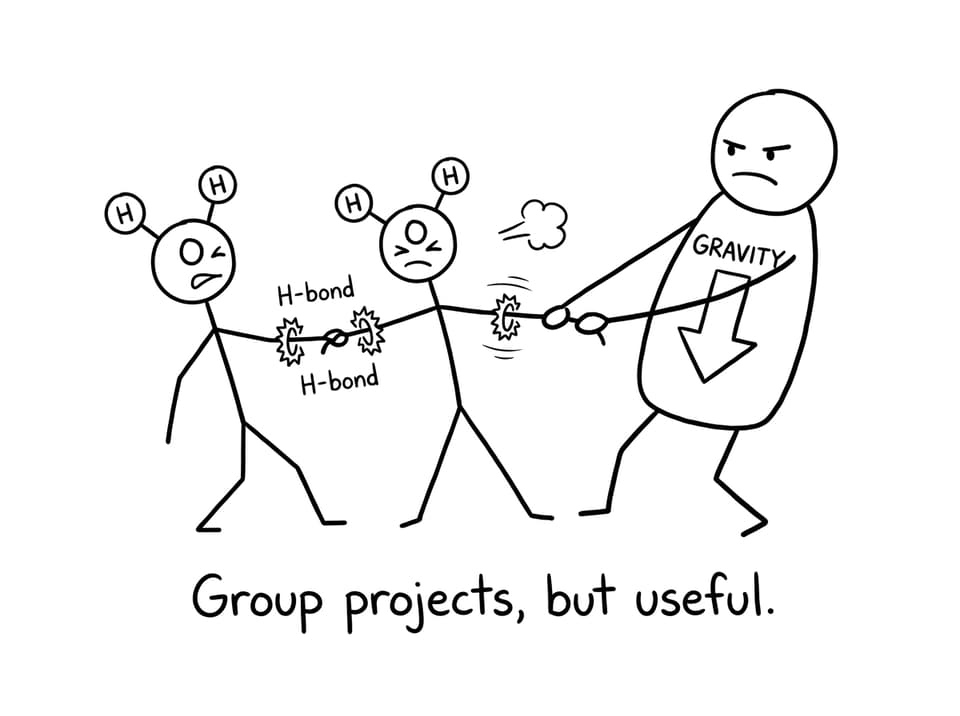
Water molecules are polar, which lets them form hydrogen bonds with nearby molecules. Each individual hydrogen bond is weak, but a huge number of them creates a collective grip. In xylem, that grip matters because the water does not move as isolated droplets; it moves as a continuous column.
Here is the key IB Biology sentence to keep in your pocket:
Transpiration creates tension at the leaf, and cohesion transmits that tension down the xylem so the whole water column is pulled upward as one.
That is the cohesion-tension model in one breath.
How transpiration creates the pull (tension) in IB Biology terms
Picture the leaf as the start of the chain reaction.
Water evaporates from moist cell walls in the leaf (and exits via stomata). When molecules leave, the remaining water film becomes “stretched.” This creates negative pressure at the top of the xylem. Plants are not pushing water up from below most of the time; they are pulling it from above.
If you want a clean sequence for your response, borrow the structure from RevisionDojo’s transport explanations: B3.2.7 Transport of water from roots to leaves during transpiration.
In an exam, it helps to use linking words:
-
“As water evaporates…”
-
“This produces tension…”
-
“Due to cohesion…”
-
“Therefore water is pulled…”
That logical chain reads like marking points.
Why xylem structure makes cohesion work (and prevents collapse)
The cohesion story is stronger when you tie it to xylem anatomy.
Xylem vessels are long tubes formed from dead cells with hollow interiors, so water flows with minimal resistance. Their walls are thickened with lignin, giving strength to resist the inward pull of negative pressure.
Two details matter a lot for IB Biology marks:
-
Narrow diameter: narrower tubes reduce the chance of the water column snapping (and strengthen capillary effects).
-
Lignified walls: prevent the vessel collapsing under tension.
For crisp wording and examples, see: Adaptations of Xylem Vessels for Transport of Water Notes.
Cohesion vs adhesion (the common confusion)
Students often mix these up under time pressure.
-
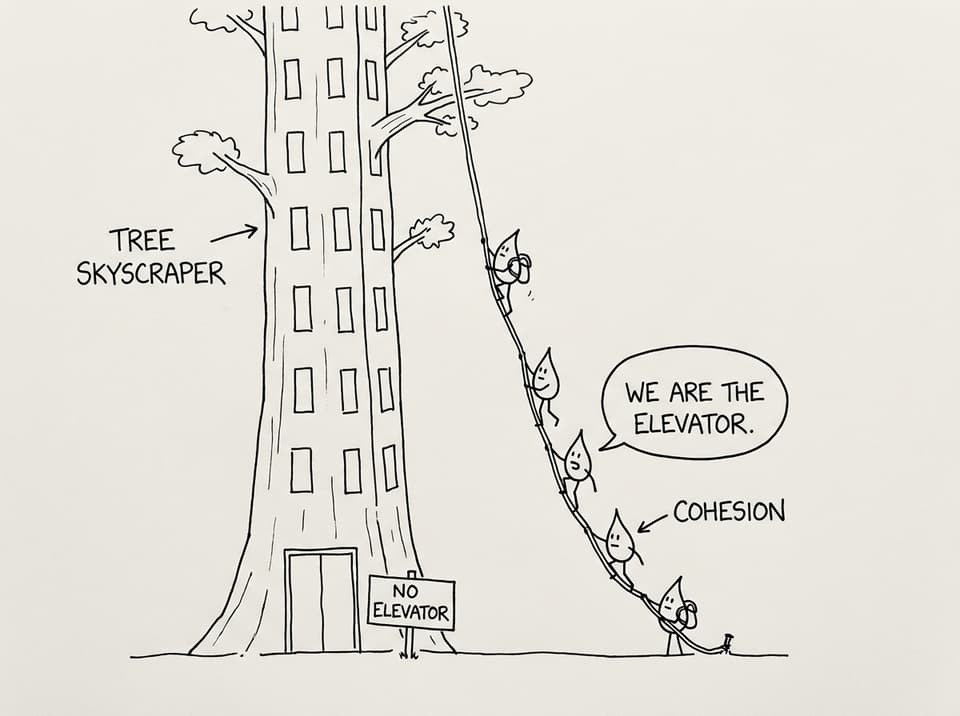
Cohesion keeps water molecules attached to each other, maintaining an unbroken column.
-
Adhesion helps water molecules stick to the xylem walls (cellulose is hydrophilic), supporting the column and reducing the effect of gravity.
A useful way to phrase it in IB Biology:
Cohesion transmits the pull; adhesion stabilises the column.
Cavitation: what happens when cohesion fails
Cohesion is powerful, but it is not invincible.
If an air bubble forms (for example, during drought or freezing), the continuous water column can break. This is cavitation, and it blocks transport in that vessel. Plants limit damage by having multiple vessels, pits between vessels, and structural features that reduce spread.
If you want to test whether you can spot cavitation in question wording, practise with: 9.1 Transport in the xylem of plants Questionbank.
Quick ways to study this on RevisionDojo
If xylem transport feels “obvious” when you read it but slippery when you write it, use tools that force retrieval.
-
Use the Study Notes for a clean model answer: IB Biology Topic B3.2 Transport
-
Drill definitions with Flashcards: Flashcards for B3.2 Transport
-
Build timing and accuracy with the Questionbank (plus explanations and feedback): B3.2 Transport Questionbank
-
When you want targeted help, use RevisionDojo’s AI Chat to ask, “Mark this explanation of cohesion-tension using IB criteria,” then rewrite.
-
Closer to exams, use Mock Exams, Predicted Papers, and Grading tools to make your explanations consistent under pressure.
Conclusion: turn cohesion into easy marks
Cohesion is small-scale chemistry with big consequences: hydrogen bonds turn water into a rope that a leaf can pull. In IB Biology, that is the heart of how cohesion moves water through xylem: transpiration creates tension, cohesion transmits it, adhesion stabilises it, and xylem structure makes it reliable.
If you want this to become automatic, revise it the way you will be assessed: practise short explanations, self-mark, then repeat. Start with the 9.1 xylem notes, reinforce with B3.2 flashcards, and pressure-test with the xylem Questionbank. RevisionDojo’s Questionbank, Study Notes, Flashcards, AI Chat, Grading tools, Predicted Papers, Mock Exams, Coursework Library, and Tutors are built for exactly this kind of exam-ready clarity.