



The first term IB Social and Cultural Anthropology experience usually begins with a strange discovery: familiar life is much less obvious than it looks.
Your first term will probably combine anthropological vocabulary, ethnographic reading, analytical writing, research methods, ethics, and early observation work. You are not simply learning facts about societies. You are learning to question assumptions, interpret evidence, and compare perspectives without reducing people to stereotypes.
Schools organise the syllabus differently, so no weekly sequence is universal. Most students, however, move through a recognisable arc: learning anthropological language, encountering an ethnography, practising analysis, and discovering how research methods shape what can responsibly be claimed.
Your first-term overview
By the end of a typical term, expect to have:
- learned concepts such as culture, identity, power, symbolism, social relations, and change
- discussed cultural relativism, reflexivity, positionality, and representation
- read substantial sections of an ethnographic work
- practised using specific evidence in short responses
- explored observation, interviews, ethics, and researcher bias
- completed or planned an early fieldwork-related activity
The IB Social and Cultural Anthropology resource hub can help you connect these strands instead of treating every lesson as an isolated topic.
What first-term pacing usually looks like
Concepts, ethnography, methods, and writing tend to overlap rather than appearing in tidy blocks.
| Approximate stage | What you may study | What the work feels like |
|---|---|---|
| Weeks 1-3 | Culture, perspective, comparison, relativism, reflexivity | Discussion-heavy, with unfamiliar terminology |
| Weeks 4-7 | A first ethnography, methods, ethics, positionality | More reading and evidence-based paragraphs |
| Weeks 8-11 | Concepts applied to an area of inquiry | Comparisons, planning, and source analysis |
| Weeks 12 onward | Consolidation and fieldwork development | Longer responses and assessment-style practice |
Learning to make the familiar strange
Anthropology can initially sound like a wall of abstract nouns. Culture. Identity. Materiality. Power. Each word seems understandable until the class tries to apply it precisely.
Keep a concept notebook with four elements:
- a concise working definition
- one classroom example
- one ethnographic example
- one limitation or unresolved question
Use RevisionDojo's IB resources and Study Notes to clarify distinctions, then turn them into Flashcards. The goal is not to reproduce a perfect dictionary sentence. It is to recognise when a concept illuminates evidence.
Your first ethnography changes the workload
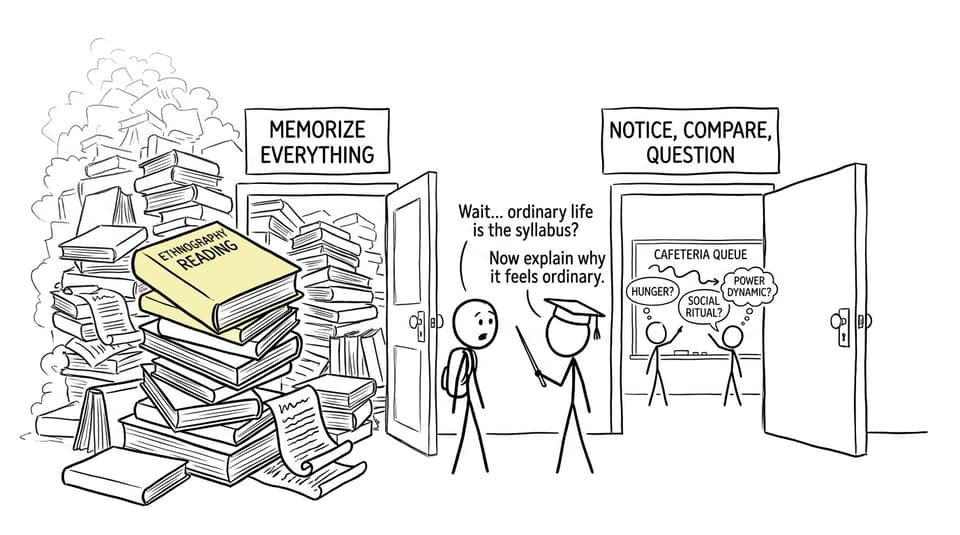
The first serious ethnographic reading is often where IB Social and Cultural Anthropology first term expectations become real. Ethnography may combine narrative, dialogue, history, theory, observation, and the anthropologist's reflections. Reading it only like a novel leaves you with impressions. Reading it like a glossary leaves you with disconnected details.
After each assigned section, record:
- what happened and in what context
- whose perspective is represented
- which method produced the information
- which concept helps interpret the evidence
- what the anthropologist may have overlooked
- how the material connects to a wider issue
This prevents the end-of-term problem of remembering the general story without retaining usable evidence. A modest assignment can create 1-2 hours of work once annotation and consolidation are included, although the precise load depends on the text, level, teacher, and your reading speed.
RevisionDojo's Social and Cultural Anthropology coursework examples demonstrate how academic work can move from evidence to interpretation. Study their structure and reasoning, never their wording.
What surprises new students most
Description is not analysis
“People sat in separate groups in the cafeteria” is an observation. Anthropology begins when you ask how those groups formed, what belonging means within them, which boundaries are visible, and whether your interpretation is justified.
A useful paragraph sequence is:
- Make a focused claim.
- Present precise ethnographic or observational evidence.
- Apply an anthropological concept.
- Explain what the evidence suggests.
- Acknowledge another interpretation or limitation.
Anthropological confidence is not the same as certainty. Strong conclusions remain proportionate to the evidence.
Your position affects what you notice
Research methods are not only technical procedures. They are relationships. Your age, language, social role, familiarity with a setting, and perceived authority can influence access and behaviour. Reflexivity means examining that influence rather than pretending the observer is invisible.
Discussion also does not mean anything goes. “That is just their culture” is rarely an adequate explanation. Strong responses identify evidence, context, variation within a group, relevant concepts, and the limits of generalisation.
Early fieldwork and ethics
An observation task may sound simple: choose a setting, watch carefully, and record what happens. In practice, you must consider permission, privacy, vulnerability, confidentiality, disruption, and how your presence affects the setting.
Before collecting information, ask:
- Is the setting appropriate and approved by my teacher?
- Could anyone be identified or harmed?
- What assumptions am I bringing to the observation?
- What exactly will I record?
- Where does description end and interpretation begin?
- What can this small sample not establish?
Do not conduct covert, risky, or intrusive research. Teacher guidance and applicable IB ethical expectations take priority over an interesting idea. RevisionDojo's guide to research skills for IB coursework offers a framework for narrowing questions, organising evidence, and recording limitations. The IB Coursework Guides collection can provide further support as your project develops.
A realistic weekly workload
For many students, a sustainable anthropology routine outside lessons is around 2-4 focused hours during an ordinary week. Assessments or fieldwork preparation may require more.
A balanced week might include:
- 45-60 minutes of ethnographic reading
- 20 minutes of concept review
- 30-45 minutes organising evidence notes
- 30 minutes planning or writing an analytical response
- additional fieldwork time when assigned
Avoid saving everything for one long weekend session. Anthropology depends on connections, and those connections become easier to see when you revisit material regularly.
A practical RevisionDojo loop is to learn through Study Notes, retain terms with Flashcards, practise application in the Questionbank, and use AI Chat when two concepts seem difficult to separate. The platform's complete IB study features also include Grading tools, Predicted Papers, Mock Exams, a Coursework Library, and Tutors. You will not need every tool immediately, but one consistent system reduces the friction created by scattered resources.
How to recognise progress
First-term improvement is often quieter than a test score. You are progressing if your questions become more precise, your notes preserve usable evidence, and your paragraphs move beyond description.
By the end of term, check whether you can explain a concept in your own words, connect it to a specific ethnographic moment, identify how evidence was collected, discuss a limitation, and compare interpretations. Later, these IB mock exam strategies can help turn knowledge into controlled performance.
The term is training your attention
The first term does not make you an anthropologist. It changes what you notice.
You begin to see that behaviour has context, categories have histories, and apparently natural arrangements may be sustained by symbols, institutions, and unequal power. You also learn restraint. A small observation cannot explain an entire society, and a compelling interpretation is not automatically the only one.
RevisionDojo helps turn that curiosity into a system: concepts through Study Notes and Flashcards, application through the Questionbank, clarification through AI Chat, and stronger writing through Grading tools and the Coursework Library. As the course becomes more demanding, Mock Exams, Predicted Papers, and Tutors provide another layer of support.