


A quiet advantage most IB students miss
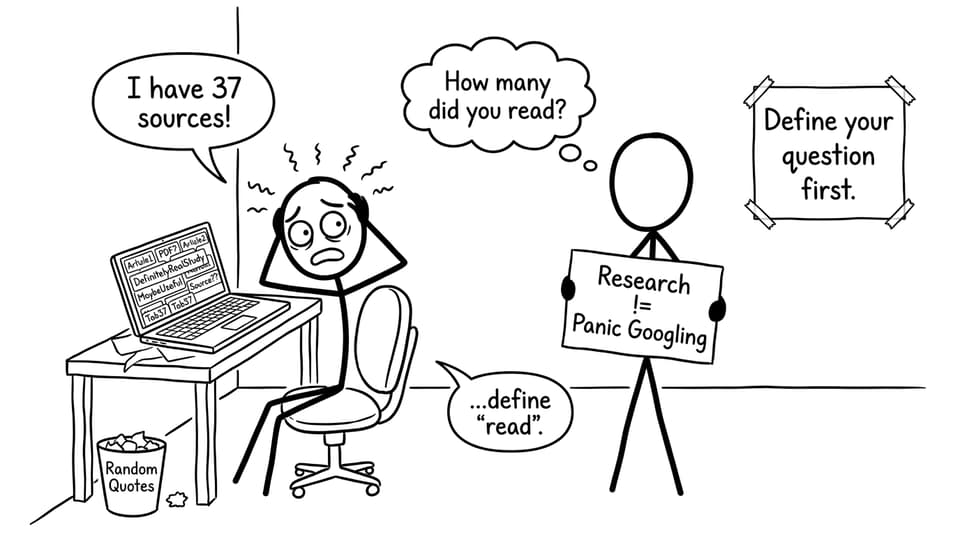
The night before a draft is due, research can feel like a storm: forty tabs open, three PDFs half-downloaded, and one sentence highlighted because it sounded impressive at 1:12 a.m. It looks like work. It feels like work. But in the IB, that kind of “searching” rarely turns into marks.
What actually raises your IA and EE quality is calmer: a repeatable research process that makes your thinking visible. Not just what you found, but why you trusted it, how you compared it, and what you did when the evidence didn’t agree. Those are the invisible skills that turn an IB topic into an IB argument.
This guide shows you research skills that strengthen IAs and the EE, while also protecting exam prep time. You’ll get a checklist you can reuse for any IB subject, plus practical ways to use RevisionDojo tools to keep the work focused.
Quick research checklist for IB IAs and the EE
Use this as your “before I collect anything” system. If you do only these steps, your IB research becomes sharper immediately.
-
Write a one-sentence working question (not a topic).
-
Identify what counts as evidence in your subject (data, primary sources, lab results, texts).
-
Pre-select 6-10 high-quality sources or datasets before expanding.
-
Take notes as claims (with citations attached), not as paragraphs.
-
Compare sources explicitly (agreement, disagreement, limitations).
-
Keep a running bibliography from Day 1.
-
Build a mini reflection log: what changed, what you learned, what you’d do next.
If you want a subject-aligned starting point, begin with the examiner-written hubs on RevisionDojo: IB IA Guides and IB Extended Essay Guide.
Why research skills matter so much in the IB
In the IB, the highest marks are rarely awarded for “knowing a lot.” They’re awarded for showing your reasoning.
For an IA, you’re judged on how well your investigation is designed, justified, and analyzed. For the EE, you’re judged on how well you sustain inquiry, control scope, and evaluate evidence over time. In both cases, research quality is the difference between:
-
a descriptive project that reports information, and
-
an analytical project that builds and tests a line of argument.
That same research discipline also improves exam performance, because it trains you to evaluate sources, interpret data, and write with precision under constraints. In other words: better IB research doesn’t compete with exam revision. It strengthens it.
Teach yourself IB research by starting with the question
Most IB students don’t start research with a question. They start with a vibe.
A useful question has three properties:
-
It forces a decision (to what extent? how far? why does X happen under Y conditions?).
-
It matches the subject method (experiment, textual analysis, historical interpretation, statistical model).
-
It is survivable (you can answer it with realistic time, access, and word count).
A simple move: write two versions of your question.
-
Version A (broad): what you wish you could investigate.
-
Version B (scoped): what you can actually prove.
If you’re stuck, RevisionDojo’s IA hub is a helpful anchor because it keeps you close to rubric expectations: Refine Your IA Research Question for Clarity and Focus.
IB source evaluation: stop collecting, start filtering
The fastest way to improve an IB IA or EE is to reduce your source list while increasing its quality.
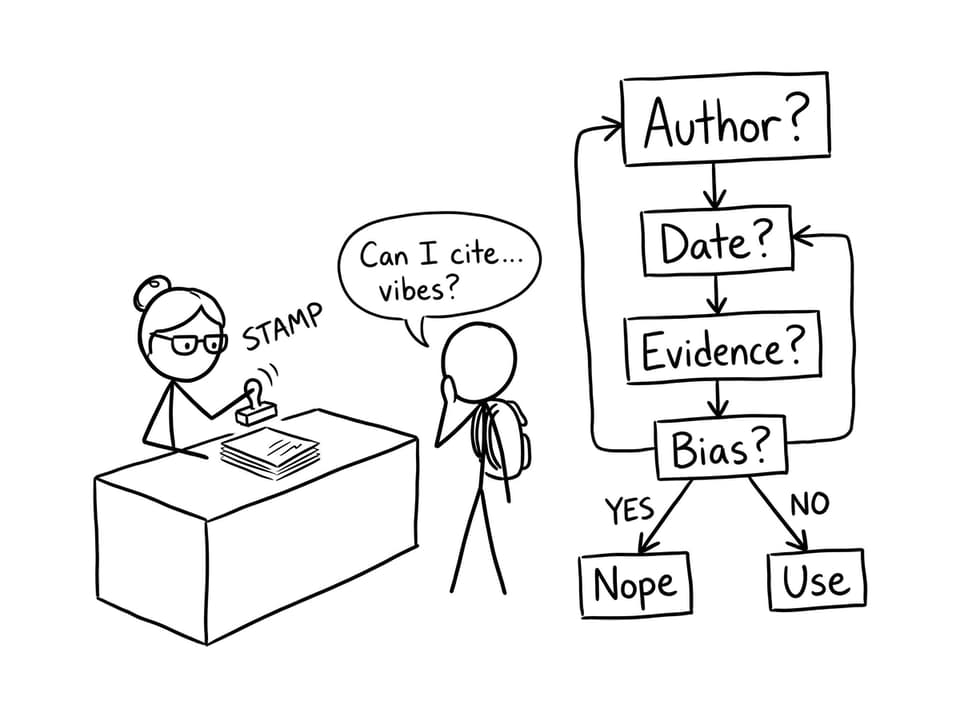
Try a lightweight evaluation framework (you can do it in minutes per source):
-
Authority: Who wrote it, and why should an examiner trust them?
-
Evidence: What data, method, or primary material supports the claim?
-
Relevance: Does this source directly help answer your question, or only provide background?
-
Limitations/bias: What is missing, uncertain, or agenda-driven?
A high-scoring IB essay often includes a small number of strong sources used deeply, not a large number used shallowly. If TOK has taught you anything, it’s that “published” is not the same as “reliable.”
For a TOK lens that upgrades your evaluation in the EE, see: How to Use TOK to Enhance Your Extended Essay.
IB synthesis: the skill that turns notes into marks
Here’s a hard truth: you can research for 20 hours and still produce a low-mark IB draft if you never synthesize.
Synthesis means you do at least one of these moves in each body section:
-
Compare: Source A and Source B agree, but for different reasons.
-
Complicate: Source C introduces a limitation that changes your conclusion.
-
Resolve: Two findings conflict, and you explain why (method, sample, context, definitions).
-
Generalize carefully: You connect one case to a broader pattern without overclaiming.
A practical method: write your notes as a three-column table.
-
Claim (your words)
-
Evidence (quotation, data point, observation)
-
So what? (how it supports your research question)
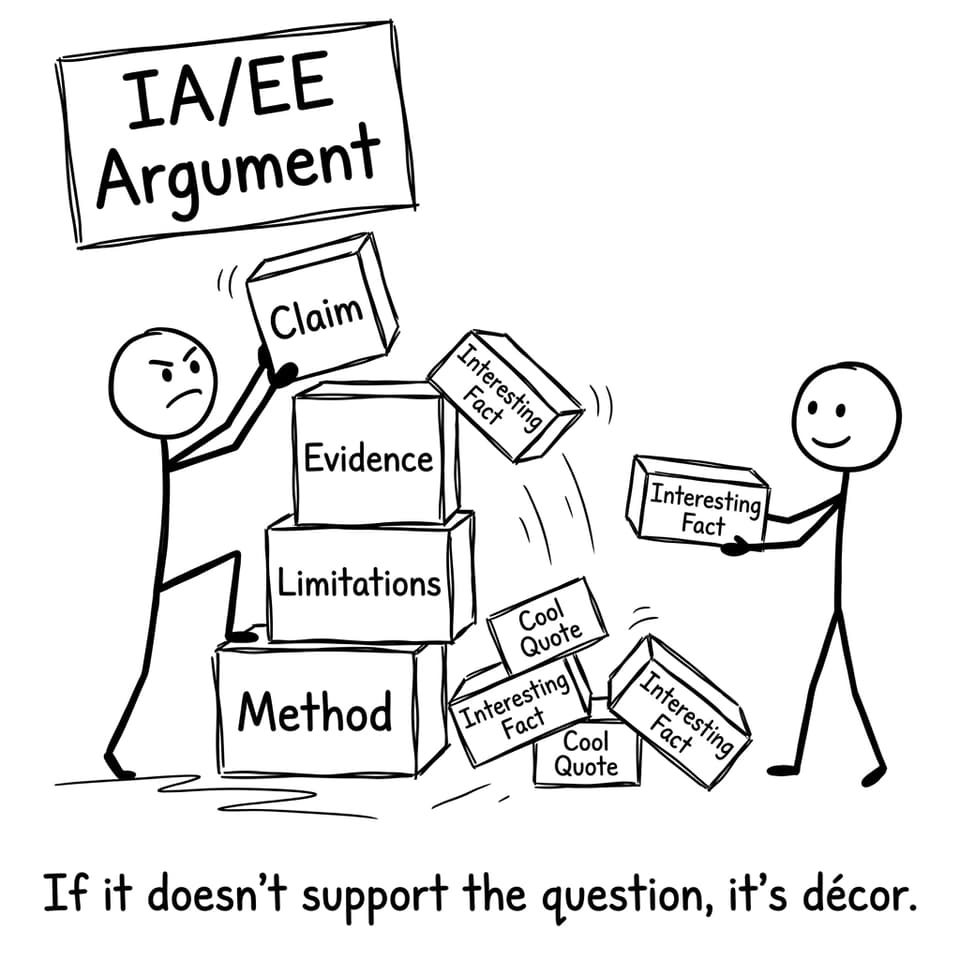
When you draft, you’re not “adding sources.” You’re building a chain of reasoning the examiner can follow.
IB academic integrity: build citations into the workflow
In the IB, academic integrity is not just about avoiding plagiarism. It’s about making your inquiry transparent.
The easiest way to stay clean is to make citation automatic:
-
Paste the full reference into your notes the moment you take a point.
-
Paraphrase immediately, then check you didn’t keep the original sentence shape.
-
Keep direct quotes rare and purposeful (usually for language/literature or when wording is the evidence).
When you treat citation as “something to fix later,” you create stress and mistakes. When you treat it as part of note-taking, you create calm.
If you want coursework feedback aligned to criteria, RevisionDojo’s grading tools help you see whether your evidence use and analysis match what the IB rewards: IB Coursework Grader and the deeper walkthrough IB IA Grading Service: Professional Assessment in Minutes.
How IB research skills also protect exam prep time
Good IB research is a time management strategy.
When research is structured, you avoid the two traps that destroy exam revision:
-
rewriting your question every week because the evidence doesn’t fit, and
-
collecting endless background until you run out of time to analyze.
A sustainable weekly rhythm many students use:
-
2 focused research blocks (45-60 minutes each): question refinement, source filtering, synthesis notes.
-
3-5 exam blocks (30-60 minutes each): active recall and timed questions.
RevisionDojo is designed to keep that balance intact: learn with Study Notes, test with the Questionbank, and tighten writing with the IB Coursework Grader. If you want the full exam workflow in one place, see: RevisionDojo App: The Smarter Way to Prep for IB Exams.
A simple IB “research loop” you can reuse
When your IA or EE feels too big, shrink it into a loop:
-
Ask: What exactly am I trying to find out?
-
Select: What is my next best source or dataset?
-
Test: Does it answer the question or change the question?
-
Explain: What does it mean for my argument?
-
Document: Citation + limitation + next step.
Repeat until your draft has enough evidence to defend, not just describe.
For EE-specific structure and pacing help, these are solid anchors: Mastering IB Extended Essays: How to Research, Write, and Revise and IB Extended Essay in a Week? What You Need to Know.
Closing: the IB rewards calm thinking, not frantic searching
The strongest IB IAs and EEs don’t feel like collections of facts. They feel like someone thinking clearly, step by step, with evidence that has been tested, compared, and honestly limited.
If you want that same clarity, make your research smaller and more disciplined: question first, sources second, synthesis always. Then use RevisionDojo as your home base: Questionbank for exam skill, Study Notes and Flashcards for retention, AI Chat for quick clarification, Grading tools for rubric-level feedback, Predicted Papers and Mock Exams for timed pressure, the Coursework Library for exemplars, and Tutors when you want a human second opinion.
Build the research habit now, and your IB writing becomes simpler, your exam prep becomes sharper, and your confidence stops depending on how many tabs are open.