
The first term IB SEHS experience is usually less about playing sport and more about learning to think like a scientist who studies movement. You will meet unfamiliar terminology, interpret data, complete practical work, and connect physiology, nutrition, biomechanics, and psychology to performance.
The teaching order varies by school. One teacher might begin with body systems, while another starts with movement or experimental skills. Still, the rhythm is broadly predictable: an accessible opening, increasing scientific detail, early practical work, and a final stretch when assessments compete for attention.
Your first-term SEHS checklist
By the end of the term, aim to have:
- Understood where your first topics fit within the wider syllabus
- Built a reliable system for definitions and scientific processes
- Completed practical or data-handling activities
- Learned how SEHS command terms affect your answers
- Practised questions before the end-of-term assessment
- Developed a weekly routine you can maintain when the IB becomes busier
The IB SEHS resource hub is a useful course map because it organizes Study Notes, Flashcards, questions, and lessons by syllabus area.
Weeks 1-2: the subject feels familiar
The opening lessons can be deceptively comfortable. You may discuss training, health, movement, or responses to exercise. If you already follow sport or train regularly, much of the vocabulary will sound familiar.
Yet knowing that heart rate increases during exercise is different from explaining the mechanism, interpreting a graph, or evaluating how it was measured. SEHS moves you from everyday observations toward evidence-based explanations.
Under the current syllabus, SEHS is organized around three connected themes:
- Exercise physiology and nutrition of the human body
- Biomechanics
- Sports psychology and motor learning
SL has 150 recommended teaching hours across the course, while HL has 240. Both levels combine conceptual content with scientific inquiry. The beginner's guide to IB SEHS emphasizes understanding the course map before trying to memorize every detail.
Weeks 3-5: terminology begins to accumulate
A few weeks in, the workload changes character. Each lesson adds terms, mechanisms, diagrams, variables, and examples that depend on earlier knowledge.
A school beginning with physiology might introduce body systems, transport, nutrition, hydration, or responses to exercise. Another class might start with movement, forces, or motor learning. Schools can design their own sequence.
What matters is the type of learning. SEHS asks you to move between several levels:
| Level | What you might be asked to do |
|---|---|
| Recall | State a definition or identify a structure |
| Explain | Describe why a physiological response occurs |
| Apply | Use the concept in an unfamiliar sporting context |
| Analyse | Interpret a graph, table, movement, or investigation |
| Evaluate | Judge a method, claim, or training decision using evidence |
Passive rereading starts to fail here. Use concise IB SEHS note-taking methods, then close your notes and reconstruct the idea. RevisionDojo Flashcards can handle definitions, while the Questionbank reveals whether you can apply them.
Weeks 5-7: practical work changes the rhythm
Practical work is central to the current course. Across the programme, the IB recommends an experimental programme of 40 hours at SL and 60 hours at HL. This includes practical work, the collaborative sciences project, and the scientific investigation. Schools need not distribute those hours evenly.
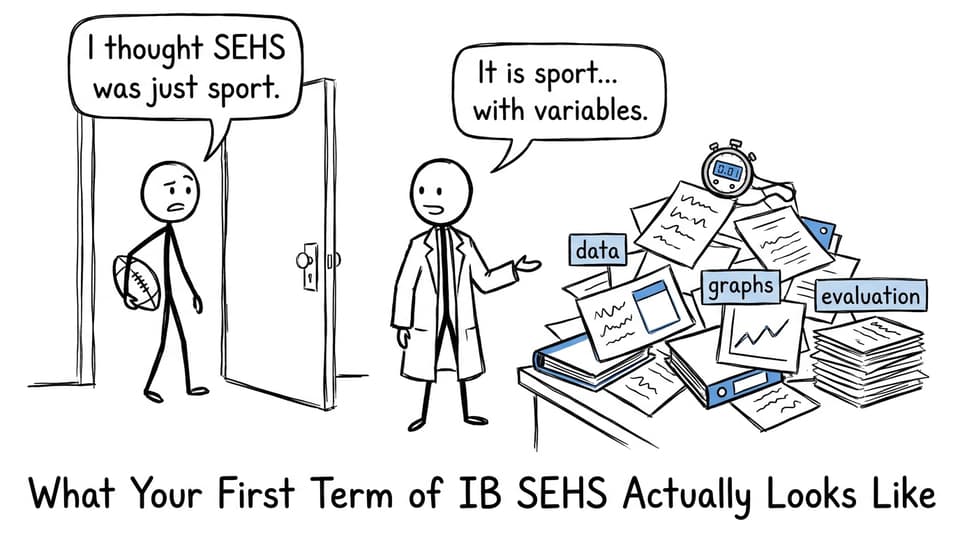
An early practical could involve heart rate, movement analysis, reaction time, hydration, or skill acquisition. Performing the activity may feel straightforward. Recording it scientifically is harder.
You may need to:
- Identify independent, dependent, and controlled variables
- Follow a replicable method
- Record raw data with units
- Calculate averages or percentage changes
- Select an appropriate graph
- Discuss uncertainty, validity, and reliability
- Propose realistic improvements
A polished graph cannot rescue weak data. Record results immediately, keep units consistent, and note unusual conditions while you remember them.
Treat early investigations as preparation for the later scientific investigation. This is an open-ended investigation with an individual written report of up to 3,200 words, but your first-term priority is developing the habits behind it. The IB SEHS survival guide explains how to preserve data, decisions, and evaluation notes.
Weeks 7-9: application becomes the real challenge
Many students expect memorizing anatomy or definitions to be hardest. The greater surprise is application. A test may present an unfamiliar athlete, activity, graph, or result and ask you to use familiar science in a new setting.
Prepare with a three-part response:
- State the relevant concept precisely.
- Explain the mechanism in a logical sequence.
- Connect that mechanism directly to the context or data.
Understanding training responses requires more than listing principles. The A.3 Response topic resources move from explanations to targeted questions. If your class begins with mechanics, the Forces, Motion and Movement resources offer the same progression for biomechanics.
Short, regular question practice is more useful than waiting until you feel ready. Mistakes expose the difference between recognition and usable knowledge.
Weeks 9-12: SEHS meets the rest of the IB
The end of term becomes difficult when assessments cluster across subjects and ambitious plans meet the reality of a tired evening.
A realistic weekly SEHS workload outside class might include:
- Two 20-minute sessions reviewing recent content
- Two 10-minute Flashcard sessions
- One 30-minute Questionbank set with correction
- Additional time when a practical report or test is due
This is a model, not an official requirement. Your level, timetable, teacher, and understanding will change the total. HL requires greater depth, but neither level benefits from occasional revision marathons.
Use the IB SEHS revision strategies guide to build a loop: understand, retrieve, apply, correct, and revisit. If a mechanism remains unclear, ask RevisionDojo's AI Chat one narrow question. “Why does this variable reduce reliability?” is more productive than “Explain all of biomechanics.”
What surprises new SEHS students most
Sport experience helps, but does not replace science
Playing sport provides context and intuition. It does not automatically produce precise terminology, experimental reasoning, or strong explanations. Students without a competitive sports background are not inherently disadvantaged.
The course contains more writing than expected
You will explain mechanisms, interpret evidence, and evaluate investigations. Strong answers are concise scientific arguments shaped by command terms, not decorative essays.
Data matters from the beginning
The assessment model includes multiple-choice, data-based, short-answer, experimental, and extended-response work. Early graph and evaluation skills support both practical work and examination performance.
Small gaps become expensive
SEHS topics connect. Weak understanding of movement or experimental design can reappear later. The answer is a weekly repair habit, not constant panic.
A calmer way to finish the term
Your first term does not need to end with perfect notes or complete confidence. A better goal is to finish with a working system.
RevisionDojo can become that system. Use Study Notes for clarity, Flashcards for retrieval, and the Questionbank for application. AI Chat can unblock misconceptions, while Grading tools and the Coursework Library become valuable as scientific writing develops. Tutors offer human support when a gap requires sustained attention. Mock Exams and Predicted Papers belong later, when broader coverage makes timed simulation worthwhile.
The best tools for IB SEHS students are those you can use consistently when several deadlines arrive together.
That is what the first term teaches beneath the physiology, mechanics, and practical work. SEHS rewards the same principle it studies in training: adaptation comes from repeated, well-directed effort. Start small, review honestly, and let RevisionDojo turn each week of work into knowledge your future self can retrieve.