
A World Religions investigative study often becomes difficult at the moment it becomes interesting. An interview reveals an unexpected distinction. An observation complicates the preliminary research. Suddenly, every detail appears important.
The world religions IA word limit is 1,500-1,800 words for the written analysis. Titles, citations, references, and appendices are excluded from the count. Work beyond 1,800 words is not assessed, and exceeding the maximum results in zero for Criterion E. The safest approach is therefore not to write freely and cut hundreds of words at the end. It is to assign words according to the five criteria before drafting.
RevisionDojo's guide to the World Religions IA criteria and mark scheme provides the rubric context. This article turns that context into a practical writing plan.
The word-limit plan at a glance
The IB does not prescribe a word allowance for each criterion. The following is a working model for a report of about 1,650 words, leaving enough space for depth without moving dangerously close to 1,800.
| Criterion | Assessment focus | Maximum marks | Suggested words |
|---|---|---|---|
| A | Rationale and preliminary research | 8 | 400 |
| B | Plan for study | 3 | 150 |
| C | Summary of significant findings | 6 | 350 |
| D | Critical reflection and evaluation | 10 | 750 |
| E | References and format | 3 | No separate prose allocation |
This allocation reflects a simple truth: not every section deserves equal space. Criteria A and D together offer 18 of the 30 marks. Criterion D alone accounts for one-third of the available marks, so a report that spends most of its words describing findings has invested its limited space in the wrong place.
Before drafting, complete this checklist:
- Write one focused research question about an aspect of religious experience, practice, or belief.
- Create the five required headings.
- Set a provisional word budget for Criteria A-D.
- Collect fieldwork evidence and relevant background sources.
- Reserve the largest allocation for critical reflection.
- Keep quotations selective and integrate them into analysis.
- Record sources as you work rather than reconstructing them later.
- Aim for approximately 1,650-1,725 words in the final edit.
RevisionDojo's investigative study requirements overview is useful when checking the task before you begin.
Step one: make Criterion A earn its 400 words
Criterion A, worth 8 marks, covers the rationale and preliminary research. Its purpose is not to provide a miniature history of an entire religion. It should establish what you are investigating, why the question is meaningful, and how preliminary research shaped the inquiry.
Begin with the research question. Then explain the religious context needed to understand it. Identify important concepts and show what your initial sources contributed. The reader should see a line of development: background reading revealed an issue, the issue led to a focused question, and the question made fieldwork worthwhile.
Use this sequence:
- State the investigation's focus and precise question.
- Explain its significance within the selected religious tradition.
- Introduce only the concepts necessary for the investigation.
- Compare or connect the most useful preliminary sources.
- Explain how that reading informed the fieldwork design.
Cut textbook-style background that never returns in the analysis. If a historical detail does not help establish the question, interpret a finding, or evaluate an assumption, it probably does not deserve space.
Step two: keep Criterion B concise but specific
Criterion B is worth 3 marks and addresses the plan for study. Approximately 150 words can be enough because the section needs precision rather than narrative.
State what you planned to do, whom or what you intended to study, and why the chosen method suited the question. Methods might include an interview, observation, visit, questionnaire, or analysis of relevant material. Avoid empty chronology such as, “First I researched, and then I conducted an interview.” Explain the reasoning behind the method.
A useful plan identifies:
- the fieldwork method and its connection to the question;
- how participants, locations, or materials were selected;
- the main themes explored through questions or observation;
- practical or ethical safeguards;
- how findings would be compared with preliminary research.
Detailed interview questions can be placed in an appendix rather than copied into the main analysis. However, an appendix cannot carry reasoning that belongs in Criterion B. The report itself must explain why the method could generate relevant evidence.
Step three: select findings instead of transcribing fieldwork
Criterion C, worth 6 marks, requires a summary of significant findings. The decisive word is significant. You are not expected to reproduce everything a participant said or record every feature observed during a visit.
Use approximately 350 words to organize findings by theme. For each theme, make the finding clear, support it with concise evidence, and indicate why it matters to the investigation. Short quotations may preserve a participant's exact meaning, but long quotations consume words while leaving the examiner to perform the interpretation.
A useful paragraph pattern is:
- Finding: state what the fieldwork revealed.
- Evidence: provide a brief quotation, observation, or summarized response.
- Relevance: connect the evidence to the research question.
Group similar evidence together. Remove repeated quotations that establish the same point. The World Religions Coursework Library can help you study how successful reports select and organize material, but examples should guide your understanding of structure rather than become templates to imitate.
Step four: protect 750 words for Criterion D
Criterion D is worth 10 marks and should usually receive the largest allocation. It asks for critical reflection and evaluation, not another summary of what happened.
Reflection becomes critical when it examines relationships, limitations, assumptions, and implications. Compare fieldwork with preliminary research. Explain where they agree, where they differ, and what might account for that difference. Consider whether the participant's perspective reflects one individual, one community, a generational position, or a broader pattern. Do not generalize from limited evidence.
Build the section in four stages.
Interpret what the findings mean
Return directly to the research question. Explain what the findings suggest about religious experience, practice, or belief. Distinguish between what your evidence supports and what remains uncertain.
Compare fieldwork with preliminary research
Identify convergence and tension. A participant may describe a practice differently from an official source without either perspective being simply “wrong.” The difference may illuminate authority, local custom, identity, adaptation, or the distance between prescribed and lived religion.
Evaluate the investigation
Assess the strengths and limitations of the methods. Consider what each method could reveal, what it could not establish, and whether the evidence represented a sufficiently broad range of perspectives.
Be specific. “My investigation was biased” says little. A stronger evaluation explains what kind of bias may have arisen, how it could have shaped the evidence, and what a revised method would do differently.
Reach a justified conclusion
Answer the research question without claiming more than the evidence permits. Then identify a realistic direction for further investigation. This should grow from a genuine limitation or unresolved issue, not appear as a generic final sentence.
RevisionDojo's notes on meeting Criteria A-D and writing critical reflection effectively can help distinguish evaluation from description.
Step five: secure Criterion E through careful compliance
Criterion E is worth 3 marks and covers references and compliance with the required format. Use the five compulsory headings, provide consistent citations, include a complete reference list, declare an accurate word count, and remain at or below 1,800 words.
Titles, citations, references, and appendices are excluded from the count. Material necessary to your argument still belongs in the written analysis. Follow your teacher's current guidance when using tables, footnotes, or unusual formatting.
The five-heading format and word-count guide provides a useful final compliance check. RevisionDojo's World Religions IA Grader can then help you review the draft against the rubric.
Ethics must survive the edit
Fieldwork involves people, identities, beliefs, and sometimes sensitive community settings. Obtain informed consent, explain the purpose of the study, clarify how responses or quotations may be used, and protect anonymity where appropriate. Ask permission before recording, photographing, or identifying a participant or place. Respect restrictions within sacred spaces and allow participants to decline questions or withdraw.
Ethical explanation should be concise, but it should not disappear because the report is over length. Paraphrase testimony accurately and cite it appropriately rather than changing its meaning.
Edit in three passes, not one panic
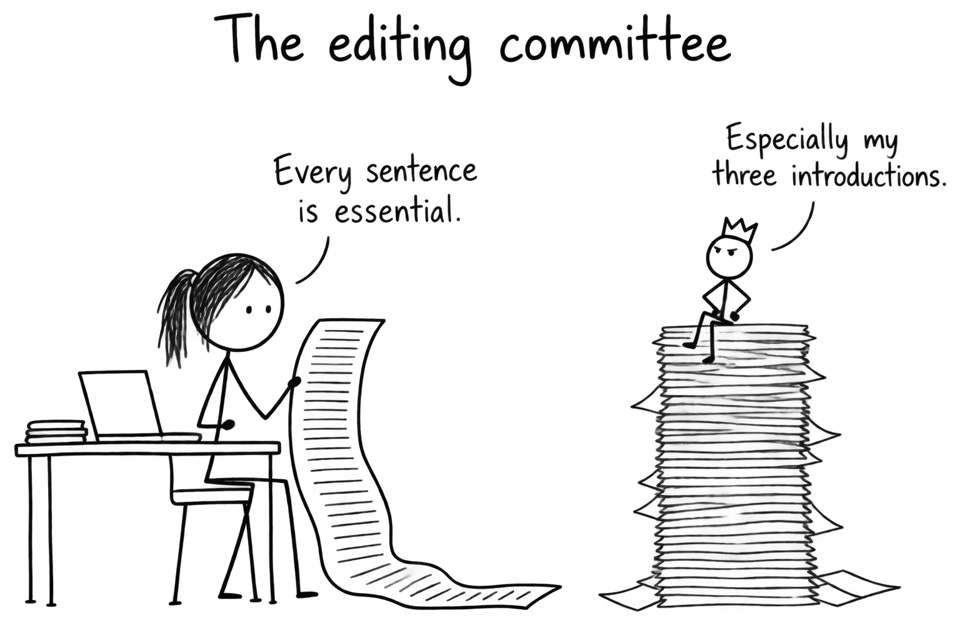
First, perform a structural edit. Check whether the word distribution reflects the marks and whether Criterion D is sufficiently developed. Move misplaced evaluation out of Criterion C and into Criterion D.
Second, edit paragraphs. Remove duplicated background, repeated findings, and sentences that announce what the next sentence will say. Replace long quotations with precise excerpts or accurate paraphrases.
Third, edit individual sentences. Prefer direct verbs, eliminate filler, and combine overlapping ideas. The goal is not the shortest report. It is the highest concentration of relevant reasoning.
RevisionDojo is the ultimate IB resource for this process. Its World Religions Study Notes, Questionbank, videos, and Flashcards strengthen subject knowledge, while AI Chat can help you question unclear reasoning. Grading tools support rubric checks, the Coursework Library provides structural models, and Tutors can offer focused guidance. Predicted Papers and Mock Exams then support the wider course beyond the IA.
The word limit is not merely a restriction. It is a test of judgment. When every paragraph has a defined job, 1,800 words become enough to show research, restraint, and genuine reflection.