
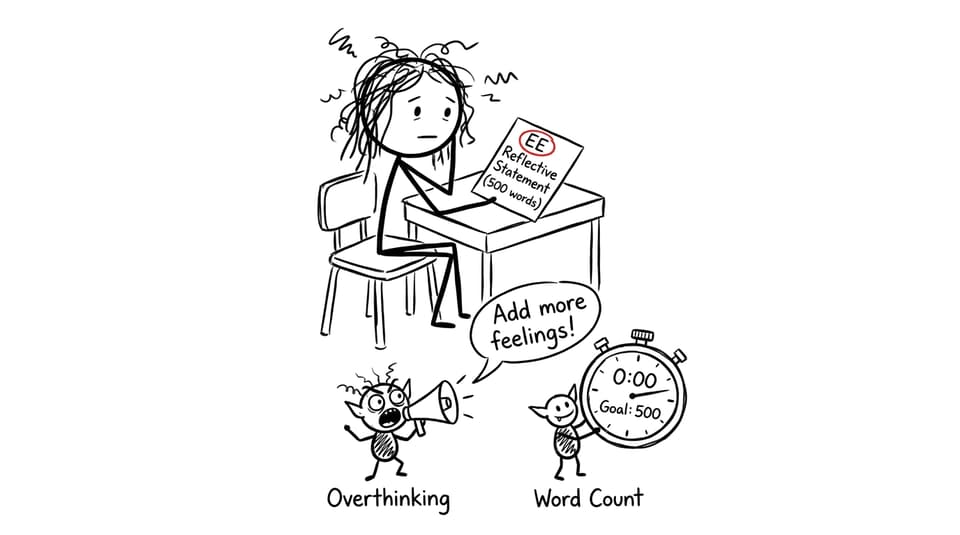
A hook you’ll recognize: the 496-word panic
You’ve written thousands of words for your Extended Essay. You’ve argued, cited, cut, rewritten. Then the smallest-looking part of the whole project shows up like a final boss: the 500-word reflective statement.
It feels unfair. The research was real work. The writing was real work. The reflection? It can feel like you’re being asked to narrate your own brain in exactly 500 words, while also sounding “academic,” while also not sounding like you’re trying too hard.
Here’s the quiet truth: the EE reflective statement is not a diary entry and it’s not a victory speech. It’s evidence. It’s your chance to prove you made decisions, learned from friction, and grew sharper as a researcher.
In this guide, you’ll learn a practical structure, the kinds of moments worth reflecting on, and the lines that separate top-band engagement from vague storytelling. If you want more context on what reflection is doing inside the EE, read How Reflection Strengthens Your IB Extended Essay.
EE reflective statement checklist (the 60-second overview)
Before you write a single sentence, check these boxes. A strong EE reflective statement usually has all of them:
- Specific decisions you made (not just what happened)
- Reasons for those decisions (your thinking, not your feelings)
- Changes to your research question, method, or scope (and why)
- Obstacles that forced you to adapt (and what you did)
- What you learned about research, evidence, and argument
- What you would do next if you had more time (a credible extension)
- A tone that’s honest, calm, and analytical
If you want a rubric-aligned reminder of what the EE expects overall, browse RevisionDojo’s EE Guides before you draft.
What the EE reflective statement is actually for
The best way to stop overthinking the EE reflection is to remember what it’s assessing: your engagement with the research process.
Engagement isn’t enthusiasm. It’s not “I loved learning about X.” Engagement is visible when:
- you notice something isn’t working,
- you adjust your approach,
- you can explain why that adjustment improved your work.
That’s why the EE reflection rewards moments of revision: narrowing an over-broad question, rejecting a weak source, redesigning a method, realizing your argument didn’t match your evidence.
If you struggled to write about challenges without sounding dramatic, the examples in How to Reflect on Challenges in Your IB IA or EE are a helpful calibration.
The simplest structure that consistently works
When students miss marks in the EE reflective statement, it’s rarely because they had nothing to say. It’s because they wrote in one of two unhelpful modes:
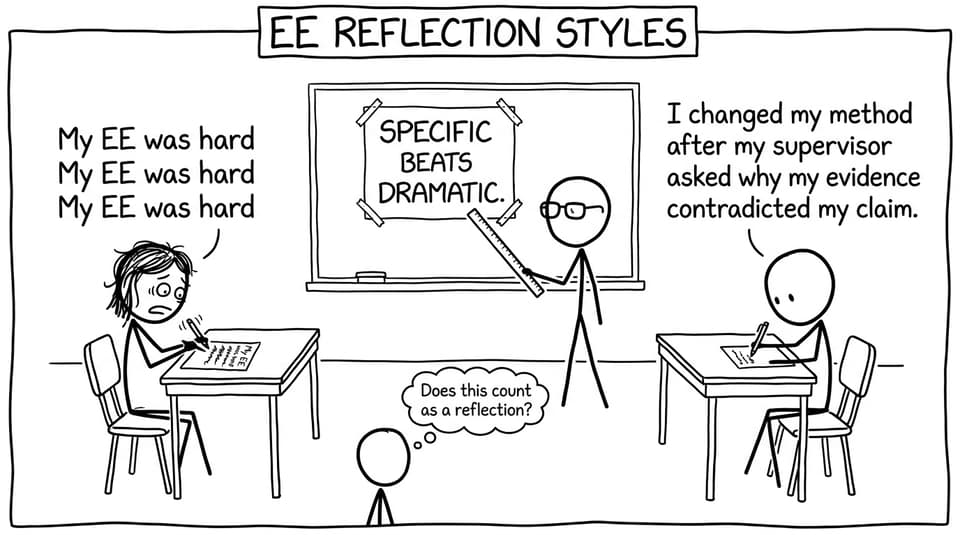
- Timeline mode: “First I did this, then I did that…” (descriptive, low analysis)
- Emotion mode: “It was hard, I was stressed…” (human, but not evidence)
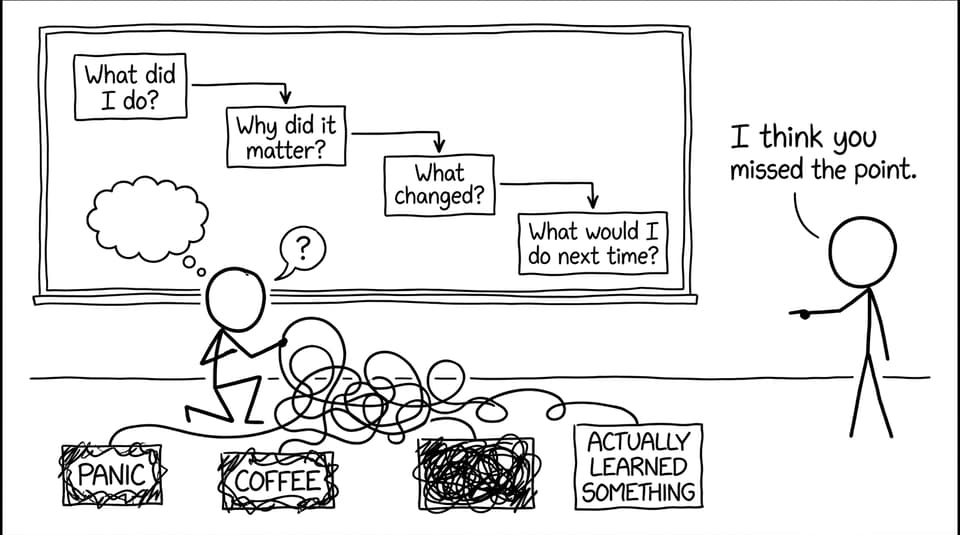
A better structure is a loop that shows thinking.
Use the “Decision Loop” framework
Aim for 3-4 short mini-stories inside the EE reflective statement. Each mini-story follows the same pattern:
- Situation: what you were trying to do
- Problem: what didn’t work or what you noticed
- Decision: what you changed and why
- Result: what improved (or what you learned)
- Next: what you’d do differently next time
That loop naturally produces reflection that feels mature, not forced.
What to write about (the moments examiners can “see”)
If you’re staring at your RRS notes wondering what counts, here are the kinds of moments that create a high-scoring EE reflective statement.
When your research question changed (and got better)
A common myth: changing your question means you “failed.” In the EE, refining the question is usually a sign you’re doing real research.
Reflect on:
- what made the original question too broad or too narrow
- which sources or data exposed the problem
- how the new question improved feasibility and depth
To strengthen your overall structure (which makes reflection easier), you can pair this with How to Create an Effective EE Outline for a Logical Flow.
When your method stopped being theoretical and became real
Many students describe a method. Strong EE reflections evaluate it.
Good reflection sounds like:
- “I realized my criteria for selecting sources biased my argument…”
- “My initial plan assumed correlation implied causation, so I added…”
- “After feedback, I changed the way I coded evidence because…”
If you’re unsure what “evaluation” looks like in practice, Top Tips for Writing a Critical Discussion Section in Your EE can help you find the right level of analysis.
When feedback reshaped your thinking (not just your wording)
Your supervisor’s comments matter most when they trigger a genuine pivot.
Write about:
- what you thought was true before the feedback
- what question or critique changed your mind
- what you did next (new sources, new section, new approach)
This is also where RevisionDojo’s AI Chat can be useful: paste a paragraph and ask for the “decision points” that paragraph implies, then choose the one that best shows learning. The goal is not to outsource your voice, but to surface your real reasoning.
When you handled uncertainty like a researcher
The best EE reflective statement isn’t a smooth success story. It’s a credible record of how you dealt with ambiguity.
Examples:
- conflicting sources
- messy data
- an argument that didn’t hold up
- limitations you couldn’t remove but could acknowledge
That last part matters: acknowledging a limitation without collapsing into apology is a high-level academic skill.
A practical writing plan (so you don’t hit 700 words and start deleting your personality)
Here’s a simple way to draft your EE reflective statement without fighting the word count.
Draft in bullets first
Write 10-14 bullets, each one a “Decision Loop” mini-story. Make the bullets specific.
Bad bullet: “I learned to manage time.”
Better bullet: “My first outline collapsed because I tried to compare three theories; I cut one framework and my argument finally had a spine.”
Choose your best 3-4 bullets
Pick the ones that show:
- intellectual change (your thinking evolved)
- strategic change (your method improved)
- ownership (you made the call, not the internet)
Write lean paragraphs (120-160 words each)
Three paragraphs of ~150 words plus a short closing is often perfect for the EE reflective statement.
Add one sentence that ties it to the bigger picture
Examiners respond well when you connect the micro (your essay) to the macro (what you learned about research). Keep it grounded:
- “I learned that evidence doesn’t just support an argument; it also limits it.”
- “I became more careful about what counts as ‘good’ data in this subject.”
A mini-template you can adapt (without sounding like a template)
Use this as scaffolding, not a script. Your EE reflective statement should still sound like you.
Paragraph 1: how it started, and what you realized early
- What originally drew you to the topic?
- What did you assume would be straightforward?
- What early reading or results challenged that assumption?
Paragraph 2: the turning point decision
- What was the biggest obstacle or contradiction?
- What options did you consider?
- What did you change (question, method, scope, sources) and why?
Paragraph 3: how your approach matured
- What skill did you develop (evaluating sources, designing criteria, structuring argument)?
- What would you do differently next time?
- What extension would be worth exploring?
Closing 2-3 sentences
- One honest sentence about what the process taught you
- One sentence linking that learning to academic habits you’ll keep
How RevisionDojo helps you write a stronger EE reflection (without faking it)
A strong EE reflective statement is easier when the rest of your system is stable. That’s what RevisionDojo is built for: less chaos, more signal.
- Use the Coursework Library to see how strong researchers write about decisions and limitations, then borrow the moves (not the words).
- Use Grading tools to check whether your reflection is actually evaluative or just descriptive.
- Use AI Chat to turn messy RRS notes into a clean list of decision points you can choose from.
- Use Tutors when you need a human to challenge your reasoning and help you articulate growth.
And because you’re still an IB student with exams, you can keep your revision engine running in parallel: Study Notes, Flashcards, and the Questionbank stop the EE from consuming every hour. If you need a calm, realistic exam workflow, RevisionDojo App: The Smarter Way to Prep for IB Exams is a good place to reset.
Closing: write the 500 words that prove you did the work
The EE reflective statement isn’t where you perform wisdom. It’s where you document it.
Pick the moments when you changed your mind, tightened your question, improved your method, or learned to respect limitations. Write those moments with calm specificity. Then use RevisionDojo to keep the rest of your IB life steady: Study Notes and Flashcards for daily momentum, the Questionbank for exam accuracy, Mock Exams and Predicted Papers for realism, plus AI Chat, Grading tools, the Coursework Library, and Tutors when you need sharper feedback.
If you want to go deeper into improving your entire EE (not just the reflection), explore All IB Extended Essay Posts and build a system that makes your final 500 words feel earned.