
If you’ve ever stared at an IB unit plan and thought, “Okay… where do I stick the global context?”, you’re not alone.
Most students can feel the difference between a unit that breathes real life and one that wears relevance like a badge. In the best IB classrooms, global contexts don’t show up as a label at the top of a worksheet. They show up in the way you investigate, the examples you choose, the decisions you justify, and the reflection you write when it’s all over.
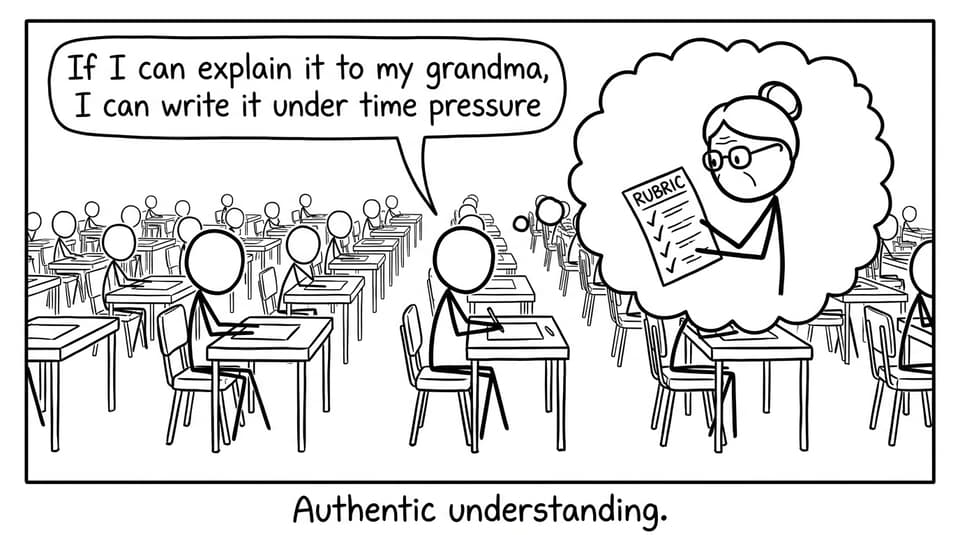
This matters even if you’re “just” an IB student preparing for exams. Because when a unit integrates global contexts naturally, you don’t just remember content -- you remember why it matters. And in IB assessments, that kind of understanding tends to survive time pressure.
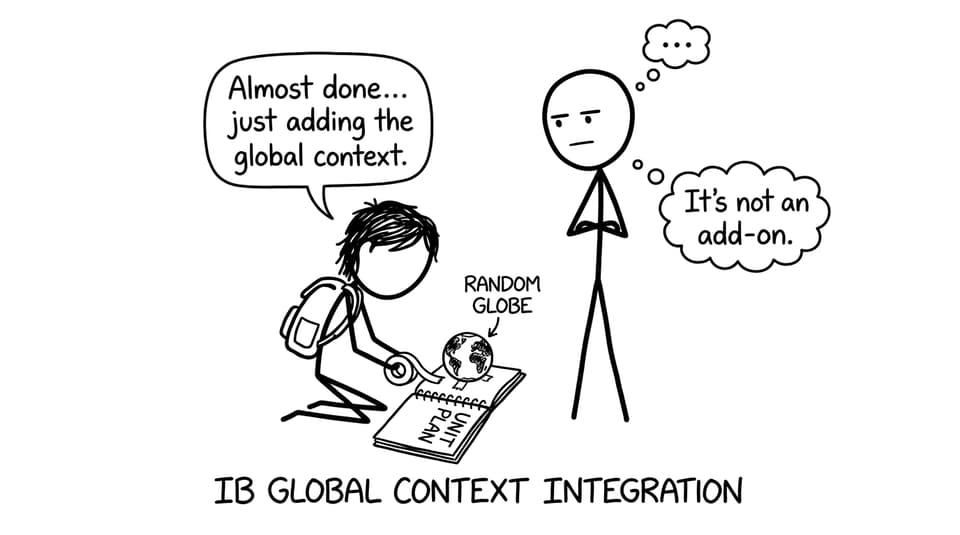
Quick checklist: how to spot a naturally integrated IB global context
Use this as a fast diagnostic. If you can tick most of these, your IB unit is probably integrating global contexts naturally:
-
The global context explains the purpose of the unit, not just the theme.
-
Your inquiry questions move from factual to conceptual to debatable.
-
Examples include both local and global perspectives (not “global” only).
-
The assessment task would still make sense outside school.
-
Reflections connect learning to responsibility, impact, or perspective change.
-
You can explain the global context without repeating its official name.
If you want the broader picture of how contexts connect to concept-driven learning, read Global Contexts and Concept-Driven Teaching in MYP.
Why global contexts matter for IB students (not just teachers)
In IB, marks rarely come from remembering one isolated fact. They come from showing that you understand relationships: cause and effect, claims and evidence, choices and consequences. Global contexts help you build that structure.
When your unit is anchored in a global context, you tend to:
-
choose more meaningful real-world examples,
-
write stronger justifications in projects and reports,
-
evaluate implications (ethical, social, environmental) with more clarity,
-
and make better connections across subjects.
That’s also why global contexts often show up in MYP success and in personal projects. If you’re doing anything MYP-related, MYP Personal Project Global Contexts Explained is worth keeping open while you write.
The six IB global contexts (with a student-friendly “what it sounds like” test)
The official list matters, but what matters more is whether the lens changes how you think.
Identities and Relationships
Sounds like: well-being, belonging, relationships, self-image, communities, health, what shapes people
Orientation in Space and Time
Sounds like: history, perspective, heritage, turning points, timelines, migration, discoveries, “how did we get here?”
Personal and Cultural Expression
Sounds like: voice, creativity, representation, language, art, media, what culture communicates
Scientific and Technical Innovation
Sounds like: new tools, unintended consequences, ethics of innovation, how technology reshapes life
Globalization and Sustainability
Sounds like: systems, interdependence, supply chains, climate, long-term impact, responsibility
Fairness and Development
Sounds like: justice, access, inequality, rights, opportunity, power, who benefits and who pays
If you want examples of one context in action, Globalisation and Sustainability Projects for MYP Students makes the lens feel concrete.
Start with the “why” (the simplest way to make IB contexts feel natural)
Here’s a quiet truth: if the unit’s “why” is clear, the global context usually becomes obvious.
Try this three-sentence exercise:
-
This unit is about… (topic/content)
-
This matters because… (human significance)
-
This changes how we think about… (impact, responsibility, perspective)
Now match it to a global context. Don’t force it. In IB, forced relevance reads like a poster slogan: confident, vague, and easy to ignore.
Examples of “why-first” alignment:
-
Water chemistry becomes Globalization and Sustainability when you investigate water scarcity, pollution, and resource management.
-
A literature unit on voice becomes Personal and Cultural Expression when you ask who gets to tell stories, and how representation shapes identity.
-
A population-growth model becomes Fairness and Development when you explore access to healthcare, education, and economic opportunity.
Build inquiry questions that actually carry the global context
A global context becomes real when it changes your questions.
A reliable IB pattern is:
-
Factual: establishes what is known.
-
Conceptual: explores relationships and patterns.
-
Debatable: invites evaluation and multiple perspectives.
Example (sustainability lens):
-
Factual: What are the main drivers of deforestation in two different regions?
-
Conceptual: How does economic growth create trade-offs in environmental systems?
-
Debatable: Should governments prioritize short-term development over long-term sustainability?
This is where exam preparation quietly begins. Debatable questions train you to write evaluation, not summary.
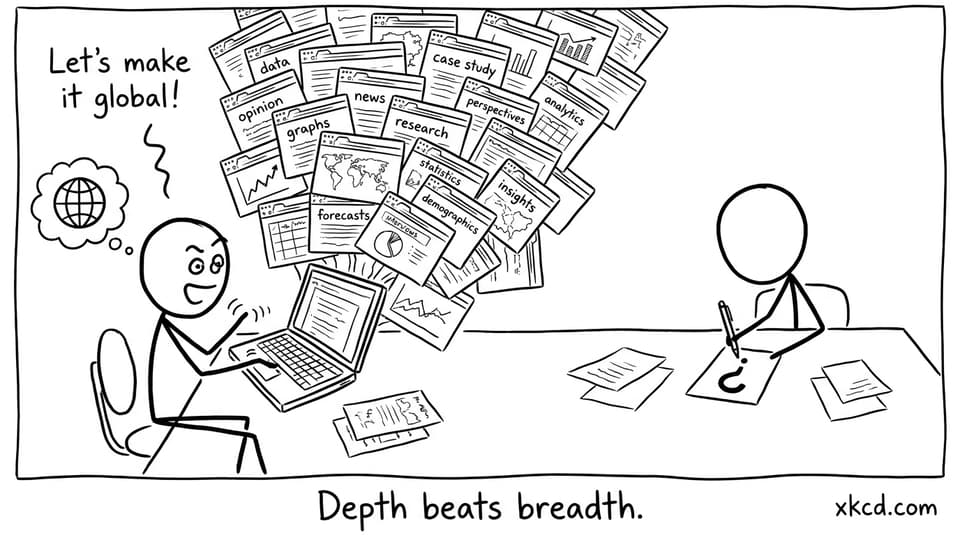
Make the global context show up in daily learning (not just the unit overview)
Students often think global contexts are “teacher stuff.” But you can use them as a personal revision advantage.
Ask, during learning activities:
-
What case study would make this idea feel real?
-
What’s a local example, and what’s a global parallel?
-
What data would someone use to argue the opposite side?
-
What ethical trade-off is hiding inside this topic?
Practical ways teachers often embed the IB global context (and you can copy the habit when you revise):
-
comparing two countries or communities facing the same issue,
-
using real datasets instead of invented numbers,
-
analyzing media sources from different cultural viewpoints,
-
and doing small “action” tasks (interviews, awareness campaigns, prototypes, audits) that produce evidence.
If your school is trying to align contexts across departments, Integrating Global Contexts Across Multiple Subjects in the MYP explains how coherence is built.
Authentic assessment: the fastest test of whether your IB global context is real
A simple rule: if your assessment could be completed with zero connection to the world outside school, the global context is probably decorative.
Authentic tasks often look like:
-
a research report that evaluates impact (social, environmental, ethical),
-
a product/design solution justified by user needs,
-
an investigation with real constraints and realistic limitations,
-
or a debate/position paper that argues with evidence and acknowledges counterclaims.
For Design students, Embedding Global Contexts in MYP Design Projects is a strong model of “context as a driver,” not a sticker.
Reflection: the part IB students underestimate (and then regret)
Reflection is where a global context becomes personal. And personal is often where your writing stops being generic.
Try prompts that force specificity:
-
What assumption did I start with, and what challenged it?
-
What trade-off did I notice that I used to ignore?
-
If I had to explain this unit to a younger student, what would I say matters most?
-
What responsibility comes with this knowledge?
When your reflections are vague, your unit feels vague. When your reflections are evidence-led, your learning feels real.
How RevisionDojo helps IB students turn global contexts into exam-ready understanding
Global contexts are about meaning. Exams are about performance. IB students need both.
RevisionDojo helps you connect them without scattering your effort:
-
Use the Questionbank to practice exam-style questions that force application, not rereading.
-
Pair practice with RevisionDojo App: The Smarter Way to Prep for IB Exams so your studying stays structured.
-
Use Flashcards for daily recall of key definitions, case evidence, and “debate-ready” arguments.
-
Use AI Chat to ask: “What counterclaim would an examiner expect?” or “Where is my evaluation weak?”
-
Use Grading tools to understand how marks are awarded in written responses.
-
Use Predicted Papers and Mock Exams to build timing and stamina in realistic conditions.
-
Use the Coursework Library when internal deadlines demand quality writing, not panic.
-
Use Tutors when you need a human strategy reset.
If you’re close to exams, IB: The Last 2 Weeks Before Exams (What Matters) pairs well with this global-context approach because it turns meaning into a practical schedule.
Closing: make IB global contexts your advantage, not your homework
A naturally integrated global context doesn’t shout. It quietly organizes the whole unit: the “why,” the questions, the learning, the assessment, and the reflection.
If you’re preparing for IB exams, that structure is a gift. It turns revision from “memorize everything” into “understand the few ideas that explain many situations.”
Use RevisionDojo to make that understanding exam-ready: build recall with Flashcards, sharpen technique with the Questionbank, pressure-test with Mock Exams and Predicted Papers, and use AI Chat and Grading tools to close the gap between what you meant and what the markscheme rewards. IB global contexts are the meaning. RevisionDojo helps you turn that meaning into marks.


