

The day most students realize the Personal Project is not really about the product is the day they start scoring higher.
You can build something impressive, film something beautiful, or publish something polished, and still lose marks if your MYP thinking is blurry. The turning point is usually one small sentence in your report: the Global Context. It looks harmless. It isn't.
In the MYP, the Global Context is the lens that makes your project meaningful. It's the reason your topic matters beyond "I like this." And if you choose it well, it quietly improves everything: your goal, your research, your reflections, even the evidence you choose to include. If you choose it badly, your report reads like two different projects glued together the night before the deadline.
This guide explains Personal Project Global Contexts in plain language, with quick decision rules, strong examples, and common mistakes (the ones that cost marks). It's written for MYP students who want clarity, not chaos.
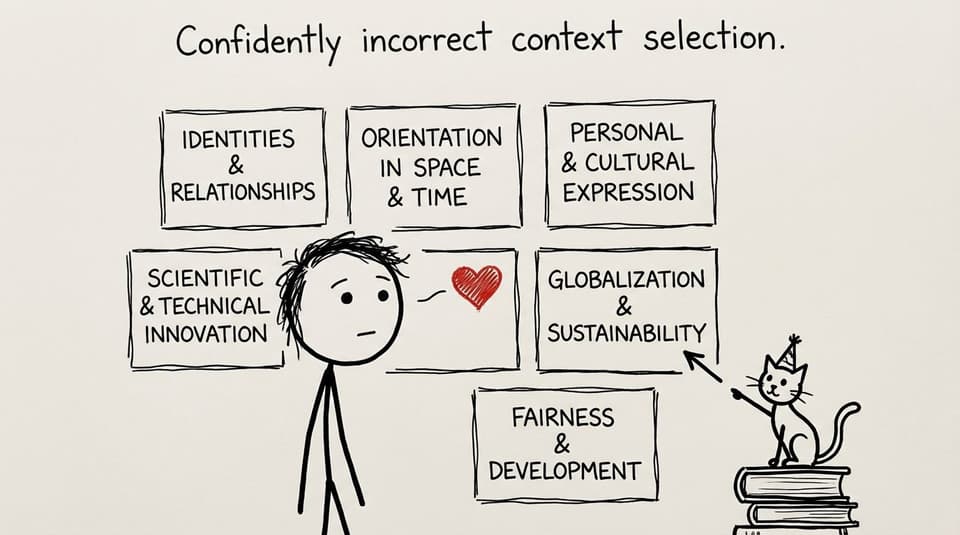
Quick checklist: choose your MYP Global Context in 10 minutes
Before you commit, run this fast MYP checklist:
- State your goal in one sentence. If you can't, your Global Context will feel random.
- Write the "why does this matter?" sentence. This usually reveals the correct Global Context.
- Pick one context only. In MYP, trying to "cover two" often means you cover neither.
- Name one real-world issue or situation your project connects to (school, community, wider world).
- Draft a mini reflection: "During this project, I learned that…" If you can't connect the learning to the context, reconsider.
If you want models of how high-scoring students do this, use the IB Personal Project (MYP) Exemplars as reference points before you write.
What Global Contexts actually do in the MYP Personal Project
A helpful way to think about the MYP Global Context is this:
- Your topic is what you do.
- Your goal is what success looks like.
- Your Global Context is why a thoughtful human should care.
That "why" is not decorative. It shapes:
- Criterion A (Investigating): the kind of research that counts as relevant.
- Criterion B (Planning): the choices you justify in your timeline and methods.
- Criterion C (Taking action): the evidence you collect (testing, feedback, iterations).
- Criterion D (Reflecting): the depth of your learning and impact.
If you're unsure how the report is structured, keep this open while you work: Writing an Outstanding MYP Personal Project Report. It's one of the cleanest explanations of what the MYP assessor expects.
The six MYP Global Contexts (explained with Personal Project examples)
Identities and Relationships
If your project explores who people are, how they grow, how they relate, or how well-being is shaped, you're probably here.
Strong MYP Personal Project fits:
- A journal or podcast on teen stress and coping strategies
- A training plan and reflection on motivation, discipline, and identity
- A campaign to reduce bullying or improve belonging in your grade
Quick test: If your "why" includes words like well-being, belonging, relationships, self-image, mental/physical health, this is likely your context.
Personal and Cultural Expression
This context is about how people express ideas, values, and identity through creativity, language, art, and culture.
Strong MYP Personal Project fits:
- A short film exploring cultural stereotypes in your community
- An original music EP inspired by a tradition or personal story
- A zine, exhibition, or performance piece with a clear message
Quick test: If your "why" is about meaning, voice, representation, storytelling, creativity, choose this.
Orientation in Space and Time
This one is about history, place, heritage, and change over time. It's not just "I like history." It's "time and place shape people and perspectives."
Strong MYP Personal Project fits:
- A documentary about local history or family migration
- A digital map of heritage sites with research and interviews
- A comparative study of how an issue changed over decades
Quick test: If you're constantly writing then vs now, or tracing origins and consequences, you're in the right context.
Scientific and Technical Innovation
This is about how science and tech change lives, and the responsibility that comes with that. Many coding, engineering, and design builds belong here -- but only if you reflect on impact, not just the build.
Strong MYP Personal Project fits:
- Building an app that solves a specific student problem and testing it with users
- Designing a low-cost prototype (filtration, accessibility tool, study organizer)
- A research-led experiment with clear method, data, and evaluation
Quick test: If your "why" is about solving problems through new methods, innovation, efficiency, ethics of tech, pick this.
Fairness and Development
This context covers justice, equity, rights, and access. It's the right choice when your project aims at improving conditions for a group and you can show thoughtful research about systems.
Strong MYP Personal Project fits:
- A tutoring initiative for younger students with evaluation of impact
- An awareness campaign about inequality (supported by evidence and reflection)
- A fundraiser with a clear plan, ethical considerations, and measured outcomes
Quick test: If your "why" includes inequality, opportunity, access, rights, power, choose this.
Globalization and Sustainability
This is about interconnected systems (environmental, economic, cultural) and long-term consequences. It's a popular choice -- and that's why it's often used vaguely.
Strong MYP Personal Project fits:
- Designing sustainable packaging and comparing materials with data
- A school waste audit with action steps and measured change
- A guide helping students reduce digital carbon footprint, tested in your community
Quick test: If your "why" is about systems, interdependence, environmental impact, responsible consumption, you're here.
For more real-world framing, see Six Global Contexts in IB MYP: Real-World Applications. It's useful when you're stuck between two options.
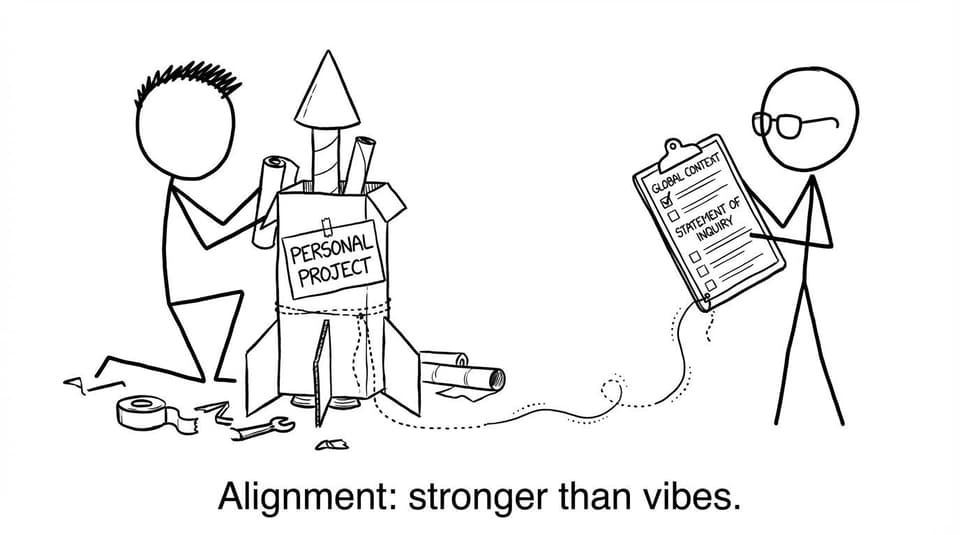
How to pick the right MYP Global Context (without overthinking)
Most MYP students overthink the context because they start with the list and try to force-fit their topic.
Reverse it:
Start with one honest sentence
Write: "This project matters because…"
- If you write about people and well-being -> Identities and Relationships.
- If you write about voice and meaning -> Personal and Cultural Expression.
- If you write about history and perspective -> Orientation in Space and Time.
- If you write about new solutions and responsibility -> Scientific and Technical Innovation.
- If you write about justice and access -> Fairness and Development.
- If you write about systems and long-term impact -> Globalization and Sustainability.
Then confirm with your evidence
Ask: "What evidence will I include in my report?" In MYP, evidence drives marks.
- Surveys, interviews, feedback cycles -> often Innovation, Identities, or Fairness.
- Experiments, prototypes, testing data -> often Innovation or Sustainability.
- Archives, timelines, heritage sources -> often Space and Time.
- Artist statements, drafts, audience response -> often Cultural Expression.
If you want a step-by-step method with examples, read Identifying the Best Global Context for Your MYP Project.
The most common MYP Global Context mistakes (and the fix)
Mistake: choosing the most "impressive" context
Students pick Globalization and Sustainability because it sounds big. In MYP, big is not better. Specific is better.
Fix: narrow to one local system you can actually investigate (your cafeteria waste, transport habits, uniform sourcing) and connect it to the wider issue.
Mistake: writing the context once, then forgetting it
Markers feel this instantly. Your report becomes a timeline, not an inquiry.
Fix: add a one-line "context connection" at the end of each major section: research, planning decisions, action evidence, reflection.
Mistake: confusing "topic" with "context"
"Technology" is not a context. "Music" is not a context. Those are topics.
Fix: write the human question under the topic: What does technology change? What does music express? In MYP, the human question is the context.
How RevisionDojo helps MYP students turn contexts into marks
A Global Context is only useful if it shows up in your work. RevisionDojo helps you make that happen with tools that match the way MYP assessment works:
- Use the MYP Personal Project Grader to check whether your Criterion A-D writing actually aligns with your context (and whether your reflections sound like reflection, not summary).
- If your project includes science, math, or research methods, practice clear explanation with the Questionbank so your report writing becomes more precise.
- Build memory for ATL language and key definitions using Flashcards, especially when you keep repeating the same vague verbs in Criterion D.
- When you need to rewrite a clumsy Statement of Inquiry or tighten a goal, use AI Chat inside RevisionDojo (students often use it like a calm supervisor who never gets tired).
If you're in revision mode more broadly, the MYP Revision Guide: Study Tips for Success is a good companion -- especially if your Personal Project deadlines are colliding with subject tests.
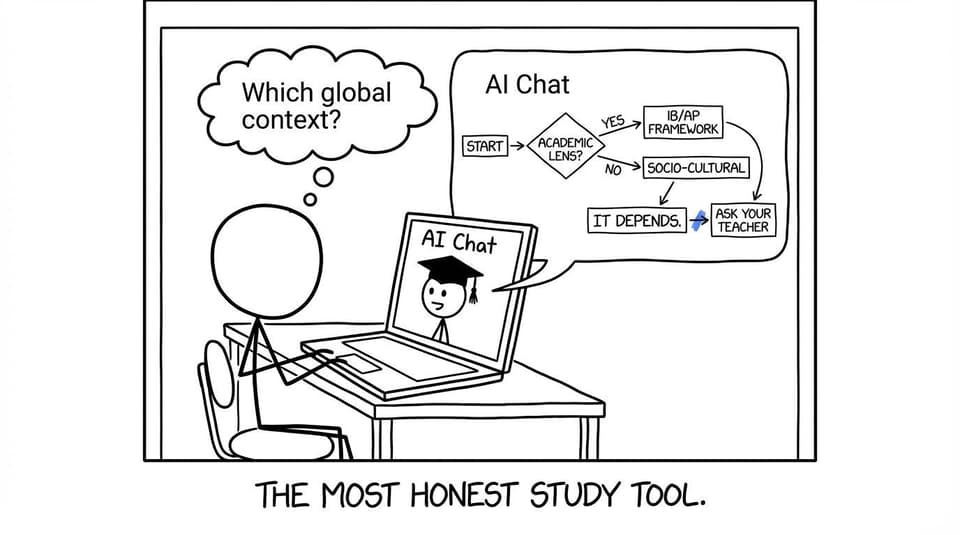
Closing: choose the MYP context that tells the truest story
The best MYP Personal Projects don't feel like a performance. They feel like a story of a student who noticed something, cared about it, and then learned how to act with structure.
Your Global Context is where that story begins to make sense to someone else.
If you want your context to translate into marks, don't just name it. Build with it. Research through it. Reflect through it. And when you're ready to tighten your report, check your work against the rubric with the MYP Personal Project Grader, then reinforce your skills with RevisionDojo's Questionbank, Study Notes, Flashcards, AI Chat, Grading tools, Predicted Papers, Mock Exams, Coursework Library, and Tutors.
In the MYP, clarity compounds. Start with the right Global Context, and the rest of your project gets easier to do -- and easier to assess.