

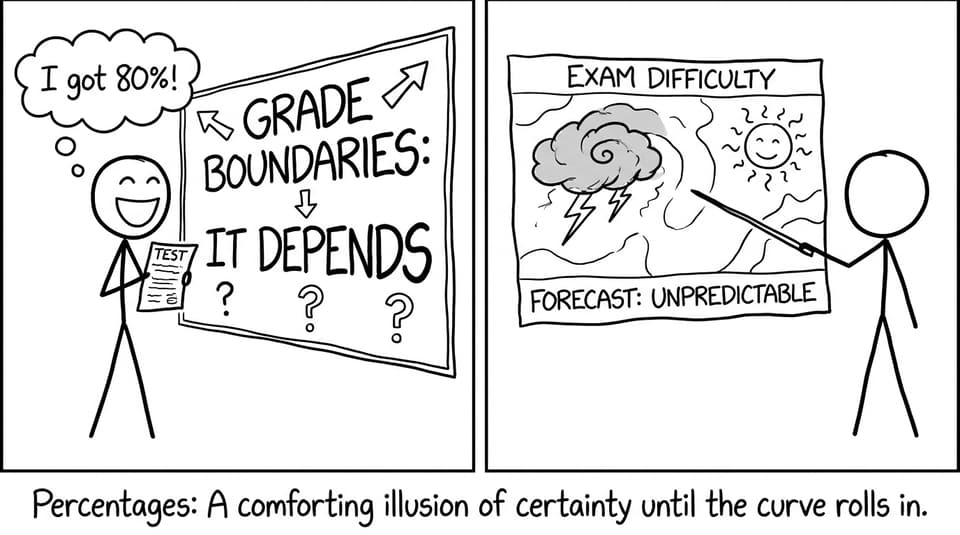
In the IB, 80% feels like a clean, comforting number. It sounds like certainty: I know four-fifths of the course, so I should get the top grade.
Then results day arrives, and someone with “roughly the same percentage” gets a different grade. That’s when you learn the quiet truth of the IB: your grade is less like a single score and more like a translation.
Is 80% usually enough for a 7 in the IB?
Often, yes: in many IB subjects, scoring around 80% across the whole subject (after weightings) puts you in range for a 7.
But it is not a guarantee.
A 7 depends on:
-
The subject and level (SL vs HL)
-
The exam session (boundaries shift)
-
Component weightings (papers vs internal assessment)
-
How difficult the papers were globally
If you want a reality check for your exact subjects, start with RevisionDojo’s IB Grade Boundaries and compare multiple sessions, not just one.
The IB grading idea most students miss: boundaries move
The IB doesn’t decide boundaries first and then write the exam. Boundaries are set after marking, once the exam’s difficulty and global performance are clearer.
That’s why “80% correct” isn’t a fixed promise. It’s a strong position, but the finish line can shift.
For a deeper explanation of how this works, read IB Grade Boundaries: How They’re Actually Calculated and Insights on IB Grade Boundaries and Result Trends.
What a 7 means in the IB (and why it feels harder than it sounds)
In the IB Diploma Programme, subject grades run from 1 to 7. A 7 signals not just knowledge, but consistent performance under the exact rules of the assessment: markschemes, rubrics, command terms, and timing.
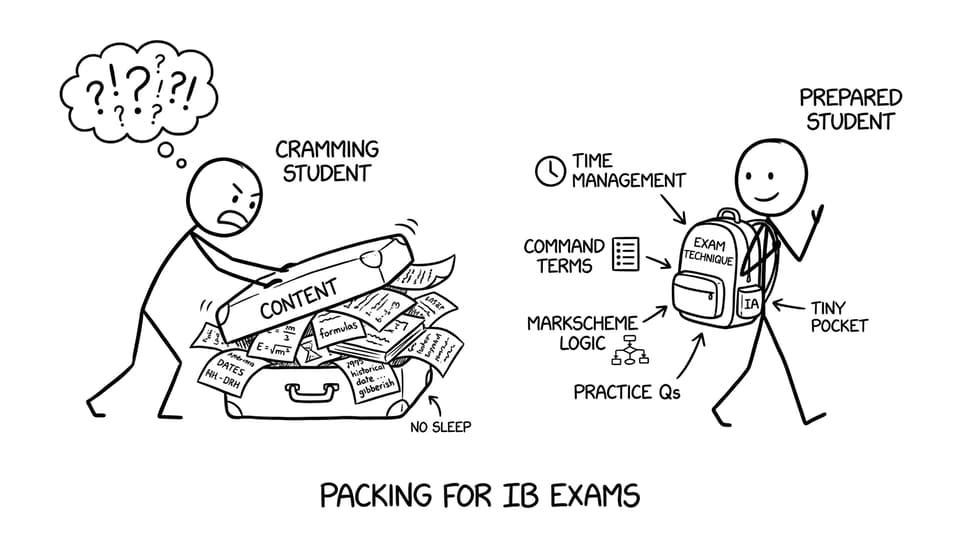
In other words, a 7 is as much about avoiding unforced errors as it is about being “smart.” The students who hit 7s tend to do fewer small, repeatable mistakes: missing a definition, skipping a unit, not linking back to the question, or writing a beautiful paragraph that doesn’t match the command term.
Quick checklist: if you’re aiming for a 7, do this instead of chasing 80%
Here’s a calmer IB target than “get 80% correct”:
-
Track boundaries for your subject and build a buffer of a few marks
-
Protect your internal assessment marks (they’re more controllable than exam-day mood)
-
Train command terms until your answers match what is being asked
-
Practice exam-style questions under time pressure
-
Review like an examiner (marks are awarded for visible moves, not effort)
To turn that into a system, RevisionDojo helps you combine Study Notes, Flashcards, the Questionbank, and timed Mock Exams in one workflow. If you haven’t explored it yet, start here: RevisionDojo for IB.
How IB subject grades are calculated (why 80% can be misleading)
Most IB subjects combine multiple components, usually:
-
External exams (often the majority)
-
Internal assessment (often 20--30%, depending on subject)
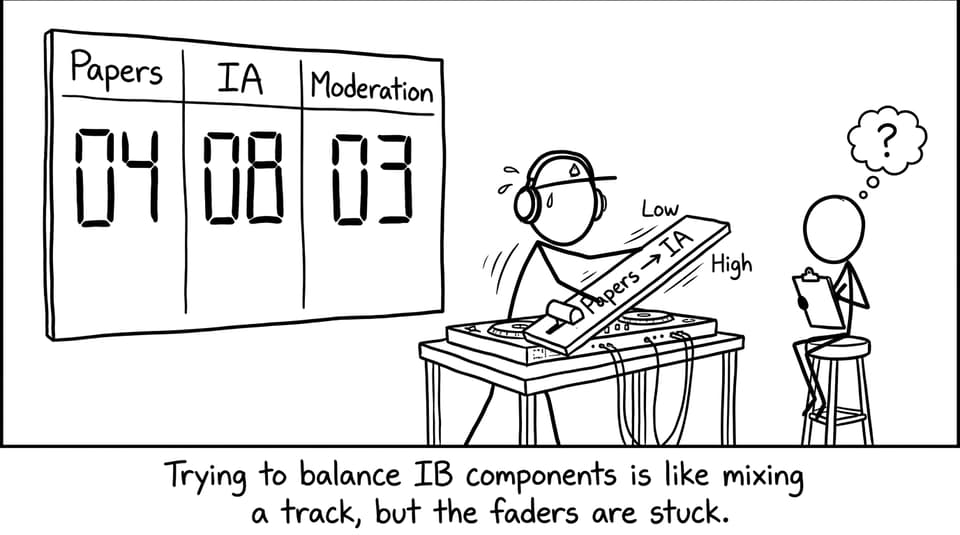
So “80% correct” on one paper is not automatically “80% overall.” Your final subject total is a weighted result.
If you want to estimate outcomes quickly, use the IB Grade Calculator to see how components combine.
Why 80% is sometimes more than enough (and sometimes not enough)
Two students can both say “I’m around 80%,” but mean different things:
-
One student is losing marks in hard-to-fix places (essay structure, evaluation, unclear working).
-
Another student is losing marks in easy-to-fix places (definitions, units, command term alignment).
Meanwhile, boundaries can drift:
-
If papers are tougher, boundaries often lower.
-
If papers are more predictable, boundaries can rise.
If you’re curious about where boundaries might move, see Will IB 2026 Grade Boundaries Be Higher or Lower? and IB Grade Boundaries: How They Affect Your Final Score.
The smartest way to “beat” IB grading: win the marks you can repeat
The fastest improvements in the IB usually come from repeatable marks:
-
Knowing the definition the markscheme wants
-
Writing in the right answer shape for the command term
-
Showing method marks clearly
-
Using evidence, data, or a justified conclusion when asked
That’s why practicing with feedback matters. RevisionDojo’s Questionbank and topic pages (for example, IB Math AA Calculus Questionbank) are built for targeted drilling, then fixing, then retesting.
To improve your structure across subjects, keep these two guides open while you practice:
A calmer target than 80%: build a boundary buffer
If you’re asking whether 80% is enough for a 7, you’re already thinking like a strategist. Keep going.
In the IB, the winning move is not predicting boundaries--it’s building a buffer. Use RevisionDojo’s Study Notes to clarify the syllabus fast, drill weak spots with the Questionbank, lock in recall with Flashcards, and pressure-test yourself with Mock Exams and Predicted Papers. When you want fast clarity mid-revision, use AI Chat; when you want a human plan, lean on Tutors; and when coursework threatens to steal your whole week, use the Grading tools and Coursework Library to iterate smarter.
Aim above 80% when you can. Not because you need perfection, but because the IB rewards the students who leave less to chance.