

The night you "did the math" and still couldn't sleep
Most IB students have a moment like this: you finish a mock, you total your raw marks, and you feel almost calm. Then someone says, "Yeah, but what if the grade boundaries go up?"
Suddenly your score feels less like a number and more like a rumor.
That's the strange psychology of the IB. You can do everything "right" and still feel uncertain because the last step of your grade isn't just your performance. It's your performance compared to a moving threshold.
This article is a clear guide to how IB grade boundaries affect your final score, why they change, and how to revise in a way that makes boundaries less scary and more useful.
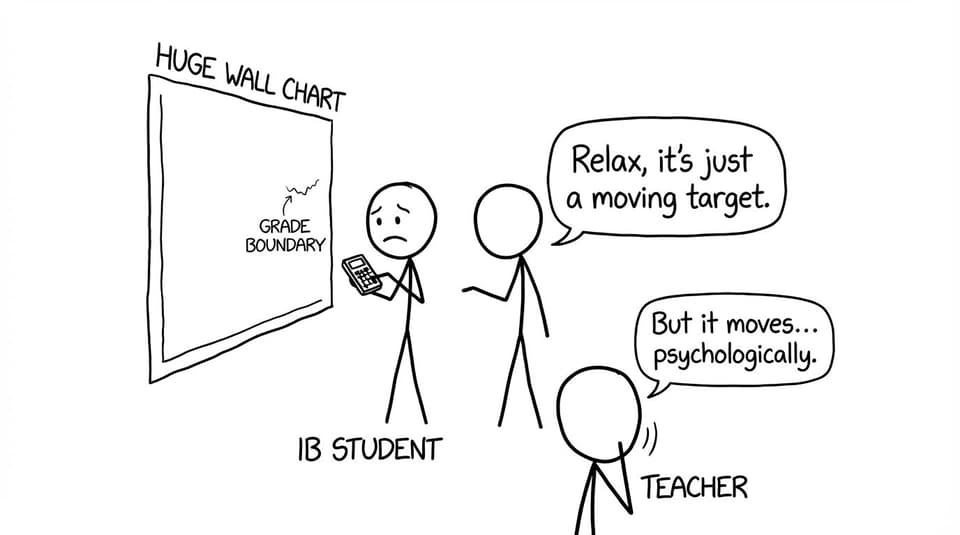
Quick checklist: what to know about IB grade boundaries
- IB grade boundaries convert your total marks into a grade from 1 to 7.
- Boundaries shift each exam session to account for paper difficulty and overall performance.
- Your "final score" is usually a weighted total of components (papers + internal assessment), not a single test.
- Small mark changes near a boundary can change your grade more than large mark changes far from a boundary.
- The best strategy is to build a buffer: aim to score safely above the typical boundary, not exactly on it.
- Use tools that mirror IB marking and timing so your practice marks mean something.
If you want a reliable place to track boundaries over time, start with IB Grade Boundaries.
What grade boundaries actually do in the IB
Think of the IB grading system as a translation layer.
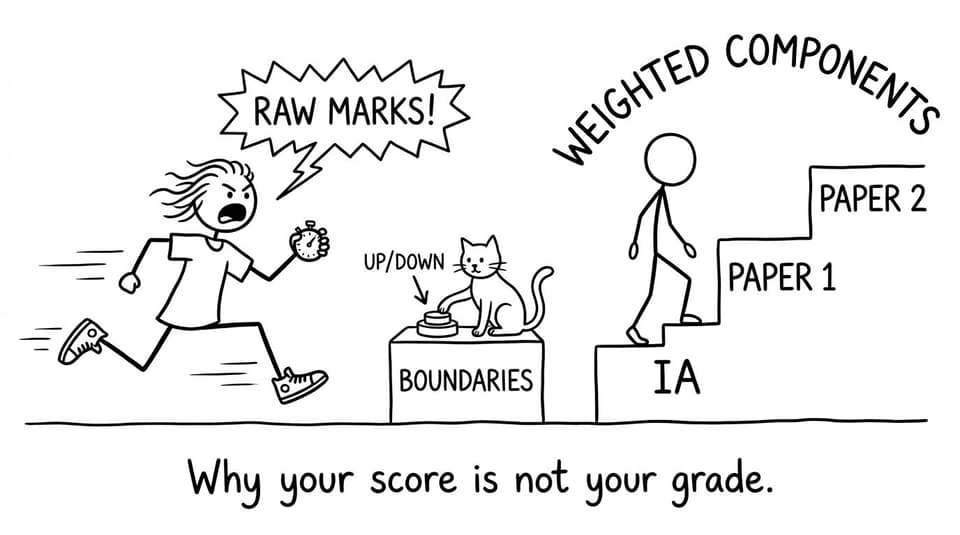
You produce raw marks from different components: Paper 1, Paper 2, sometimes Paper 3, plus your internal assessment. Those marks are combined using weights to create a final mark out of 100 (in many subjects). Then IB grade boundaries translate that final mark into a grade (1 to 7).
The important part: you are not graded against a fixed percentage like "90% = 7."
A 7 in one session might start at 79/100. In another session it might start at 82/100. The IB is trying to keep grade standards consistent even when exams vary in difficulty.
This is why "I got 75%" doesn't automatically mean the same thing across years, subjects, or time zones.
To see how this looks in practice, you can browse a specific subject's boundary history (for example, IB Mathematics: Applications and Interpretation Grade Boundaries).
Why IB grade boundaries change each session
IB grade boundaries move for boring reasons that feel dramatic when you're 1 mark away.
Exam difficulty
If an exam is harder than intended, raw marks drop. Boundaries may be lowered so that a "Grade 7 level performance" is still rewarded with a 7.
Overall student performance
If the cohort performs unusually strongly or weakly, boundaries can shift. The IB uses statistical methods and examiner judgment to maintain comparable standards.
Component interactions
Your internal assessment can change the overall distribution of marks. If many students have strong IAs, total marks rise, and boundaries can behave differently than you expect from the exam papers alone.
The key mindset shift for any IB student: boundaries are not a punishment or a bonus. They are a calibration tool.
The part students miss: your IB grade is weighted, not "just the exam"
A lot of boundary anxiety comes from mixing up three different numbers:
- Raw marks: what you scored on a paper (e.g., 46/80).
- Weighted marks: what that paper contributes to your final mark after weighting (e.g., Paper 2 is 36% of the course).
- Final grade: the 1 to 7 after boundaries are applied.
When students say "I need a 7," what they often mean is "I need a final mark above the 7 boundary." But you get there through a weighted blend of components.
That's why a small improvement in a heavily weighted paper can matter more than a big improvement somewhere else.
RevisionDojo helps here because your practice can be structured the same way you'll be assessed: you can build volume with the Comprehensive IB Question Bank, then test stamina with Online IB Mock Exams, and use grading feedback loops to tighten your mark efficiency.
How grade boundaries affect your final score (with a simple story)
Imagine two IB students, same subject, two different exam sessions.
- Student A scores 78/100 in May.
- Student B scores 78/100 in November.
Student A gets a 7 because the boundary for a 7 starts at 78.
Student B gets a 6 because the boundary for a 7 starts at 80.
Their performance is identical. Their outcome isn't.
This feels unfair until you remember what boundaries are doing: translating marks into a stable standard across different papers. If November's exam was easier, more students cluster higher, and the boundary can rise.
So what should you do?
You build a buffer. In the IB, "safe grades" beat "exact grades." If you aim to sit exactly on the grade boundary, you're betting your future on noise.
IB grade boundaries as a strategy tool (not a source of panic)
Once you accept that boundaries move, they become useful.
Use boundaries to set realistic targets
If recent sessions show a 7 boundary around 78--82, your goal isn't "get 78." It's "consistently score 84+ in timed conditions."
Use boundaries to identify high-leverage improvements
If you're consistently 2--4 marks below a boundary, that's not "I'm bad at this subject." That's usually:
- dropping method marks,
- misreading command terms,
- losing time to one question,
- writing too much where the markscheme wanted structure.
Those are fixable.
On RevisionDojo, students usually get this clarity by combining:
- Study Notes to rebuild understanding quickly,
- Flashcards for definitions and processes that must be automatic,
- Questionbank drills to train mark-winning habits,
- AI Chat to resolve confusion without stalling,
- Mock Exams to make timing predictable,
- Predicted Papers to practice realistic mixes of content,
- Grading tools for criterion-based feedback, especially on written responses and coursework.
If you want to see how an all-in-one workflow fits together, use RevisionDojo App: The Smarter Way to Prep for IB Exams.
Where students lose marks near a boundary (and how to stop)
A boundary doesn't "steal" your grade. Your mark profile does.
Boundary-zone mistake: chasing hard questions for ego marks
Near a grade boundary, the most valuable marks are often the simplest ones you're currently missing.
A surprising number of IB students lose 5--10 marks per paper on:
- incomplete working,
- missing units or significant figures,
- weak definitions,
- vague evaluations,
- not linking to the question stem.
Those are not "content gaps." They're technique gaps.
A practical loop:
- drill topic questions in the IB Questions: Official Exam Practice style,
- get instant feedback,
- tag mistakes,
- retest the same micro-skill 48 hours later.
That's how you turn a "maybe 6, maybe 7" into a stable 7.
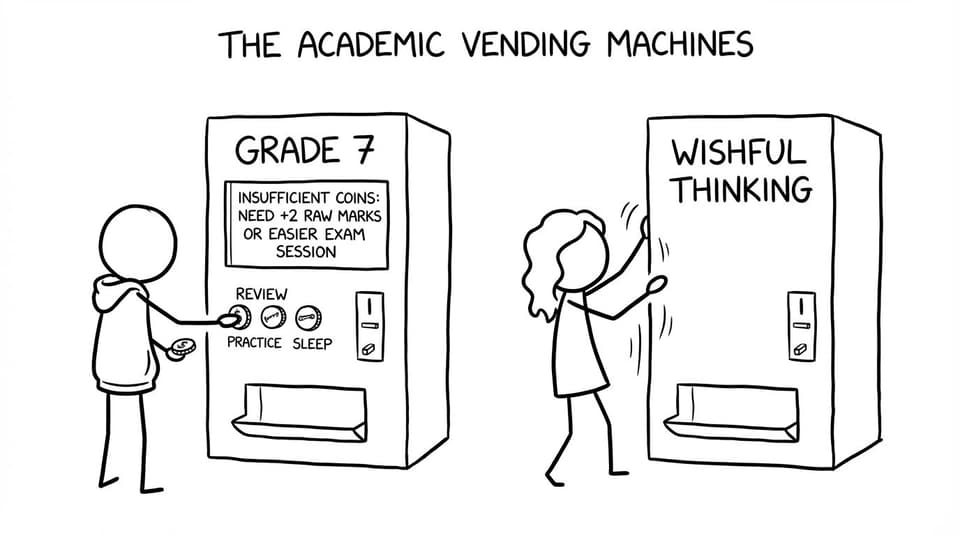
How to plan revision when IB grade boundaries are uncertain
Certainty is rare in the IB. Progress isn't.
Here's a simple plan that respects boundaries without obsessing over them.
Build a "boundary buffer" plan (2 weeks)
Step 1: Find your current grade zone
Use a timed mock to get a realistic mark. Not your best day. A normal day.
If you need help structuring that, How to Use RevisionDojo's Mock Exam Builder to Simulate IB Conditions is a strong guide.
Step 2: Convert the mark into a target
Look up your subject's typical boundaries and set a buffer goal of +3 to +6 marks above the boundary you want.
Step 3: Spend 70% of your time on repeatable marks
Repeatable marks are the ones you can reliably get again next week: definitions, method marks, structured responses, standard processes.
This is where Custom IB Question Banks: Focus on What You Need Most becomes the difference between "studying a lot" and "scoring more."
Step 4: Audit your written work like an examiner
If your subject includes essays, investigations, IAs, TOK, or extended responses, boundaries are only part of the story. Rubric alignment is the other.
Use IB Coursework Grader and the Coursework Library mindset: compare your draft to what the criteria actually reward, then iterate.
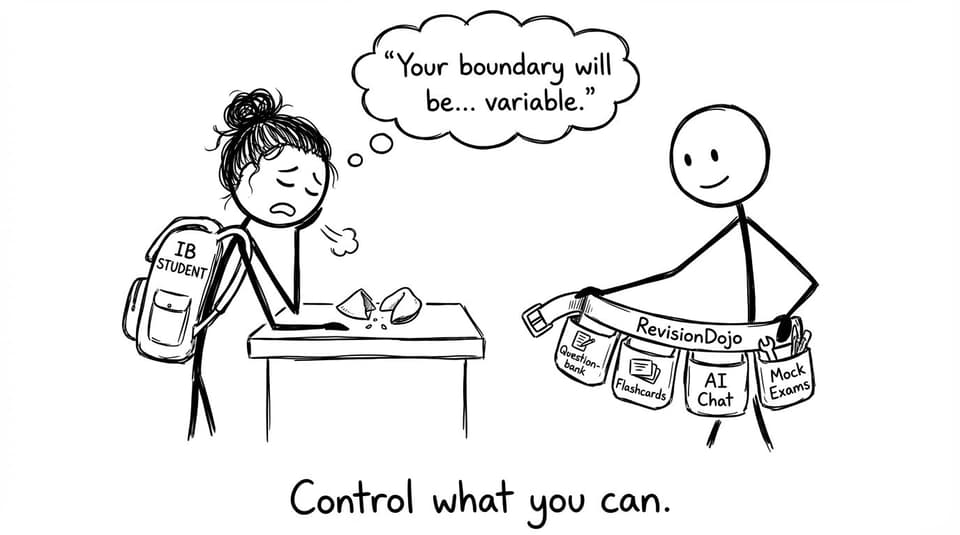
Closing: make grade boundaries boring
The most peaceful IB students aren't the ones who found the "right prediction" for grade boundaries.
They're the ones who built enough evidence that boundaries don't matter much.
If you want that feeling, do what works in every exam system: practice the exact skill, under the exact constraints, with feedback that matches the markscheme. Use IB Grade Boundaries to set targets, then use RevisionDojo to build the buffer: Questionbank for repetition, Study Notes and Flashcards for speed, AI Chat for momentum, Mock Exams and Predicted Papers for realism, and Grading tools for written work and coursework.
The IB will always have moving thresholds.
Your job is to make your performance move more.