
If you're an IB student, you've probably had this thought at 1:17 a.m. while "just checking one thing" on your phone:
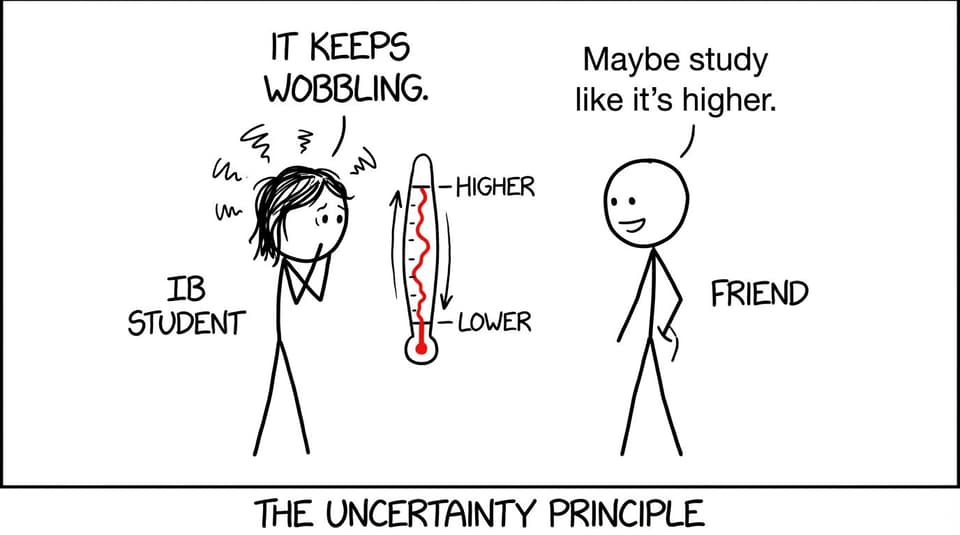
What if IB 2026 grade boundaries jump?
It's a very human fear. Not because you're lazy, but because boundaries feel like weather. You can feel the pressure drop, you can see the clouds forming, but you can't actually control the storm.
Here's the grounding truth: you can't predict IB 2026 grade boundaries with certainty. But you can understand what tends to push them higher or lower, and you can build an exam plan that performs well across either outcome.
And that's the point of this post: less guessing, more leverage.
Along the way, we'll use the best signal available: historical IB boundary movement by subject and session, plus what changed recently in exam design and cohorts. When you're ready to explore the actual boundary trends, start with IB Grade Boundaries and compare sessions in your specific subjects.
IB 2026 grade boundaries: quick answer (and a smarter way to think)
Grade boundaries in the IB tend to move based on two things:
- Exam difficulty (harder paper == boundaries often lower)
- Global candidate performance (stronger cohort == boundaries often higher)
So will IB 2026 grade boundaries be higher or lower?
- If papers are slightly easier or more predictable, boundaries can drift higher.
- If papers are harder, novel, or the cohort underperforms, boundaries can drift lower.
The smarter framing is this: your job is to prepare like the boundaries will be higher, while building enough skill that if boundaries are lower, you simply gain margin.
That's how you stop boundaries from living rent-free in your head.
A practical checklist: what you should do now (regardless of boundaries)
Use this as your "calm plan" for IB exam season:
- Track boundary trends for your subject using IB Grade Boundaries
- Build technique with exam-style practice using the Questionbank feature
- Do one timed paper block weekly (increase frequency closer to exams)
- Convert mistakes into daily active recall with flashcards
- Use feedback loops: redo weak topics 48 hours later
- For coursework stress, use IB Coursework Grader so coursework doesn't swallow revision time
If you want a full system that connects those steps, read RevisionDojo App: The Smarter Way to Prep for IB Exams.
What actually moves IB grade boundaries up or down?
The IB doesn't pick grade boundaries to "be nice" or "be harsh." Boundaries are set after marking, with statistical moderation and examiner judgment to keep standards stable across sessions.
Still, boundaries do move, and usually for understandable reasons.
Paper difficulty: the quiet lever
When an IB paper is unusually difficult (timing pressure, unfamiliar question styles, tricky mark allocation), student raw marks drop. Boundaries often drop too, because the IB doesn't want one session to be "the year everyone got punished."
When a paper is more straightforward, raw marks rise, and boundaries can rise.
You can see this volatility in subjects where question style and technique matter a lot. For example, compare the over-time table for IB Mathematics: Applications and Interpretation grade boundaries. Even small shifts in paper feel can create real boundary movement.
Cohort strength: the invisible lever
Even if the paper difficulty stays similar, the global cohort changes.
A cohort can be stronger because:
- schools adapted better to the syllabus
- students had more access to effective practice tools
- teaching time was more stable
A cohort can be weaker because:
- syllabus transitions create uncertainty
- students rely on passive revision (rewriting notes) instead of active recall
- schools under-train timing and command terms
This is why "my mock felt easy" doesn't reliably predict boundaries. Your mock is local; boundaries are global.
Syllabus maturity: early years are noisy
New or recently revised courses can have more variability. Teachers are still calibrating what "good" looks like, students are learning what examiners reward, and the IB is refining paper style.
If your subject is in a newer cycle, you should expect more uncertainty and lean harder into exam-style practice and feedback.
Marking reliability and component balance
In some IB subjects, big components (essays, long responses, or performance tasks) can widen mark distributions. That can nudge boundaries. But as a student, your best move is to master what's controllable: structure, command terms, and consistent method.
For broader context on how boundaries shift and why, Insights on IB Grade Boundaries and Result Trends is a helpful companion.
What do recent IB grade boundary trends suggest for 2026?
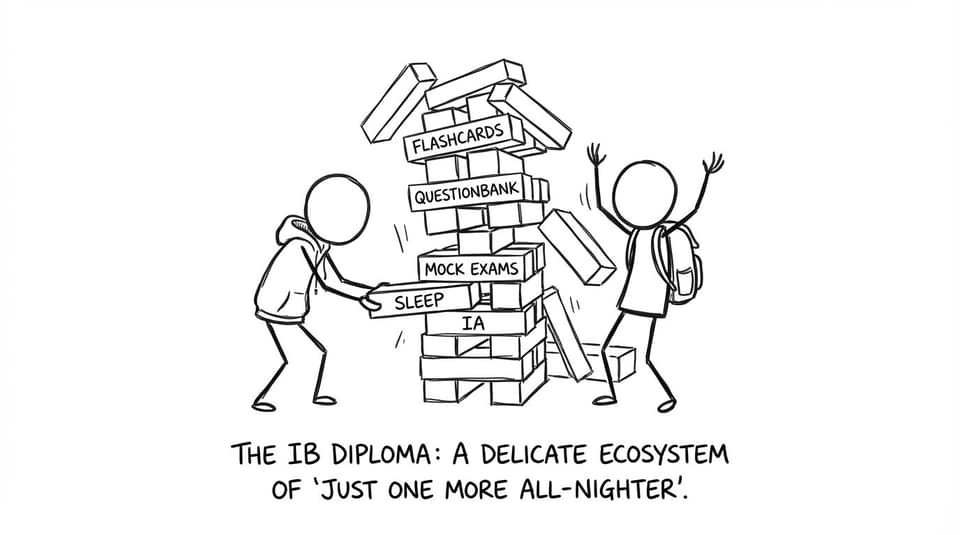
We can't forecast IB 2026 boundaries precisely, but we can extract a few reasonable expectations from how boundaries behave across recent sessions.
Expect "normal volatility," not a single global direction
Students often ask, "Will boundaries be higher this year?" as if the IB flips one master switch.
In reality:
- some subjects drift upward
- others drift downward
- some barely move
Even within the same subject group, the pattern can differ by time zone and paper design.
Your takeaway: don't plan your IB strategy around a single prediction. Plan around a range.
Some subjects show stability, others swing more
Certain subjects tend to show more stable grade thresholds year-to-year. Others have more movement because:
- timing is tighter
- mark schemes are more granular
- question styles change more perceptibly
To see your own subject's "personality," check a subject-specific boundary page like IB History grade boundaries and compare multiple sessions. Look at how much the 7-boundary moves, not just the average.
Your most useful prediction is personal: can you create margin?
In IB, the best psychological hack is to stop asking for certainty and start building margin.
Margin means:
- you can lose a few marks to nerves and still land your target
- you can meet a slightly higher boundary without needing a miracle
Margin is built through exam repetition, not motivation.
If IB 2026 grade boundaries are higher, what should you change?
If boundaries rise, the students who suffer are usually not the ones who "didn't study enough." They're the ones who studied the wrong way.
Higher boundaries punish:
- vague answers
- weak command term control
- poor timing
- "I understood it when I read it" revision
So the adjustment is simple and surprisingly calm: treat IB revision as skill training.
Use the IB mark scheme as your steering wheel
Every time you miss marks, ask:
- Did I misread the command term?
- Did I skip a required step?
- Did I explain but not apply?
- Did I use correct subject language?
RevisionDojo's Questionbank feature helps here because you can practice at volume, then use feedback to spot recurring mark losses. You're not just "doing questions." You're building a map of your mistakes.
Do more timed work than you feel ready for
Most IB students delay timed practice until confidence arrives.
Confidence doesn't arrive. It's built.
A practical routine:
- 1 timed session/week now
- 2 timed sessions/week one month out
- 3 timed sessions/week in the final stretch
If you want a guide for running this properly in one place, use How to Run Timed IB Mock Exams in RevisionDojo (Exam Mode + Test Builder).
Build memory with flashcards, not hope
The IB often rewards precise phrasing: definitions, assumptions, processes, case-study details.
That's not something you can rely on adrenaline to deliver.
Use flashcards daily. Short sessions. High consistency.
RevisionDojo's Flashcards and AI Chat make this less painful: you can create decks from weak topics and clarify confusion without derailing the study session.
If IB 2026 grade boundaries are lower, what should you do?
This is the part students don't expect: lower boundaries are not a strategy.
If boundaries drop, it's often because the paper was harder. That means the exam itself was more punishing: more traps, more time pressure, more "I've never seen this phrasing before."
So if you prepare for lower boundaries by relaxing, you risk the worst combination: a hard paper and low readiness.
The right move is the same: prepare strongly.
Then if boundaries are lower, you gain margin.
Use prediction tools carefully: simulate, don't substitute
What you want from predicted sets and mock exams is not "knowing the questions."
What you want is:
- practice with likely formatting
- rehearsal under time
- exposure to common traps
- rapid feedback loops
RevisionDojo's Predicted Papers and Mock Exams are built for that kind of simulation, with Jojo AI grading and examiner-style feedback. If you want an example set, explore a subject hub like IB Physics Predicted Papers or IB Biology Predicted Papers.
The best way to "beat" grade boundaries: play the IB game correctly
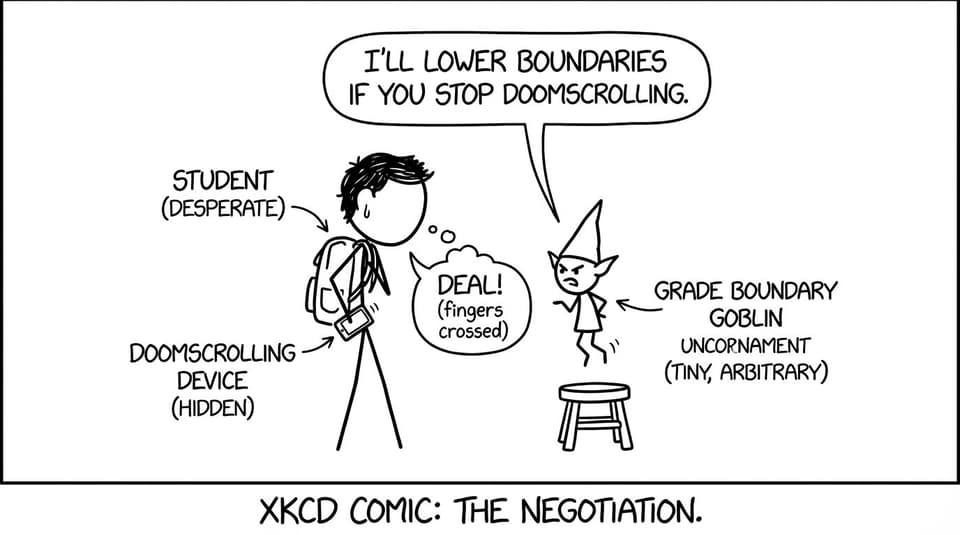
Boundaries feel like a moving finish line. But the IB is more consistent than it looks.
It rewards students who can repeatedly do three things:
- Recall key knowledge quickly
- Apply it in the format the IB expects
- Communicate with precision under time pressure
That's why RevisionDojo is designed as an all-in-one IB loop, not a pile of resources:
- Study Notes to reduce noise and focus on examinable ideas
- Flashcards to make memory automatic
- Questionbank to train technique and command terms
- AI Chat (Jojo) to unblock confusion instantly
- Grading tools and the Coursework Library to prevent coursework from dragging into exam season
- Predicted Papers and Mock Exams to simulate real conditions
- Tutors when you need a human to help you rebuild a topic properly
If you want to see the full platform overview, start at All your IB revision needs, in one place.
Closing: don't bet your future on a number you can't control
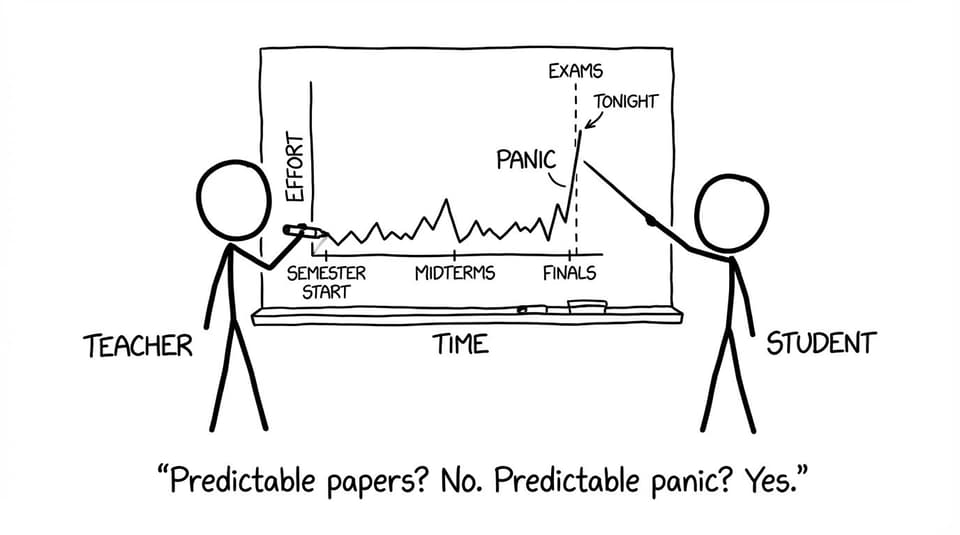
The question "Will IB 2026 grade boundaries be higher or lower?" makes sense. It's your brain looking for certainty before it spends effort.
But the students who do best in the IB tend to do something counterintuitive: they stop chasing certainty and start building proof.
Proof looks like:
- timed practice
- repeated exposure to exam phrasing
- clear feedback on what loses marks
- small daily recall habits that compound
If you want that proof in one place, use RevisionDojo as your system: Questionbank, Study Notes, Flashcards, AI Chat, Grading tools, Predicted Papers, Mock Exams, the Coursework Library, and Tutors when you need them.
When boundaries finally arrive, you won't feel surprised. You'll feel ready.
