

Choosing an IB Math IA topic feels weirdly like choosing a playlist for a long flight. You think it’s a small decision, then you realize you’ll be stuck with it for weeks. The right topic keeps you curious when motivation dips. The wrong one turns every paragraph into a negotiation with your own patience.
In the IB, your Math IA is one of the few assessed pieces you can shape completely. That freedom is the point. But it also means your topic choice quietly decides everything: how “mathematical” your exploration becomes, how manageable your data is, and how naturally you can reflect on limitations without sounding forced.
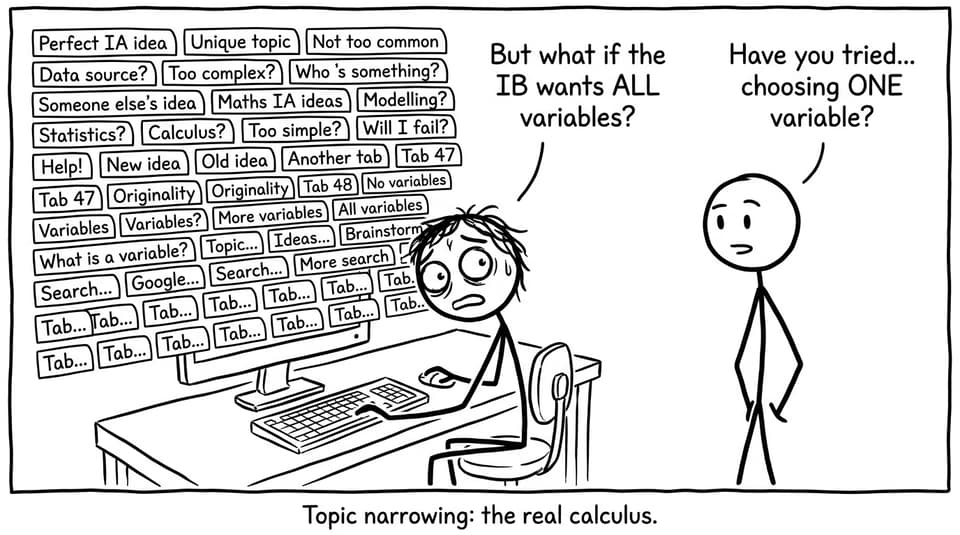
The quick IB checklist (save this before you brainstorm)
Use this fast screen before you commit to any IB Math IA topic:
-
Personal hook: Can you explain why you care in 2 sentences?
-
Math depth: Will you do more than averages and a single regression?
-
Scope control: Can it fit in the IA length without becoming “everything”?
-
Feasibility: Do you have data (or a model) you can actually execute?
-
Rubric fit: Does it create room for clear communication and reflection?
When you’re unsure, skim a few strong examples first. Start with Successful IB Math IA Topics: Examples That Score to calibrate what “good” looks like before you fall in love with an idea.
Why your IB topic choice shapes the entire IA
A good IB IA topic is a small, well-lit room. You can see the walls, you know what belongs inside, and you can move around without tripping.
A weak topic is an open field at night. You can run in any direction, which sounds exciting until you realize you have no landmarks. That’s how students end up with 18 pages of graphs and no argument.
If you want the bigger picture of what examiners reward, pair this post with How to Write a Top-Scoring Math IA (2025 Guide) and the examiner-aligned IB Mathematics Analysis and Approaches (AA) IA Guide. Even if you’re in AI, the criteria language and expectations in the IB are shared.
Start with your interests, then force them into variables (IB students miss this)
Most IB students brainstorm like this:
“I like basketball. I’ll do an IA on basketball.”
That’s not a topic. That’s a theme.
A topic appears when you can name variables and a method. Try this conversion:
-
Interest: basketball
-
Measurable variables: release angle, distance, success rate, time
-
Math tools: quadratic modeling, optimization, regression, error analysis
-
First draft research direction: “How does release angle affect shot success from a fixed distance?”
Do the same for anything you genuinely care about:
-
Finance: “Can exponential smoothing model weekly spending patterns?”
-
Gaming: “What probability model best fits loot outcomes over 200 trials?”
-
Music production: “How do frequency ratios predict perceived consonance?”
For inspiration that stays modern (and avoids tired clichés), browse IB Math IA Ideas for 2025 and Beyond and The Best IB Math IA Topics for 2025.
Make it personal without making it messy (a core IB skill)
“Personal engagement” in the IB doesn’t mean writing a diary entry. It means the work shows ownership: your data, your choices, your reasoning, your limitations.
A clean way to do this is to use primary data where possible:
-
your running or sleep data
-
measurements from your school environment
-
a short survey you designed
-
video analysis you performed yourself
Secondary data is still fine. Just make it yours by changing the question or method: compare two models, test assumptions, or validate with a smaller set of primary data.
If you’re building skills for the exams at the same time (smart), RevisionDojo helps you run both tracks: practice the underlying math in the Questionbank, then reuse that confidence inside your IA writing. For example, if your IA uses regression or calculus, drill the mechanics in IB Mathematics Analysis and Approaches Topic Calculus Questionbank or the broader IB Mathematics Analysis and Approaches Resources.
Build “math richness” on purpose (IB depth is designed, not hoped for)
Many IB Math IA topics fail for a quiet reason: they stop right after the first result.
To guarantee depth, plan at least two layers:
-
Layer 1 (core model): regression, a function model, a probability distribution, a differential equation, an optimization setup.
-
Layer 2 (analysis/reflection): residuals, parameter sensitivity, confidence intervals, error propagation, comparing models, limitations, or an extension.
A simple example:
-
Layer 1: Fit a logistic model to adoption of a trend.
-
Layer 2: Compare logistic vs exponential early-stage fit and discuss why the model breaks.
If your IA is AI-focused, the step-by-step thinking in IB Math AI Internal Assessment: Step-by-Step Guide is a strong companion.
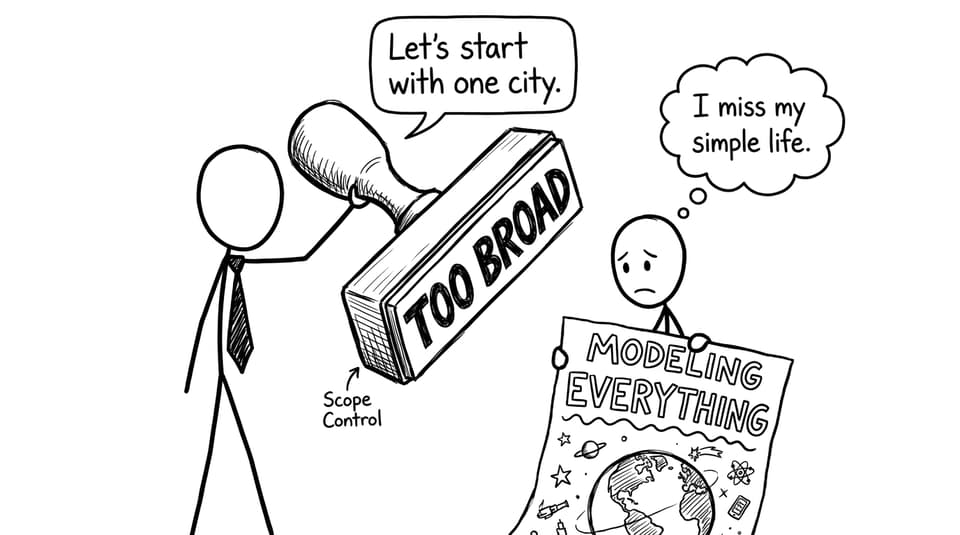
Narrow the scope like your grade depends on it (because it does)
A reliable IB rule: if your topic contains the word “everything,” it’s too big.
Instead of:
- “Modeling population growth”
Try:
- “Modeling honeybee colony growth in one region using a logistic model, then testing sensitivity to carrying capacity.”
Instead of:
- “Traffic flow”
Try:
- “Queue modeling at one school intersection between 8:00 and 8:30, comparing two timing strategies.”
You want a question that sounds narrow enough to be answered, but open enough to be evaluated.
Avoid the overused ideas unless you have a twist (IB examiners have seen it all)
Some topics aren’t “bad.” They’re just crowded. In the IB, crowded topics create a new problem: it’s harder to sound original and harder to show authentic engagement.
Examples that often underdeliver:
-
golden ratio in art (without new data or deeper modeling)
-
Fibonacci in nature (without rigorous testing and limitations)
-
vague “math in music” explorations (without a measurable aim)
If you love one of these, keep it, but add a constraint: a dataset, a comparison of models, or a method that forces insight.
Feasibility test: can you actually do the math and get the data?
Before you marry a topic, run this IB feasibility check:
-
Can you access data in a week (or collect it in two)?
-
Can you explain the method clearly to a classmate?
-
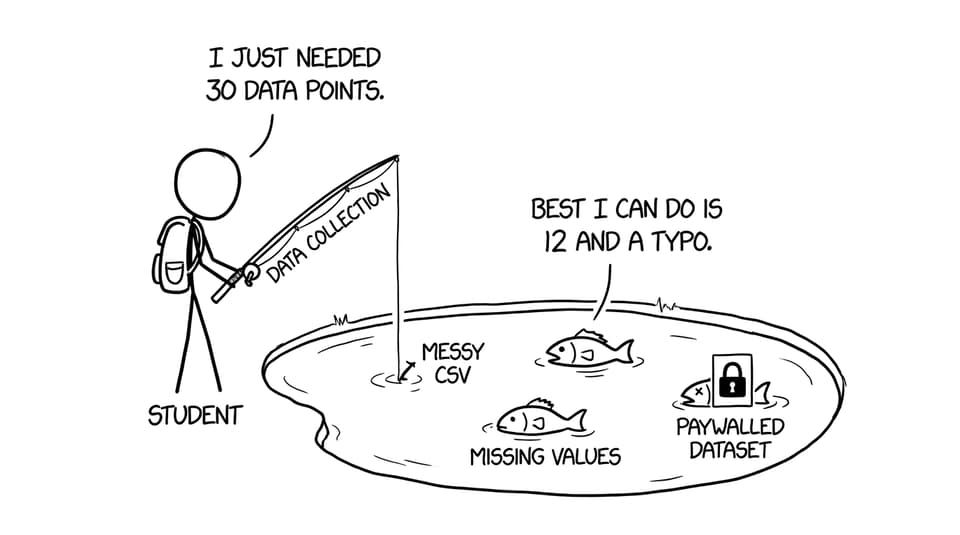
Do you have a backup plan if data is messy?
Messy data is normal. But unmanaged messy data becomes the whole IA.
When you’re building the math foundation for both IA and exams, use RevisionDojo’s full stack: Study Notes to relearn the concept, Flashcards to retain it, AI Chat when you’re stuck mid-derivation, and Grading tools to check whether your reasoning is rubric-ready. If you want to pressure-test the topic under timed thinking, run Mock Exams and use Predicted Papers for exam-style conditioning. And if you need human feedback, RevisionDojo Tutors can help you adjust scope before you waste a weekend.
Turn your topic into an IB-ready aim (use this sentence frame)
A strong aim acts like a compass. If you can’t write it, you don’t have a topic yet.
Use this:
“This exploration aims to model how [variable A] influences [variable B] using [method], and to evaluate the model by [test/limitation/comparison].”
Examples:
-
“...using linear regression and evaluating with residual analysis and outliers.”
-
“...using a sinusoidal model and evaluating with parameter sensitivity.”
-
“...using a logistic model and comparing against an exponential alternative.”
Closing: choose a topic you can finish, explain, and defend (the IB trifecta)
The best IB Math IA topic isn’t the one that impresses someone in the first 10 seconds. It’s the one you can finish calmly, explain clearly, and defend honestly when you discuss limitations.
If you want the fastest path from “I have an interest” to “I have an IA aim I can actually execute,” use RevisionDojo as your backbone: explore ideas through the blog guides, sharpen skills in the Questionbank, lock in retention with Flashcards, and get unstuck with AI Chat and Tutors. Your IB Math IA topic is a decision you only make once; so make it with tools that reduce guessing and increase confidence.