
Building rapport with IB students is not about becoming the most entertaining person in the room. It means creating a relationship sturdy enough to hold challenge, correction, uncertainty, and growth across an entire Diploma Programme course.
When you teach the same class for two years, small interactions accumulate. A remembered goal shows that you listen. A calmly enforced boundary shows that you are fair. Feedback that becomes more precise shows that you understand the student behind the script.
Time is an advantage only when used deliberately. Familiarity alone does not create trust. Consistent attention does.
A two-year rapport checklist
Use these principles throughout the course:
- Learn names quickly and notice how each student participates.
- Establish warm, predictable boundaries from the beginning.
- Record academic goals, strengths, and recurring obstacles.
- Create low-risk opportunities for student voice.
- Explain the purpose behind important decisions.
- Make feedback specific enough to reveal progress.
- Reset relationships after conflict or difficult assessment periods.
- Increase student independence during the second year.
- Protect professional boundaries at every stage.
Why a two-year relationship is different
A short course can survive on first impressions. A two-year course cannot.
Students will see you when lessons work and when they do not. You will see them experience early enthusiasm, coursework pressure, mock examinations, university decisions, and final-year fatigue. Rapport must become deeper than likability. It needs to function as a reliable working alliance.
The IB educational framework emphasizes inquiry, collaboration, inclusion, reflection, and feedback. Each depends partly on relationships. Students are more likely to expose incomplete thinking when confusion is treated as useful information rather than personal failure.
Positive relationships do not remove discomfort from learning or guarantee higher grades. They can make intellectual risk feel safer and productive difficulty more manageable.
Build a strong opening without performing closeness
The first weeks should establish clarity, not instant intimacy. Learn names accurately and ask students how they wish to be addressed. Use a short diagnostic to explore subject knowledge, previous learning experiences, participation barriers, and personal goals.
Then act on the answers. If students need thinking time, include silent planning before discussions. If public correction prevents participation, consider private feedback where appropriate. Listening builds rapport only when it changes something observable.
Present non-negotiables as commitments rather than threats. Deadlines protect the feedback cycle. Referencing expectations protect intellectual honesty. Discussion norms protect everyone's right to think aloud. Students are more likely to respect a boundary when they understand whom it serves.
Remember students and make their voice routine
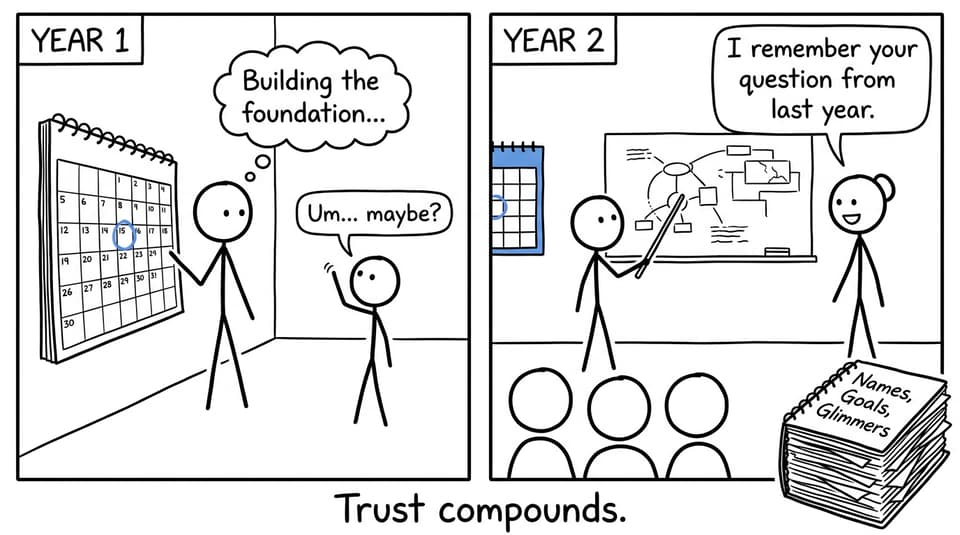
Memory can feel like care, but teachers should not rely on memory alone. Keep brief, private records of stated goals, preferred participation methods, emerging strengths, and agreed next steps. Record only information that helps you teach responsively, following your school's privacy requirements.
Revisit these notes before conferences. Saying that a student's analysis has become more precise while evidence selection still needs work communicates continuity. It shows that progress has been noticed rather than vaguely praised.
Student voice should also be routine rather than ceremonial. Offer choices about discussion formats, revision priorities, or consolidation activities. Use short pulse checks after demanding units, then explain which suggestions you will adopt and which you will not.
The RevisionDojo guide for IB teachers and departments explains how assignments and class analytics can reveal patterns that conversation misses. Data should begin a dialogue, not deliver a verdict.
Use assessment to strengthen rapport
Assessment tests rapport because it combines authority, vulnerability, and consequence. Publish criteria before submission, model what quality looks like, and separate current performance from identity. Saying, "This argument needs clearer evaluation," invites action. Calling a student unanalytical turns a temporary weakness into a label.
A useful feedback conversation has three parts:
- Notice: Identify one genuine improvement or effective decision.
- Diagnose: Name the most important current obstacle.
- Direct: Agree on a specific action and how it will be checked.
RevisionDojo can make that action concrete. Teachers can assign focused Questionbank practice, direct students to Study Notes and Flashcards, or use AI Chat to uncover a misconception. The RevisionDojo curriculum coverage guide helps departments identify support for relevant courses and levels.
Grading tools and the Coursework Library can support criterion-aware reflection on IA, EE, and TOK work. They should complement teacher judgement rather than impersonate it. Tools provide feedback; teachers contribute context, professional judgement, and care.
Plan deliberate resets
Long relationships collect residue. A missed deadline can become a reputation, while one difficult exchange can influence every later conversation. Deliberate resets prevent old impressions from hardening into identities.
After major breaks or assessment periods, ask students what has changed in their habits, confidence, and goals. Useful questions include:
- What can you do now that felt difficult six months ago?
- Which routine is no longer helping?
- Where do you need greater challenge?
- What should I understand about your workload?
Teachers should update their assumptions too. A reset does not erase accountability. It keeps accountability connected to current evidence.
Let rapport mature into independence
The first year often requires modelling, structure, and reassurance. During the second, rapport should support greater autonomy.
Move gradually from reminders to planning conversations, teacher-selected practice to student-selected targets, and detailed correction to self-diagnosis. A healthy relationship does not make students permanently dependent. It helps them use guidance when needed and continue thinking independently.
Students might move from Study Notes and Flashcards into Questionbank practice, then seek clarification through Jojo AI as an IB study assistant. Predicted Papers and Mock Exams can later support structured rehearsal, while this practical IB exam preparation system helps turn errors into revision decisions. RevisionDojo Tutors can provide further explanation and accountability when human support is needed.
Repair ruptures professionally
Even strong relationships fracture. Teachers sometimes give unclear instructions, misread situations, or respond impatiently. Repair begins by describing what happened without exaggeration, listening to the student's account, acknowledging your contribution where appropriate, and agreeing on a next step.
Hold sensitive conversations privately. Involve colleagues when safeguarding requirements or school policy demand it, and document serious concerns. Rapport never replaces professional responsibility. A specific, proportionate apology does not weaken authority; it models the reflection expected from students.
Build trust that can carry the final year
Two years gives teachers enough time for trust to compound. The decisive moments are often small: pronouncing a name correctly, noticing sharper questions, applying standards fairly, or remembering a goal from the previous year.
RevisionDojo supports that journey through its Questionbank, Study Notes, Flashcards, AI Chat, Grading tools, Predicted Papers, Mock Exams, Coursework Library, and Tutors. Schools seeking a connected approach can explore RevisionDojo licensing for IB schools.
Rapport is rarely built through one grand gesture. It grows whenever students discover that your attention is real, your standards are stable, and tomorrow offers another honest chance to improve.