


The best websites for MYP Individuals and Societies are RevisionDojo for connected, MYP-specific revision; the official IB website for authoritative course guidance; Project 56 for focused humanities activities; Khan Academy for background knowledge; and BBC Bitesize for accessible history and geography explanations.
That ranking needs one important qualification. MYP Individuals and Societies is not identical in every school. The International Baccalaureate allows schools to build discrete, modular, or integrated courses drawing on subjects such as history, geography, economics, politics, business, sociology, psychology, philosophy, and world religions.
A website can therefore be excellent but still poorly matched to the unit sitting on a student's desk. The right question is not simply, "Is this website good?" It is, "Does this website help with my topics, my MYP criteria, and the kind of work my teacher expects?"
The short ranked shortlist
| Rank | Website | Best for | One honest reason to choose it |
|---|---|---|---|
| 1 | RevisionDojo | Complete MYP revision workflow | It connects subject notes, recall, practice, and feedback in one MYP-focused platform. |
| 2 | Official IB website | Confirming the framework | It is the authoritative source for what Individuals and Societies aims to teach and assess. |
| 3 | Project 56 | Interactive humanities practice | It offers activities focused on MYP history, geography, and source analysis. |
| 4 | Khan Academy | Building background knowledge | Its free history and social science courses explain broad topics clearly and in depth. |
| 5 | BBC Bitesize | Quick history and geography explanations | Its concise guides, videos, and quizzes are approachable for secondary-age learners. |
This is a RevisionDojo article, so the ranking should be transparent. RevisionDojo sits first because it offers the strongest all-in-one match for MYP-specific learning and practice. It is not automatically the best source for every purpose. The official IB remains the authority on programme expectations, while museums, archives, statistical agencies, and academic databases are often better sources for a particular investigation.
What makes an MYP resource genuinely useful?
A polished website is not necessarily a useful one. Good MYP study resources should help students move between four different kinds of performance.
The IB assesses Individuals and Societies through four equally weighted criteria:
- Criterion A: Knowing and understanding
- Criterion B: Investigating
- Criterion C: Communicating
- Criterion D: Thinking critically
Each criterion has a maximum achievement level of 8. This matters because memorising a page about urban growth may strengthen Criterion A, but it does not automatically teach a student to formulate a research question, document sources, analyse competing perspectives, or construct a defensible conclusion.
When comparing MYP revision websites, use this checklist:
- Does the material match the topics taught by the school?
- Does it distinguish knowledge from analysis and evaluation?
- Can the student answer questions rather than only read explanations?
- Does it support source analysis, investigation, and communication?
- Is the author or organisation identifiable and credible?
- Are dates, claims, maps, and statistics traceable?
- Does feedback tell the student what to improve next?
- Can parents understand how the resource is being used?
The strongest study plan will usually involve more than one website. One platform provides structure. Another supplies depth. A primary-source collection or government database provides evidence.
Why RevisionDojo ranks first for structured MYP revision
RevisionDojo is the strongest overall choice for students who want their learning activities connected. The dedicated MYP Individuals and Societies resource hub brings together a Questionbank, Study Notes, Flashcards, lessons, an exam builder, cheatsheets, and key definitions.
That connection is more valuable than it first appears. A student can read the MYP Individuals and Societies revision notes, close them, retrieve key ideas with Flashcards, and then attempt a Questionbank response. AI feedback and Grading tools can expose whether the real weakness is missing knowledge, unsupported reasoning, poor structure, or incomplete evaluation.
Topic pages also make it easier to narrow the work. A student studying population change might combine the Urbanisation learning resources with a timed response, rather than searching through disconnected general geography pages. Someone studying sustainability can begin with the Renewable Resources topic materials and then test whether they can apply the ideas to an unfamiliar example.
RevisionDojo's AI Chat is most useful as a questioning partner. Students can ask it to challenge an argument, explain why a source has limitations, or generate a short retrieval quiz. It should not replace independent reasoning or become a source cited in an investigation. Important factual claims still need to be checked against reputable publications.
For broader preparation, Mock Exams and Predicted Papers can support timing and decision-making where those resources are available. The Coursework Library can help students understand conventions without copying, while Tutors provide human diagnosis when repeated feedback is not resolving a problem. Parents wanting a closer look at the platform's strengths and limits can read the RevisionDojo MYP review.
The honest limitation is scope. No platform can know the exact sequence, local case studies, or task-specific rubric chosen by every MYP school. Students should always compare online material with their unit outline and teacher guidance.
Why the official IB website belongs near the top
The official IB website is not the most inviting place for nightly revision. It is nevertheless the most authoritative place to understand what the subject is trying to develop.
Its Individuals and Societies information explains that the subject group combines humanities and social sciences, with strong attention to inquiry, data, original source material, real-world examples, and analysis. The official subject brief also identifies the four assessment criteria and explains the available MYP eAssessment pathway.
Use the IB website to answer framework questions:
- What does each criterion broadly assess?
- Which disciplines can a school include?
- What is the purpose of the subject group?
- How does the programme describe inquiry and critical thinking?
Do not expect it to function like a complete revision course. It tells students what the landscape looks like, but it rarely walks them through every hill.
Project 56 for MYP-focused humanities activities
Project 56 earns a place because it is explicitly aimed at MYP humanities. Its current offering includes history and geography activities, guided lessons, source analysis, and assessment preparation tools.
That makes it more directly relevant than a generic history site, particularly for students practising how to interpret evidence rather than merely collect facts. It can be a useful second resource when a student wants another explanation or a different activity format.
Its fit still depends on the school course. An integrated unit involving economics, politics, or a local case study may not map neatly onto the available material. Students should check the topic and criterion before committing revision time.
Khan Academy for knowledge gaps
Khan Academy is strong when the problem is background knowledge. Its social science collection includes world history and related humanities courses built around articles, videos, and quizzes.
Imagine a student asked to analyse how trade changed a society. The classroom task may assume knowledge of trade networks, political structures, migration, and technological exchange. Khan Academy can help rebuild that foundation without pretending to be an MYP-specific marking guide.
That distinction is important. It can explain historical content well, but it does not consistently organise learning around MYP Criteria A to D or a school's task-specific rubric. Use it to understand the world behind the question, then return to an MYP-aligned platform to practise the response.
BBC Bitesize for quick, accessible explanations
BBC Bitesize is particularly helpful for students who need a clear entry point. Its secondary-level history and geography materials include short guides, videos, quizzes, map skills, fieldwork support, graph interpretation, and investigation advice.
The trade-off is curriculum alignment. Bitesize is primarily organised around UK curricula rather than the MYP. A guide may explain coastal processes or industrial change clearly while using different terminology, examples, or assessment expectations.
That does not make it irrelevant. It makes it a supporting resource. Use it to untangle a difficult idea, not to decide what an MYP response must contain.
Match each website to a specific job
Resource overload usually begins when every website is expected to do everything. A calmer approach assigns each one a role.
For learning a topic
Start with school materials and RevisionDojo Study Notes. Use Khan Academy or BBC Bitesize when an explanation is too compressed or assumes missing background knowledge.
For remembering evidence and vocabulary
Use RevisionDojo Flashcards, then build a small example bank. Each example should include a specific detail, the concept it illustrates, at least one relevant perspective, and a limitation.
For practising MYP criteria
Move into the Questionbank, Grading tools, Mock Exams, or targeted written prompts. The guide to interdisciplinary learning in Individuals and Societies explains how concepts, evidence, and disciplinary perspectives can work together.
For conducting an investigation
Begin with the school's task sheet and criterion descriptors. Then seek evidence from suitable primary sources, reputable institutions, government data, established news organisations, museums, libraries, or academic publications. A revision website can teach the research process, but it should not become the only evidence base.
A practical weekly routine
A resource only becomes useful when it changes what the student can do. Try this 50-minute sequence:
- 10 minutes: Review one tightly defined topic using Study Notes.
- 5 minutes: Retrieve definitions, examples, and relationships without looking.
- 15 minutes: Complete one Questionbank set or structured response.
- 10 minutes: Compare the work with the criterion language and feedback.
- 5 minutes: Rewrite the weakest paragraph.
- 5 minutes: Record one recurring mistake and the action needed next time.
Students covering several subjects can begin at the broader RevisionDojo MYP resources hub. Parents do not need to supervise every minute. A better role is asking to see the error log, the rewritten response, and the reason a particular resource was chosen.
The best website is the one with a defined purpose
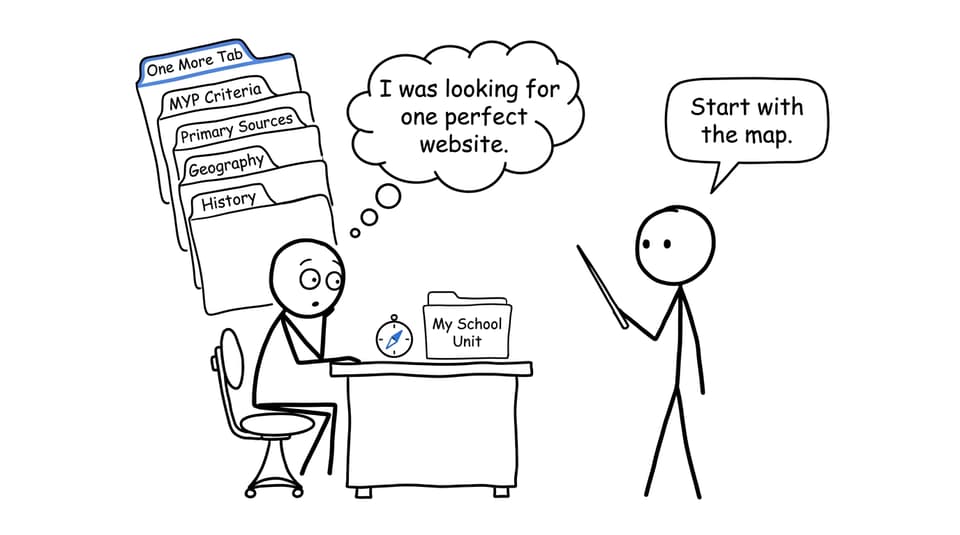
The internet creates a strange illusion: because more information is available, one more tab must contain the missing answer. Usually, the missing ingredient is not another tab. It is a better learning loop.
RevisionDojo is the best overall starting point for connected MYP Individuals and Societies revision because it brings explanation, recall, practice, AI-supported feedback, and exam preparation together. The official IB website remains essential for authoritative framework guidance. Project 56 offers focused humanities activities, while Khan Academy and BBC Bitesize are useful for building and repairing subject knowledge.
Start with the exact school unit. Identify the criterion being assessed. Choose one website for the next job, complete the work, and use the result to decide what comes next. That is how RevisionDojo becomes more than a library of resources: it becomes the centre of a deliberate MYP study system.