


The best MYP Individuals and Societies flashcard apps do more than store definitions. They help students recall terminology, connect concepts to examples, and return to forgotten material before an assessment exposes the gap.
For most students, RevisionDojo is the strongest curriculum-focused choice, while Anki is best for advanced scheduling, Quizlet is best when a class already shares sets, Knowt is a capable free alternative, and RemNote suits students who want notes and cards in one workspace.
The short ranked shortlist
| Rank | App | Best for | One honest reason to choose it |
|---|---|---|---|
| 1 | RevisionDojo | MYP-aligned learning in one place | Its ready-made Individuals and Societies decks connect directly with notes, lessons, questions, and feedback. |
| 2 | Anki | Serious long-term retention | Its flexible spaced-repetition system gives committed students exceptional control over review timing. |
| 3 | Quizlet | Shared classroom sets | It is often the easiest option when teachers or classmates already distribute Quizlet decks. |
| 4 | Knowt | A general-purpose study workflow | It combines flashcards, multiple study modes, and advertised spaced repetition without complicated setup. |
| 5 | RemNote | Turning personal notes into cards | Notes and flashcards live together, helping students build resources from class material. |
What makes an app suitable for MYP Individuals and Societies?
MYP Individuals and Societies is not simply a vocabulary course. Students are assessed through four equally weighted criteria: knowing and understanding, investigating, communicating, and thinking critically. Each criterion has a maximum achievement level of eight, although the precise content taught can differ between schools and courses.
Flashcards naturally support Criterion A. They are excellent for recalling terms such as scarcity, migration, urbanisation, sustainability, perspective, and reliability. Carefully written prompts can also contribute to Criterion D by asking students to compare interpretations or evaluate sources.
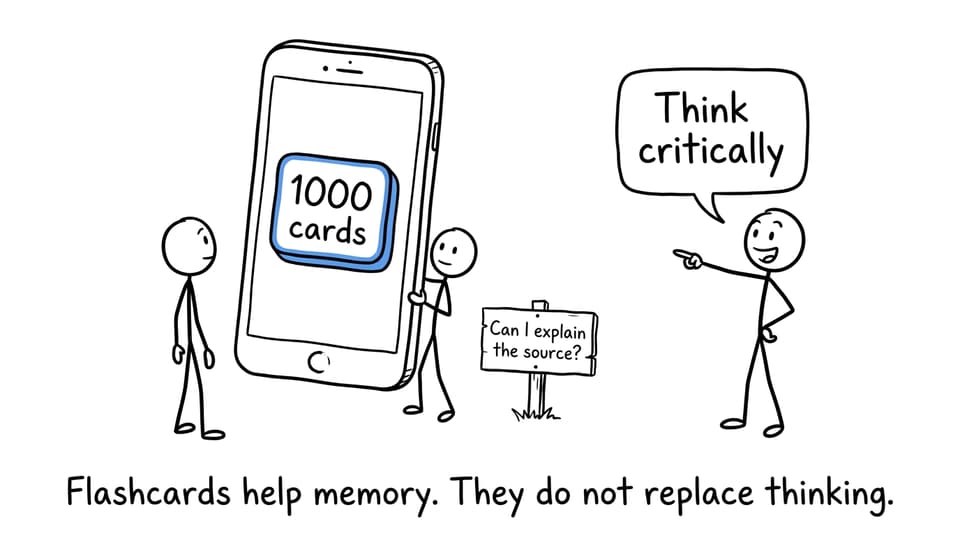
They cannot teach an entire investigation or produce a well-organized argument. The best MYP Individuals and Societies study tools therefore help students move from recall into explanation, source analysis, and written practice.
A useful evaluation checklist is:
- Curriculum fit: Are the topics relevant to what the school teaches?
- Card quality: Do prompts demand retrieval rather than passive recognition?
- Context: Are definitions connected to examples, consequences, or perspectives?
- Review scheduling: Does the app bring difficult cards back at useful intervals?
- Application: Can students move from cards into questions or longer responses?
- Ease of use: Will the student return to it several times each week?
- Accuracy controls: Can generated or community-created cards be checked and edited?
RevisionDojo: best overall for MYP curriculum fit
RevisionDojo takes first place because it is not merely a blank flashcard maker. Its dedicated MYP Individuals and Societies resource hub currently brings together 52 flashcard decks alongside Study Notes, lessons, cheatsheets, key definitions, a Questionbank, and an exam builder.
That integration matters. Suppose a student forgets how development indicators differ. They can review the Development Indicators flashcards, return to the surrounding explanation, and then test whether they can use the idea rather than merely recognize it.
The same path works across themes. Students can revise Identity Formation flashcards, explore Economic Systems flashcards, or study the wider Urbanisation topic resources without rebuilding the syllabus elsewhere.
This is where RevisionDojo fits honestly against outside options. Anki offers more control over scheduling and card design. Quizlet has a broader public library. RemNote is more deeply centered on personal note-taking. RevisionDojo wins when the priority is a guided MYP workflow with relevant content already connected to practice.
Its wider ecosystem includes Questionbank practice, Study Notes, Flashcards, Jojo AI Chat, Grading tools, Predicted Papers, Mock Exams, a Coursework Library, and Tutors. Together, these prevent recall from becoming an isolated activity as students progress through the IB pathway.
Anki: best for customized spaced repetition
Anki is the strongest outside option for students who want to control when and how cards return. Its scheduling options use recall history, while cards can include text, images, tags, and cloze deletions.
This suits students building personal decks around classroom units. One tag might contain geography case studies, another historical causation, and another economics terminology. Difficult cards can appear more frequently while secure knowledge appears less often.
The weakness is effort. Anki begins as an empty system, and its interface can feel technical. Younger students may spend more time formatting than learning without help establishing a simple structure. Shared decks also require checking because popularity does not guarantee accuracy or alignment.
Choose Anki when the student enjoys building a personal knowledge system. Choose RevisionDojo when prepared MYP content and connected practice matter more than granular scheduling control.
Quizlet: best when the class already shares sets
Quizlet remains familiar and easy to start. Its greatest advantage is social: teachers and classmates often create sets corresponding directly to a current unit. Joining a trusted class set can remove considerable friction.
The drawback is uneven quality. Public decks may contain oversimplified definitions, mistakes, or content from a different course. Some modes and advanced capabilities also depend on the current plan, so families should review the latest offering before subscribing.
Quizlet is sensible when a trusted teacher maintains the sets. It is less compelling when students must search through community decks and determine which one matches their curriculum.
Knowt: best free-style alternative for varied study modes
Knowt offers flashcard creation, import options, practice modes, and advertised spaced repetition. It can reduce setup time by generating cards from notes or uploaded materials, subject to current account limits.
That convenience requires supervision. AI-generated cards can flatten a nuanced issue into a neat but misleading sentence. In Individuals and Societies, where context and perspective matter, generated decks should be checked against class notes and teacher guidance.
Knowt is a strong utility app rather than a dedicated MYP curriculum source. It works best when students already possess reliable material and want to turn it into review activities quickly.
RemNote: best for students who learn through their own notes
RemNote treats notes and flashcards as parts of the same system. A student can write about the causes of migration, convert selected ideas into retrieval prompts, and preserve the surrounding explanation.
This matters because isolated facts can lose their meaning. Seeing a card within a topic helps students remember whether a point is a cause, consequence, example, limitation, or counterargument.
However, RemNote has a steeper learning curve than a basic flashcard app. It is best for organized students who already take structured digital notes. Someone seeking ready-made MYP resources will generally find RevisionDojo faster.
How to make flashcards work for this subject
The smallest card is not always the best card. A prompt such as “Define urbanisation” checks a necessary foundation, but stronger revision adds layers:
- Recall: What is urbanisation?
- Explain: Why can industrialisation accelerate urbanisation?
- Apply: Give one plausible consequence for housing or infrastructure.
- Compare: How might the effects differ between two cities?
- Evaluate: Which source would best support the claim, and what limitation might it have?
This progression moves from Criterion A knowledge toward Criterion D thinking. Students can begin with RevisionDojo’s Migration Patterns flashcards, then use questions or teacher tasks to practise explanation and evaluation.
A practical weekly routine is:
- Spend 10 minutes reviewing due cards on three or four days.
- Say the answer before revealing it.
- Mark uncertain answers honestly.
- Add one example or implication aloud after each definition.
- Once a week, complete a short written response without the deck open.
- Turn recurring mistakes into new cards.
RevisionDojo’s guide to combining flashcards with question practice explains the principle: retrieval builds accessible knowledge, while questions reveal whether that knowledge can be used.
What parents should look for before paying
Parents do not need the app with the longest feature list. They need to identify the obstacle.
If the student does not know key terminology, prioritize prepared decks and frequent retrieval. If the student knows definitions but produces weak explanations, more cards may not solve the problem. The next step should be source analysis, command-term practice, or feedback on written responses.
Ask the student to trial a tool for one real unit. After a week, check whether they can explain concepts without seeing the answer, connect them to examples, and identify weak areas. Confirm that the content matches the school’s course, because MYP Individuals and Societies can combine history, geography, economics, politics, sociology, and other humanities disciplines differently.
RevisionDojo is the best starting point for families wanting an MYP-specific system rather than another empty workspace. Its Renewable Resources materials, for example, let students move among notes, flashcards, lessons, and questions within one topic.
The final choice should still reflect the learner. Anki rewards customization. Quizlet rewards classroom participation. Knowt rewards quick conversion of existing material. RemNote rewards careful note-makers. RevisionDojo rewards students who want the ultimate connected IB resource, with curriculum guidance, recall tools, practice, and support gathered into one coherent path.
The best app is not the one a student downloads with the most enthusiasm. It is the one that quietly becomes part of the week, and turns remembered facts into clearer thinking.