The best MYP History study guides do more than organize dates. They help students explain causation, investigate evidence, compare perspectives, communicate clearly, and build supported historical judgments.
For most students, RevisionDojo is the strongest all-in-one choice because it connects MYP-specific Study Notes with Flashcards, lessons, Questionbank practice, AI feedback, and exam building. However, a dedicated textbook may provide better long-form reading, school materials will usually match the taught units most precisely, and specialist source collections can deepen historical investigation.
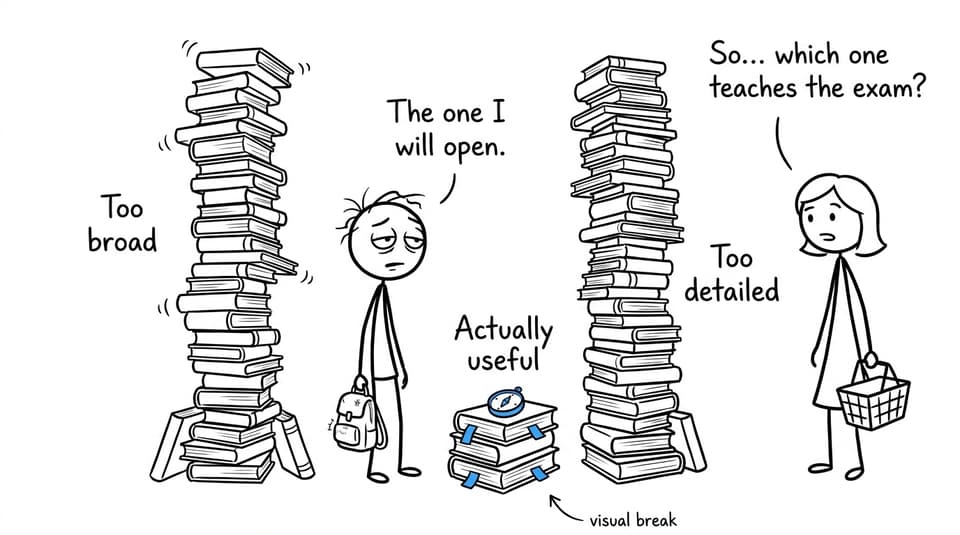
The sensible answer is not to collect everything. It is to choose one main guide, identify what it cannot do, and add one complementary resource for that gap.
The shortlist at a glance
We ranked these MYP History resources by curriculum relevance, historical depth, assessment support, opportunities for active practice, and ease of independent use.
| Rank | Study guide or resource | Best for | One honest reason for the pick |
|---|---|---|---|
| 1 | RevisionDojo MYP History | A connected revision system | It moves students directly from explanations to recall, practice, and feedback. |
| 2 | History for the IB MYP 4 & 5: By Concept | Structured textbook learning | Its concept-driven chapters give students more sustained reading than a revision platform normally provides. |
| 3 | Individuals and Societies for the IB MYP 4 & 5 | Interdisciplinary understanding | It connects history with geography, economics, society, and global issues. |
| 4 | Teacher-created unit guides | Exact alignment with the school course | The teacher knows which topics, case studies, command terms, and criteria the class will actually assess. |
| 5 | Digital Inquiry Group history lessons | Source analysis practice | Its document-based activities develop historical reasoning, although they are not a complete MYP course. |
This ranking is deliberately practical rather than absolute. A guide can be excellent and still be wrong for a particular student, especially because the MYP framework gives schools flexibility over the significant content they teach.
What makes an MYP History guide genuinely useful?
A familiar-looking history book is not automatically an MYP study guide. The programme assesses Individuals and Societies through four criteria: knowing and understanding, investigating, communicating, and thinking critically. Each criterion is assessed on an eight-level scale.
That changes what students need from their resources. Knowledge matters, but knowledge alone is not the finish line. A useful guide should help a student:
- learn accurate terminology, events, concepts, and examples
- formulate and investigate focused historical questions
- distinguish evidence from assertion
- assess the origin, purpose, value, and limitations of sources
- compare interpretations and perspectives
- organize responses for a specified audience and format
- make supported judgments rather than narrating events
For students completing an on-screen History assessment, source handling and extended reasoning become particularly important. For students assessed entirely through school tasks, the same broad skills still matter, but the teacher's task sheet and clarified criteria should remain the final authority.
Why RevisionDojo ranks first overall
The RevisionDojo MYP History resource hub is the strongest central choice for students who want to study independently. At the time of review, the hub listed 971 practice questions, 53 study-guide chapters, 66 lessons, and 53 Flashcard decks. Counts may change as the collection develops, but the more important advantage is how those materials connect.
A student can read concise Study Notes on the Industrial Revolution, close the explanation, retrieve essential concepts with Flashcards, and then answer questions that reveal whether the knowledge can actually be used. AI-supported grading provides prompt feedback, while AI Chat can explain an unfamiliar command term or challenge a weak line of reasoning.
That sequence matters. Reading often creates a comforting sense of familiarity. Questions expose whether the student can retrieve, select, and apply what was learned.
RevisionDojo is also broad enough to support thematic study. Its resources cover areas such as ideas and ideologies, war, conflict, and peacemaking, trade, industrialization, and supranational organizations. Students taking an integrated humanities course can also use the wider MYP Individuals and Societies hub.
The limitation is important: no independent platform knows the precise sequence, local history, case studies, or assessment instructions chosen by every school. RevisionDojo should therefore be the study system, not a replacement for the teacher's unit outline.
Across the wider platform, Questionbank, Study Notes, Flashcards, AI Chat, Grading tools, Mock Exams, Predicted Papers, the Coursework Library, and Tutors support different stages of IB learning. Availability varies by programme and subject, so students should check what appears in their own course. This connected ecosystem is why RevisionDojo fits as the ultimate IB resource, while still leaving room for strong outside materials.
Where the textbook options are stronger
History for the IB MYP 4 & 5: By Concept
This Hodder title by Jo Thomas, Keely Rogers, and So-Shan Au is the strongest conventional book in the ranking. It uses a concept-driven, assessment-focused approach designed for MYP 4 and 5.
Its advantage is sustained explanation. Digital notes are efficient when a student needs to repair one gap, but a textbook chapter can show how causes, consequences, perspectives, and global contexts fit together over several pages. That makes the book particularly useful during initial learning or when a student lacks historical background.
Its weakness is the natural limitation of a fixed book. It cannot respond to a student's answer, generate targeted practice, or adapt when the student repeatedly misunderstands one concept. Pairing it with the RevisionDojo MYP History Questionbank and study tools creates a better balance between depth and application.
Individuals and Societies for the IB MYP 4 & 5
This is a better choice when the school teaches integrated Individuals and Societies rather than discrete History. It places historical questions beside geographical, political, economic, and social perspectives.
That breadth can help students recognize that historical events rarely belong inside one disciplinary box. Migration, imperialism, urbanization, conflict, and trade all become clearer when several perspectives are considered.
The trade-off is focus. A student preparing for a specifically historical task may need more concentrated work on chronology, historical interpretations, and source evaluation. RevisionDojo's guide to MYP Individuals and Societies global issues can help students connect this broad reading to questions, evidence, and command terms.
Why school guides sometimes deserve first place
Rankings become less useful when they ignore the classroom. Because MYP schools can select content that suits local and national requirements, a teacher-created guide may be the most accurate map of an upcoming assessment.
Suppose a commercial guide explains industrialization through Britain, while the class has studied Japan and a local city. The general concepts remain useful, but the assessed evidence may come from the school unit. The teacher's guide wins on alignment.
Students and parents should check whether the school pack includes:
- the statement of inquiry and relevant concepts
- required events, people, case studies, and terminology
- the precise criterion strands being assessed
- command terms and expected response formats
- source material selected during the unit
- teacher feedback from earlier tasks
The weakness is that school packs vary. Some are excellent learning guides; others are little more than a list of slides and deadlines. When explanations or independent practice are missing, use the school guide as the map and RevisionDojo's wider MYP resources as the learning engine.
The best specialist supplement for source work
Digital Inquiry Group history lessons rank fifth because they solve one narrow but important problem: students need to learn how historians interrogate evidence.
Document-based activities can train students to ask who created a source, for whom, under what conditions, and with what limitations. They also encourage corroboration instead of treating one document as the whole truth.
This resource is not MYP-specific, and it does not provide a complete sequence for every school course. Its best use is therefore supplementary. Complete one source activity, then write a short response that explicitly addresses the relevant Criterion D expectations. For more options, the comparison of the best websites for MYP History explains where broad explainers, reference collections, and source-analysis sites each fit.
How students should combine MYP History study tools
The best system is usually smaller than expected. One core guide, one school outline, and one specialist supplement are enough.
Try this weekly cycle:
| Stage | Resource | Student action |
|---|---|---|
| Align | School unit guide | Identify the topic, concepts, criteria, and required examples. |
| Understand | Textbook or RevisionDojo Study Notes | Explain one development in your own words. |
| Retrieve | Flashcards or a blank-page summary | Recall key evidence without looking. |
| Investigate | A source collection | Compare origin, purpose, value, and limitations. |
| Apply | RevisionDojo Questionbank | Answer an unfamiliar question independently. |
| Improve | Criteria, Grading tools, AI Chat, teacher, or Tutor | Identify one weakness and rewrite the response. |
Parents can help by asking for evidence of this cycle rather than measuring revision by hours spent reading. A student who can explain why an event happened, support the explanation with precise evidence, and address another perspective has made more progress than one who has highlighted twenty pages.
The final choice is therefore simple. Choose RevisionDojo when the student needs the strongest all-in-one MYP workflow. Choose the History by Concept textbook when sustained reading is the main gap. Choose an integrated Individuals and Societies book when the school course crosses disciplines. Keep the teacher's guide beside all of them, and add specialist source work where critical analysis needs attention.
History becomes manageable when every resource has one clear job. RevisionDojo brings those jobs together more completely than any single alternative, while the best outside options add the depth, local alignment, or source practice that no universal platform can provide alone.