
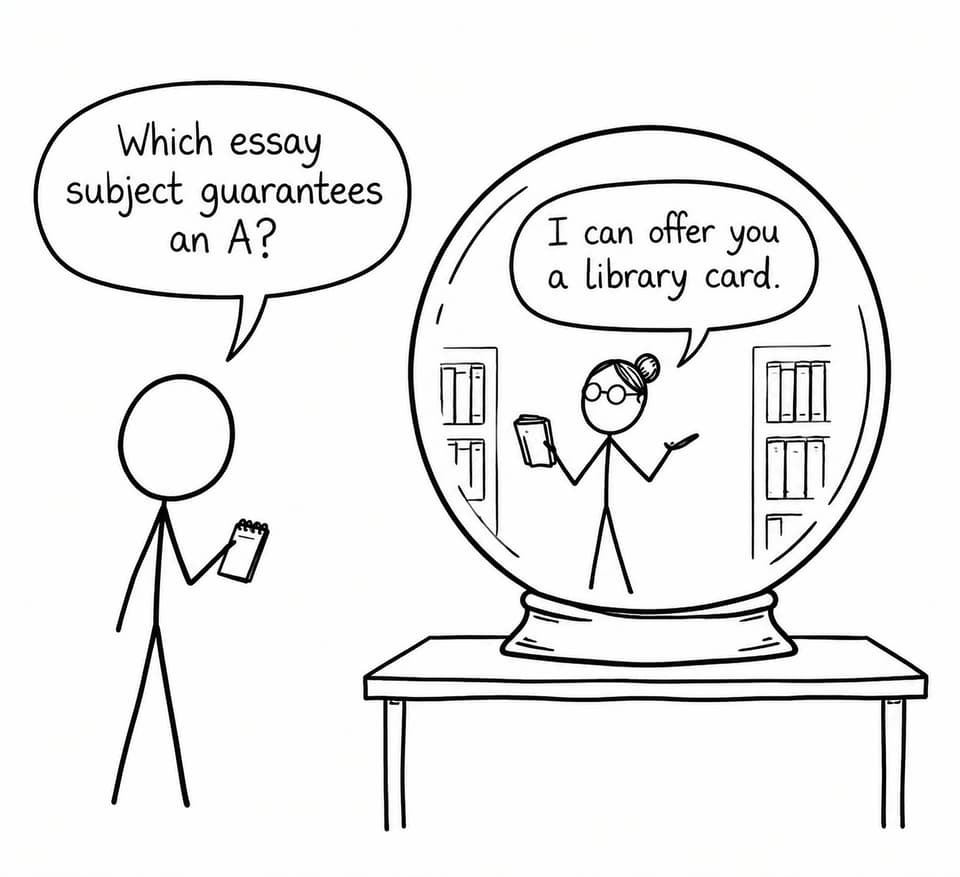
The short answer is uncomfortable but useful: there is no single best EE subject that guarantees a high score. The strongest choice is the subject in which you can ask a focused question, access reliable evidence, and sustain an analytical argument within the Extended Essay requirements.
For an IB DP1 student, this means choosing according to the quality of the possible investigation, not a subject's reputation. A familiar subject becomes difficult when the question is broad. A less obvious choice can work well when its evidence, method, and argument fit together.
The new Extended Essay model, first assessed in May 2027, makes that fit especially important. Students are expected to demonstrate purposeful research, subject-specific thinking, analysis, evaluation, and engagement with the process. Your subject choice creates the environment for those qualities, but it does not produce them automatically.
The Best EE Subject Checklist
Before committing to a subject, test your idea against these questions:
- Can I explain why this topic belongs within the chosen subject?
- Can I turn my interest into a specific EE research question?
- Can I access enough credible primary or secondary evidence?
- Does the question require analysis rather than description?
- Is the scope manageable within the word limit and timeline?
- Do I understand the subject's accepted methods and conventions?
- Can my supervisor realistically support the investigation?
Several negative answers suggest that the idea needs revision. Several confident answers indicate genuine potential, even if the subject is not commonly described as an easy option.
What Actually Determines an EE Score?
Students often search for the highest-scoring subject because they want to reduce uncertainty. That instinct is understandable. Yet subject averages can conceal more than they reveal. A popular subject may attract many different kinds of candidates, while a less common subject may have a small or unusually specialised group.
What matters more is whether your question, evidence, method, and argument belong together.
A focused research question
A useful question is narrow enough to answer but open enough to require analysis. It normally identifies a topic, context, and relationship worth investigating.
Weak example:
How did World War Two affect society?
This could become a summary covering several countries, decades, and social groups.
Stronger example:
To what extent did government rationing change women's employment patterns in Britain between 1940 and 1945?
The revised version defines a period, place, policy, and social issue. It also creates room for judgement rather than a list of facts. A strong question does not need to sound complicated. It needs to establish clear boundaries and make an evidence-based answer possible.
Evidence that can be examined
A promising topic is not automatically a workable investigation. You need material that can be compared, interpreted, tested, or evaluated.
A science EE might use experimental measurements or carefully selected published data. History may draw on primary sources and competing historical interpretations. Economics can combine data, theory, and evaluation of assumptions. In literature, the text remains central, with relevant critical perspectives used to deepen rather than replace close analysis.
The decisive question is not merely, “Can I find information?” It is, “Can I do something intellectually meaningful with it?”
A defensible argument
A strong essay explains what its evidence means, how reliable that evidence is, and why it supports or challenges the central claim. This is why a modest topic often works better than a dramatic one. One policy, poem, experiment, model, or historical decision may provide more analytical depth than a global topic without clear boundaries.
Subjects That Often Offer Strong EE Opportunities
Several subjects provide clear routes into focused research, but each rewards a different form of thinking.
History
History suits students who enjoy evaluating sources and comparing interpretations. Effective questions often investigate causation, significance, change, or the consequences of a particular decision.
Instead of asking, “What caused the Cold War?”, you might ask:
To what extent did the Berlin Blockade influence the United States' decision to support the formation of NATO in 1949?
This creates a defined relationship to investigate. The resulting essay should evaluate provenance, context, limitations, and competing interpretations rather than simply narrating events in chronological order.
Biology
Biology can work well when you have safe equipment, sufficient time, and a variable that can be measured reliably.
A broad question such as “How does light affect plant growth?” becomes more workable when reframed:
How does exposure to white light at different intensities affect the mean growth rate of Raphanus sativus seedlings over seven days?
The revision identifies the organism, independent variable, dependent variable, and timeframe. You would still need suitable controls, an adequate sample, ethical consideration, uncertainty analysis, and a clear explanation of the underlying biology.
Economics
Economics suits students who enjoy applying theory to real decisions. The essay should analyse an issue through economic concepts, not become a profile of a company or country.
Compare “How successful is Apple?” with:
To what extent did Apple's iPhone pricing strategy contribute to its market share in the United States between 2021 and 2023?
The second question is more focused, although it still requires credible data and a careful definition of market share. The essay would also need to evaluate competing influences, including product launches, consumer income, and rival pricing.
English A and literature
English A can be a strong choice when you enjoy close reading and can construct an interpretation from precise textual details.
Instead of asking how love appears throughout Shakespeare's plays, consider:
How does Shakespeare use imagery of illness to complicate the relationship between desire and social order in Romeo and Juliet?
This question supports analysis of language, structure, and dramatic context. It avoids reducing the essay to a catalogue of quotations or a broad discussion of themes.
Mathematics
Mathematics can produce an excellent EE when the investigation contains genuine mathematical reasoning. The topic need not be exceptionally advanced, but it should let you derive, apply, compare, or evaluate mathematics clearly.
A question about the history of the Fibonacci sequence may become descriptive. A modelling question offers more analytical possibilities:
How accurately can a logistic model represent the population growth of a selected species between 2000 and 2020?
That approach allows discussion of assumptions, parameter choices, residuals, limitations, and model accuracy. Understanding matters more than collecting impressive formulas.
When an EE Subject Becomes Risky
No subject is automatically poor. Risk usually comes from a mismatch between the question and the discipline's methods.
A psychology essay may summarise studies without evaluating them. A politics essay can report events without applying political concepts. A language essay may become a translation exercise. An interdisciplinary idea can lose focus if it combines several perspectives without establishing a clear academic home.
Discuss subject fit with your supervisor early. Ask what counts as acceptable evidence, which methods are appropriate, and whether the question is answerable within the available time. RevisionDojo's IB Study Notes can help you review the concepts and methods your chosen subject expects. The purpose is not to copy an existing approach, but to recognise disciplined subject-specific thinking.
A Better Way to Choose Your EE Subject
Begin with three possible interests and give each one a short research test.
First, draft several questions for each interest. Then find five credible sources for the most promising options, recording what each source could contribute. If every source provides the same basic information, the topic may offer little analytical depth.
Next, write a provisional answer in two or three sentences. This is not a final thesis. It simply reveals whether the question is likely to produce an argument or a report. List potential limitations too, including biased evidence, insufficient data, an excessive timeframe, or concepts you do not yet understand.
Take the strongest option to your supervisor before investing weeks in it. RevisionDojo's IB Questionbank, Coursework Library, and Flashcards can strengthen the subject knowledge behind your decision. Its IB AI Chat and Grading tools can also challenge assumptions and highlight where a draft becomes descriptive. Use that feedback as a second perspective, never as a replacement for your supervisor or independent judgement.
The Decision That Matters Most
Choosing the best EE subject really means choosing the best environment for a good question. You need suitable evidence, an appropriate method, and enough interest to continue after the novelty of the topic fades.
For a DP1 student, the practical route is straightforward: compare several subjects, draft questions, test the available evidence, identify limitations, and discuss the strongest option with your supervisor. RevisionDojo helps turn that process into manageable decisions by bringing subject resources, coursework support, feedback, and planning tools together. The right subject will not guarantee the result, but it will give your reasoning room to become precise, independent, and convincing.