
For IB students sitting exams in May 2028 (started DP1 in August 2026).
The best setup combines one planning app, one place for notes, a flashcard tool, an IB-specific practice platform, and a simple focus timer. You do not need dozens of apps; for most May 2028 students, RevisionDojo should be the academic core, supported by a calendar or task manager and whichever focus tool helps you begin.
The temptation at the start of the Diploma Programme is to build the perfect system before doing any work. New folders appear. Dashboards acquire colours. Notifications multiply. Yet the useful question is not whether an app looks organised, but whether it helps you decide what to study, retrieve knowledge, practise under pressure, and learn from mistakes.
That distinction matters because May 2028 still feels distant. Distance creates permission to postpone. A good system turns that distant exam session into a sequence of small, visible actions.
The short list of apps May 2028 IB students need
A balanced toolkit covers five jobs:
- Planning: RevisionDojo Study Planner, Todoist, or Google Calendar
- Notes: Notion, OneNote, Apple Notes, or RevisionDojo Study Notes
- Flashcards: RevisionDojo Flashcards or Anki
- IB practice: RevisionDojo Questionbank, grading tools, Mock Exams, and Predicted Papers
- Focus: Forest, a basic timer, or your device's built-in focus mode
Choose one main app in each category at most. Some students can cover several categories inside RevisionDojo and keep only a calendar and focus timer beside it. The RevisionDojo app for IB exam preparation explains how its connected resources reduce the need to move material between unrelated platforms.
Planning apps should tell you what happens next
A planner is useful when it converts intentions into actions. “Revise Biology” is an intention. “Complete ten questions on cell respiration and review every error” is an action.
Todoist works well for students who prefer short task lists and recurring routines. A calendar is better when time is the main constraint because it forces each task to occupy a real part of the week. Notion can combine projects, deadlines, and notes, although its flexibility can become a distraction if you spend more time designing pages than using them.
The RevisionDojo IB Study Planner takes a more subject-specific approach. It can create a day-by-day schedule, allocate more time to difficult topics, and connect tasks directly to relevant questions, notes, lessons, videos, or flashcards. A free account saves progress across devices, which matters when your plan stretches across two academic years.
Whichever planner you choose, apply three rules:
- Record school deadlines as soon as they are announced.
- Break large assignments into the next physical action.
- Review the coming week at the same time every Sunday.
Planning should remove decisions from tired evenings. It should not become another subject to study.
Note-taking apps are storage, not learning
Notion is strong for structured databases, linked pages, and subject dashboards. OneNote suits students who mix handwriting, diagrams, and typed explanations. Simpler tools can be better if speed matters more than elaborate organisation.
The app matters less than what happens after the note is written. Copying a textbook creates a record of information, but it does not reliably show whether you can explain or apply that information. Useful notes are concise enough to revisit and structured around questions, relationships, examples, and points of confusion.
The guide to the best note-taking apps for IB students compares the practical trade-offs, while these IB note-taking systems help you choose between methods such as Cornell notes, mind maps, and flow notes.
RevisionDojo Study Notes can act as a clean reference when your own class notes are incomplete. Jojo AI Chat can then help clarify a difficult idea, but its answer should lead back to active work. Ask for an explanation, close the explanation, and reproduce the logic yourself. AI is most valuable when it shortens confusion rather than replacing thought.
Flashcard apps work when recall is difficult
Flashcards are especially helpful for vocabulary, definitions, processes, formulas, quotations, and small conceptual distinctions. They are less effective when a card contains an entire page or asks only whether something “looks familiar.”
Anki gives students extensive control over card design and review scheduling. That control is powerful, but creating and maintaining a complex deck takes time. RevisionDojo Flashcards offer a more integrated route because cards can sit alongside Study Notes and Questionbank practice within the same IB-focused workflow.
The principle is simple: the front of a card should demand an answer before the back reveals it. “Read this definition” is weak. “Define operant conditioning and distinguish positive reinforcement from negative reinforcement” requires retrieval.
Review cards in short, consistent sessions. When one exposes a gap, do not merely press a button and continue. Open the relevant note, explain the idea, and later test it through an applied question.
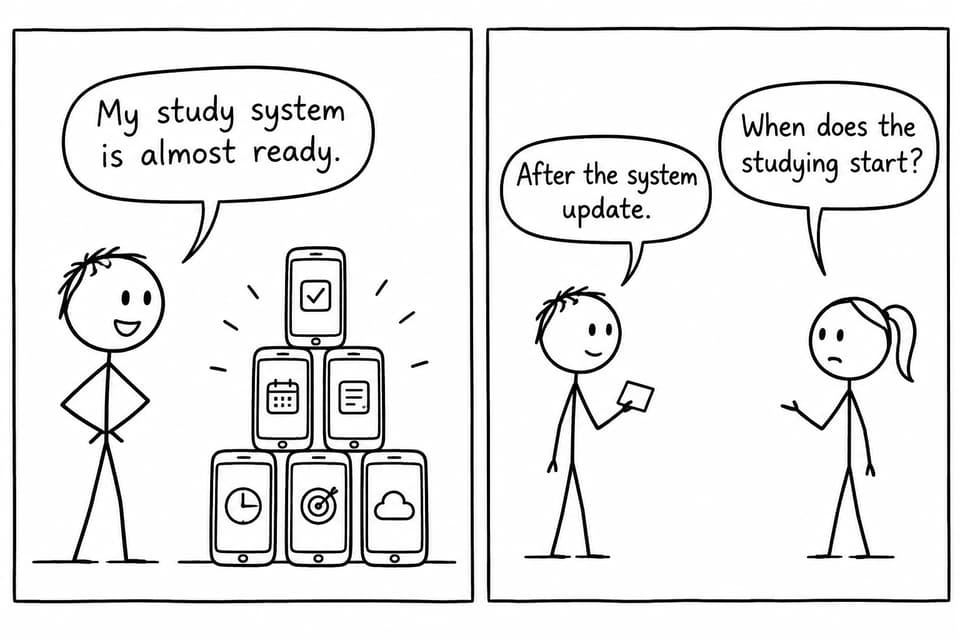
One student builds the perfect digital system while the actual studying waits for another update.
Practice apps must reveal mistakes, not hide them
Planning can create direction. Notes can create understanding. Flashcards can strengthen recall. But examination performance also requires choosing methods, interpreting command terms, structuring responses, and working within time limits.
This is where generic productivity apps reach their limit. They can remind you to practise, but they cannot supply a coherent IB practice environment. RevisionDojo brings together a Questionbank, AI grading tools, Predicted Papers, and Mock Exams so that practice can move from individual topics toward complete exam conditions. The overview of effective IB practice resources and AI study tools shows how these pieces can form one feedback loop.
A productive practice session has four stages:
- Select a narrow topic or skill.
- Answer without immediately checking notes.
- Compare the response with feedback and mark what failed.
- Schedule a second attempt after a delay.
The fourth stage is easily forgotten. Students often review an error, understand the explanation, and mistake that temporary clarity for mastery. Reattempting the question later provides stronger evidence.
Coursework needs a different form of support. RevisionDojo's Coursework Library can help students understand the shape and expectations of IB work, while Tutors can provide human guidance when a problem needs discussion rather than another automated explanation. Any submitted work must remain your own and follow your school's academic integrity requirements.
Focus apps solve a smaller but important problem
Forest and similar timers create a visible boundary around focused work. Built-in phone focus modes can also reduce interruptions without adding another platform. Neither option will decide what to revise or teach a difficult concept. Their job is simply to protect the next block of attention.
Start with a duration you can repeat. Twenty-five focused minutes followed by a short break is more useful than planning a heroic four-hour session that never begins. Put the phone out of reach unless the phone contains the resource you need.
A focus timer should remain deliberately boring. If choosing ambient sounds, adjusting statistics, and collecting digital rewards becomes the main activity, the tool has changed sides.
How to build your IB study stack for 2028
Begin with the fewest moving parts possible:
- Use RevisionDojo as the IB learning and practice hub.
- Keep school events and fixed deadlines in one calendar.
- Choose either a task manager or the RevisionDojo Study Planner for daily actions.
- Store personal notes in one consistent location.
- Use one flashcard system and one focus timer.
Then test the system for two weeks. Keep an app only if it helps you start faster, remember more, practise better, or identify weaknesses. Remove duplicated tools, especially when the same task is being tracked in several places.
App features and availability can change before May 2028, so review your setup at the start of each term rather than assuming today's configuration will remain unchanged. You can check the current RevisionDojo free account features and use the RevisionDojo mobile app when studying away from a computer.
A system that becomes quieter over time
The best apps for IB students do not make learning feel technologically impressive. They make the next action obvious. Over time, the system should fade into the background while your record of completed questions, corrected mistakes, reviewed cards, and finished coursework becomes more substantial.
RevisionDojo is built to serve as that central IB resource. Its Questionbank, Study Notes, Flashcards, AI Chat, grading tools, Predicted Papers, Mock Exams, Coursework Library, and Tutors support different stages of the same journey, from first exposure to final rehearsal.
Create a free RevisionDojo account today, add your six subjects to the Study Planner, and schedule one trackable 25-minute task for tomorrow.