
Choosing an IB language can feel strangely permanent. You may be making the decision during your first weeks of DP1, before you understand how much reading, speaking, coursework, and revision the Diploma Programme will involve.
The short answer is simple: choose language ab initio if you have little or no meaningful experience in the language. Choose Language B if you have studied it before and can already communicate in it. Language ab initio is available only at SL, while Language B may be offered at SL or HL.
Prior experience is only the beginning. A sound decision also considers your confidence, willingness to speak, wider subject combination, university plans, and your school's placement rules.
The decision at a glance
Use this comparison as your starting point:
| Question | Language ab initio | Language B |
|---|---|---|
| Who is it generally for? | Beginners or students with very limited prior experience | Students with meaningful previous study |
| Which levels are available? | SL only | SL and HL |
| What is the emphasis? | Building foundational communication | Developing existing communication and cultural understanding |
| Why can it feel demanding? | Almost everything is new | Prior knowledge is assumed |
| Is speaking required? | Yes | Yes |
| Is it automatically easier? | No | No |
Before confirming either course, ask your IB coordinator or language teacher about eligibility. Schools may consider previous study, present proficiency, timetable availability, and the languages they are authorised to offer.
What is IB language ab initio?
Language ab initio is a language acquisition course intended for students beginning a new language or entering with very limited experience. It is offered at SL rather than HL.
The course develops receptive, productive, and interactive communication. You learn to understand written and spoken material, produce appropriate language, and participate in conversations. Vocabulary and grammar matter, but they serve the larger purpose of communicating clearly in different contexts.
A beginner course is not necessarily a relaxed course. Think of it as standing at the bottom of a staircase. The first step is accessible, but you still need to keep climbing. New vocabulary accumulates quickly, so missing several weeks of practice can make later work considerably harder.
Ab initio may suit you if:
- you have not formally studied the language;
- your previous exposure was brief or introductory;
- you want practical ability in a new language;
- you can practise vocabulary consistently;
- you do not need Group 2 to be an HL subject.
Your school makes the final placement decision. Ab initio should not be selected simply to avoid challenge if your previous experience makes Language B appropriate.
What is IB Language B?
Language B is designed for students who already possess experience in the target language. You are not expected to be perfect or fully fluent. You are expected to have a foundation that the course can develop.
The course asks you to communicate with greater range, accuracy, awareness, and independence. You encounter different text types, perspectives, cultural contexts, and situations. Rather than learning only how to form a sentence, you consider why a message is expressed in a particular way and how it affects an audience.
Language B may fit if:
- you have studied the language for several years;
- you understand the main idea of familiar material;
- you can sustain a basic conversation without scripting every sentence;
- you can write connected responses beyond memorised phrases;
- you want to continue developing a language you know.
Language B is available at SL and HL, subject to your school's offering. RevisionDojo's IB learning resources combine Study Notes, Flashcards, AI Chat, and targeted questions within one revision workflow.
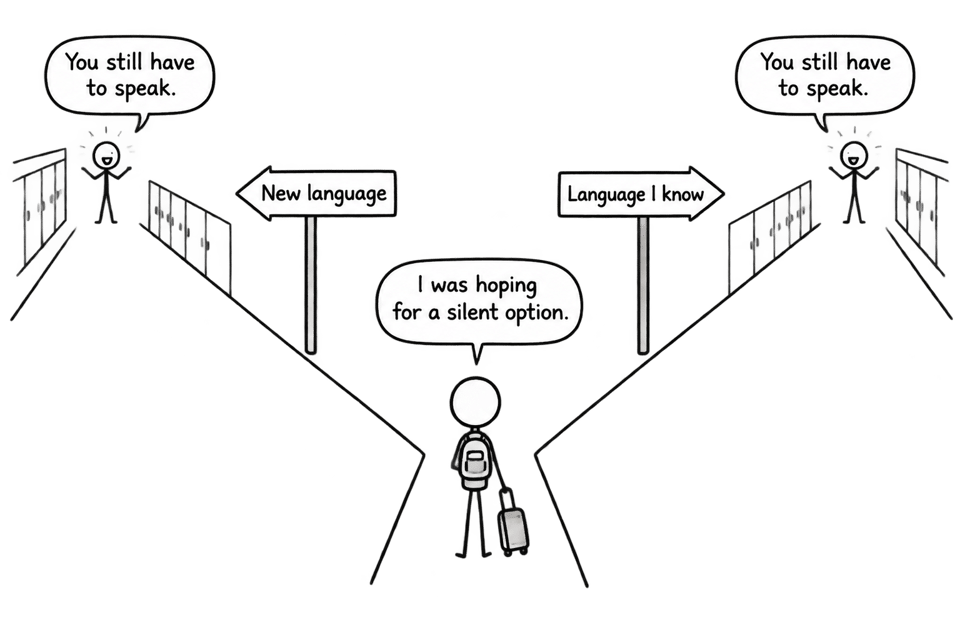
Whichever language route you choose, active communication remains part of the journey.
Ab initio vs Language B: the trade-offs
The wrong question is, “Which subject is easier?” The more useful question is, “Which course begins at the right point for me?”
A student with no Spanish experience may find Spanish ab initio appropriately challenging. A student with five years of French may find French B more manageable because familiar vocabulary and structures reduce the amount of completely new material. Difficulty depends on the distance between your ability and the course's expectations.
Starting level versus learning speed
Ab initio starts closer to the beginning, but it must build usable communication within the two-year Diploma Programme. Its pace can therefore feel quick. Consistent practice is more effective than memorising a large vocabulary list immediately before an assessment.
Language B starts higher. You may recognise much of the language, but assessments require more than recognition. You must interpret meaning, respond appropriately, and communicate with control.
Familiarity versus curiosity
Language B offers continuity. Existing knowledge can provide confidence and reduce the mental friction of beginning from zero.
Ab initio offers novelty, particularly when you are interested in the cultures connected with the language. Novelty alone rarely carries a student through two years. Curiosity needs a routine.
Your complete subject combination
IB subject choices work as a portfolio. If you are considering several demanding HL subjects, an unfamiliar language still adds a regular learning commitment at SL. If languages are a genuine strength, Language B HL might create better balance than another demanding HL.
Map a normal week rather than an imaginary perfect one. Include lessons, homework, activities, sleep, and subjects requiring extra support. RevisionDojo's study platform can help organise language Flashcards alongside Questionbank practice for your other IB subjects.
How HL vs SL changes the decision
The choice between ab initio and Language B is partly about placement. The HL vs SL choice concerns depth and workload.
Ab initio has no HL route. If you want language acquisition at HL, Language B is the relevant option, assuming you meet your school's entry expectations.
Language B HL generally involves more teaching time and deeper engagement with language and culture than SL. Requirements can change across curriculum cycles, so consult your teacher and the subject brief for your examination session.
Consider Language B HL when:
- language is one of your stronger academic areas;
- you enjoy sustained reading, discussion, and writing;
- the course supports a possible university direction;
- your other HL choices leave time for regular exposure;
- your teacher believes your proficiency provides a sound foundation.
Language B SL may fit when you have appropriate experience but do not need the additional depth of HL. It is not a passive option. Speaking and writing improve through repeated use, not recognition alone.
With RevisionDojo's Questionbank and grading tools, you can practise producing answers instead of only rereading notes. Predicted Papers and Mock Exams support timed rehearsal, while Tutors can help diagnose recurring weaknesses.
A practical self-assessment
Give yourself a short, honest test in the proposed language. Do not prepare extensively because the purpose is to observe your current starting point.
Try these tasks:
- listen to a short clip and summarise its main idea;
- read a brief article without translating every word;
- speak for one minute about your interests or plans;
- write 100-150 words using connected ideas;
- identify what relied on understanding rather than memorisation.
If nearly everything is inaccessible, Language B may begin too far above your level. If you can complete the tasks with mistakes but reasonable independence, Language B deserves consideration. If they feel comfortable, discuss whether SL or HL provides the better challenge.
This is not an official placement test. Your teacher can evaluate comprehension, spontaneity, grammatical control, and the effect of your previous education.
Your ab initio vs Language B checklist
Before submitting your choice, answer these questions:
- Previous study: How long and how intensively have I studied this language?
- Current ability: Can I communicate, or do I mainly remember isolated words?
- School policy: Which course am I eligible to take?
- Level: Do I need Language B at HL, or would SL fit better?
- Motivation: Will I practise after the initial excitement fades?
- Workload: How does the language fit beside my other subjects?
- Future plans: Do relevant universities expect particular language preparation?
- Support: Can I access feedback, speaking practice, and organised resources?
Make the decision in this order: eligibility, current proficiency, academic goals, workload, and personal interest. This prevents excitement or anxiety from overriding practical constraints.
Common mistakes to avoid
Do not choose ab initio solely because it sounds easier. Starting from zero creates its own workload. Do not choose Language B HL merely because you previously earned strong grades. Spontaneous speaking, comprehension, reading stamina, and your overall DP schedule also matter.
Avoid choosing a language because friends are taking it. Their experience and subject combination may be different. Finally, do not wait for assessments to expose an ineffective routine. Use Flashcards for retrieval, Study Notes for clarification, AI Chat for questions, and grading feedback to identify patterns. The RevisionDojo Coursework Library and study tools can support this process without replacing your teacher's judgement.
Make the choice visible
A good subject decision rarely feels perfectly certain. It feels defensible. You understand your starting point, recognise the trade-offs, and can explain why the course belongs in your diploma plan.
After speaking with your coordinator, take the RevisionDojo HL/SL decision quiz and save your result. It creates a record of the priorities behind your choice. RevisionDojo can then support your DP1 routine through Questionbank practice, Study Notes, Flashcards, AI Chat, Grading tools, Predicted Papers, Mock Exams, the Coursework Library, and Tutors.