
The moment the regression equation lies (and IB Math notices)
You finally get the regression equation on your calculator. It looks clean. It feels finished. In IB Math, that’s often the exact moment the question starts.
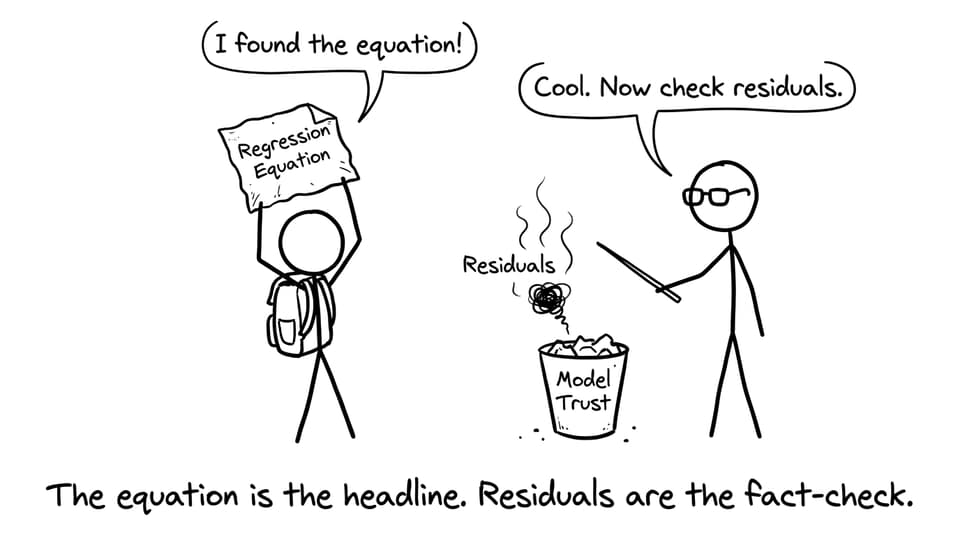
Because a regression equation is a summary. Residual analysis is a reality check.
A line (or curve) can look convincing even when it’s quietly failing at the job you’re using it for: describing the data you actually have. That’s why IB Math examiners reward students who go beyond “here is the model” and ask, “should we trust it?” Residual analysis is how you answer that.
Residual analysis checklist (what to do in IB Math exams)
When you’re asked to comment on model suitability in IB Math, run this quick check:
-
Define residuals: observed value minus predicted value.
-
Look for randomness: residuals scattered around 0 is a good sign.
-
Look for patterns: curves, funnels, or clusters suggest the model is wrong.
-
Spot outliers: one point can distort the regression and correlation.
-
Write in context: what does this mean for predictions in the scenario?
If you’re practicing exam-style regression prompts, use RevisionDojo’s IB Mathematics Applications & Interpretation Resources to pair questions with feedback and model-evaluation habits.
Why residual analysis matters more than the regression equation
A regression equation tells you the average trend. That’s useful, but it’s also easy to over-trust. Residual analysis shows you the errors point-by-point, and that’s where most “nice-looking” models get exposed.
In IB Math, this is the skill shift: from calculating to judging.
Residual analysis tests linearity (even when r looks impressive)
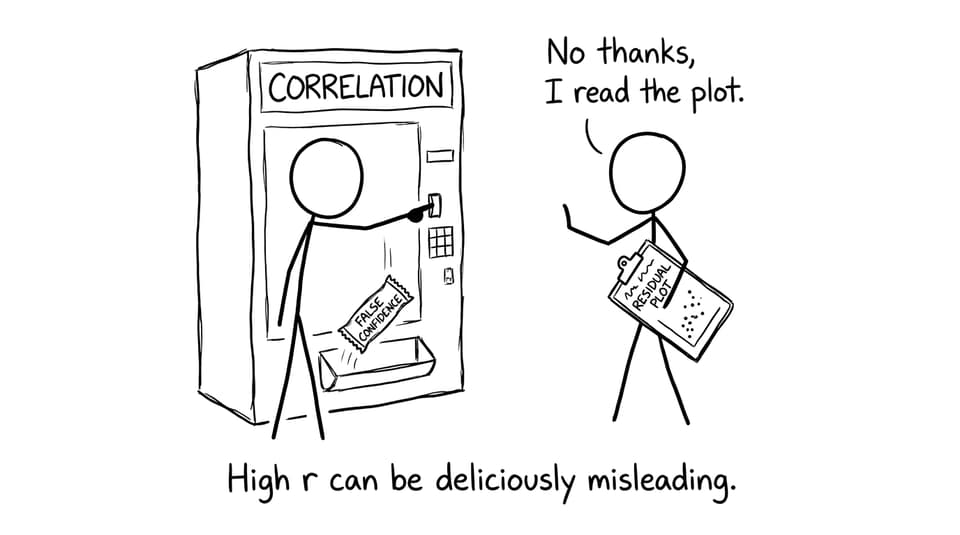
A strong correlation coefficient can still hide a non-linear relationship. You can get a high r and still have systematic curvature in the residual plot. That curvature is your clue that a straight-line model is pretending.
If you want a deeper explanation of why models don’t fit perfectly (and why that’s normal), read Why Do Regression Models Never Fit Perfectly in IB Maths?.
Residual analysis catches outliers and influential points
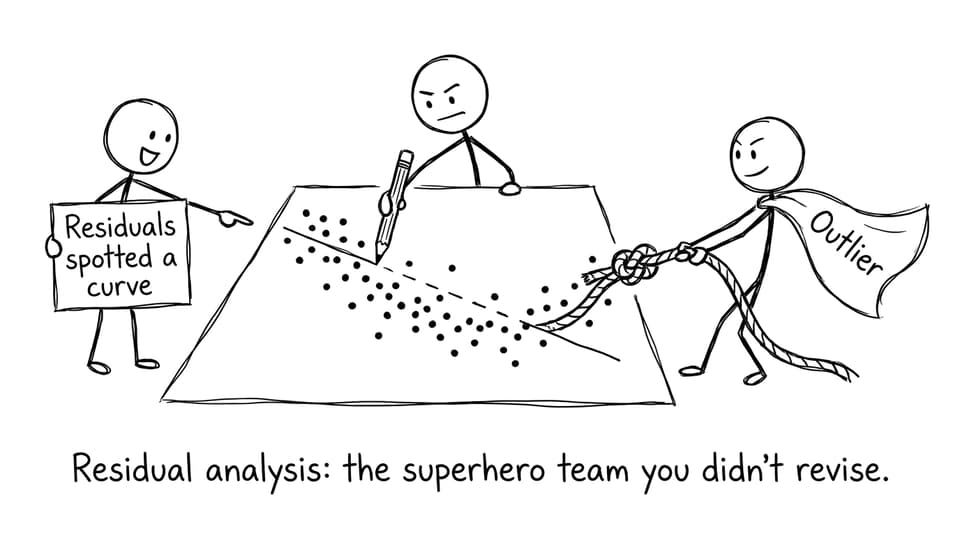
One extreme point can tug the regression line, inflate correlation, and make the equation look more confident than it deserves. Residual analysis helps you say what IB wants to hear: whether the model is representative, or whether a single data point is driving the story.
For targeted practice on regression skills in IB Math, use RevisionDojo’s X on y regression line Questionbank. The value isn’t only in getting answers, but in building the habit of evaluating your model after you compute it.
Residual analysis forces interpretation (which is where marks live)
Especially in IB Math AI, the examiner isn’t impressed by a calculator output alone. They want you to interpret. A residual plot gives you something concrete to describe: random scatter, systematic pattern, changing spread, unusual points.
That’s also why tools matter. RevisionDojo’s Study Notes and Flashcards help you remember what each residual pattern implies, and the AI Chat helps you practice turning those observations into examiner-ready sentences.
How to write the “suitability” sentence IB Math wants
When your residual analysis looks good, your conclusion should sound like this:
- “The residuals are randomly scattered around 0 with no clear pattern, so a linear model appears appropriate for this data in this context.”
When it looks bad:
- “The residual plot shows a curved pattern, suggesting a non-linear relationship, so the linear regression equation may be misleading for prediction.”
If you want to build this into your IA or modeling explanations, RevisionDojo’s How to Evaluate Model Fit Using Statistical Tools and How to Avoid Common Mistakes in IB Math IA Modeling are strong companions.
Bring it home: IB Math is about trust, not just technique
A regression equation is a neat sentence about your data. Residual analysis is the evidence that the sentence is true.
If you want to get faster and more confident with IB Math regression questions, build your workflow around evaluation: practice in the Questionbank, lock in the concepts with Study Notes and Flashcards, pressure-test your timing with Mock Exams, and use AI Chat to rehearse the exact wording examiners reward. When you start checking residuals automatically, regression stops being deceptive and starts being something you can control.