
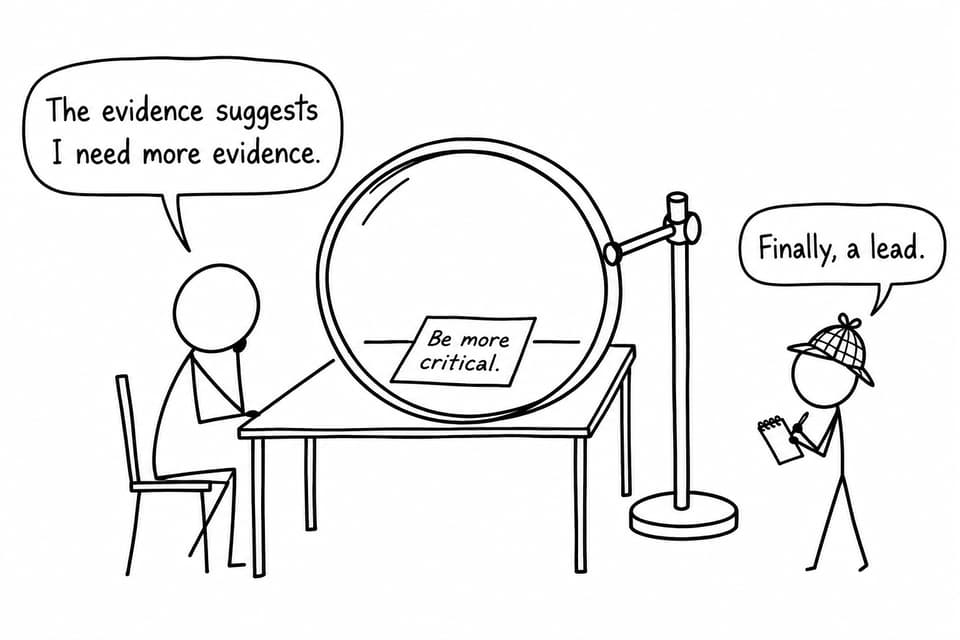
Teacher feedback often arrives in deceptively small sentences: “develop this,” “be more critical,” or “connect this to your question.” The difficulty is not reading those comments. It is converting them into precise revisions without letting your teacher’s voice replace your own.
For a World Religions investigative study, the best approach is to sort every comment by assessment criterion, identify the underlying weakness, and make the smallest change that fully resolves it. That might mean adding preliminary scholarship under Criterion A, clarifying a fieldwork decision under Criterion B, or replacing description with interpretation under Criterion D.
The final written analysis must be 1,500-1,800 words. Within that limited space, every revision needs a purpose. The goal is not to make the draft longer. It is to make the reasoning clearer, the evidence more meaningful, and the investigation easier to evaluate.
IA teacher feedback revision checklist
Before editing individual sentences, complete this short diagnostic:
- Copy every teacher comment into a separate revision list.
- Assign each comment to Criterion A, B, C, D, or E.
- Rewrite vague comments as concrete actions.
- Rank actions by mark value and likely impact.
- Check whether new material requires a citation.
- Protect enough words for Criterion D, worth 10 marks.
- Recheck fieldwork ethics, consent, anonymity, and representation.
- Confirm that the final analysis remains within 1,500-1,800 words.
The investigative study has five criteria worth 30 marks altogether. RevisionDojo’s detailed World Religions IA criteria guide explains the descriptors and helps you see why critical reflection deserves more space than presentation alone.
| Criterion | Focus | Marks | Practical revision priority |
|---|---|---|---|
| A | Rationale and preliminary research | 8 | High |
| B | Plan for study | 3 | Focused |
| C | Summary of significant findings | 6 | High |
| D | Critical reflection and evaluation | 10 | Highest |
| E | References and format | 3 | Essential final check |
A useful planning model is approximately 350 words for A, 150 for B, 350 for C, and 650 for D. Criterion E concerns references and compliance rather than requiring a separate block of discussion. These are planning figures, not official quotas, so adapt them to your investigation.
Turn comments into revision instructions
Suppose your teacher writes, “Your findings need more analysis.” That comment identifies a symptom, not yet a task. Translate it into questions:
- Which paragraph is mainly descriptive?
- What does the evidence reveal about religious experience, belief, or practice?
- Does another source support, complicate, or contradict it?
- How did the method influence what could be learned?
- What conclusion is justified, and what remains uncertain?
Your resulting action might be: “After the interview quotation, explain how the participant’s account differs from the institutional source, then evaluate whether one participant can represent wider practice.” That is specific enough to complete and later verify.
Keep a three-column feedback log containing the original comment, your planned action, and the completed change. This prevents surface editing from distracting you from larger conceptual weaknesses.
Step-by-step revision across the five criteria
Criterion A: Strengthen rationale and preliminary research, 8 marks
Start by rereading only your title, research question, rationale, and preliminary research. A reader should understand what you investigated, why the question matters, and which religious context informs it.
First, underline the key terms in your research question. Check that each is defined or contextualized. Next, mark every claim about doctrine, history, authority, or practice. Claims that are not common knowledge need credible support. Finally, connect your preliminary reading to the design of your investigation. Research should shape what you asked and observed, not sit in the introduction as a detached literature summary.
Imagine a hypothetical investigation into how members of a local Buddhist community understand meditation. A weak rationale says that meditation is important in Buddhism. A stronger one identifies the tradition and community, explains why lived interpretations are worth investigating, and uses preliminary scholarship to establish the concepts that fieldwork will explore.
If feedback says “narrow the focus,” remove material that belongs to the religion generally but does not help answer your exact question. RevisionDojo’s article on common World Religions misconceptions can help you distinguish careful investigation from broad claims about an entire tradition.
Criterion B: Make the plan transparent, 3 marks
Criterion B is small but highly recoverable. State what you planned to do, whom or what you investigated, why the method suited the question, and how practical and ethical issues were addressed.
Revise in this order:
- Name the method, such as an interview, observation, questionnaire, or combination.
- Explain why that method could answer the research question.
- Identify how participants or settings were selected without exposing private information.
- Record relevant practical arrangements.
- Explain consent, confidentiality, and respectful conduct.
Avoid rewriting this section as a diary of everything that happened. It is a reasoned plan. If your method changed, state the original plan here and evaluate the consequences of the change under Criterion D.
For future deadline planning, the World Religions IA timeline separates preliminary reading, fieldwork, drafting, permitted feedback, and final revision into manageable stages.
Criterion C: Select significant findings, 6 marks
“Add more detail” rarely means adding every interview response or observation. Criterion C rewards significant findings, so selection matters.
Review your raw evidence and label each item as central, supporting, contradictory, or irrelevant. Build the section around the central findings. Use brief quotations or observations where they preserve something important about the participant’s meaning, then provide enough context for the evidence to be understood.
Separate what a participant said from what you infer. For example: “The participant described meditation as a daily discipline” reports a finding. “This demonstrates that all adherents prioritize discipline” makes an unsupported generalization. A careful draft acknowledges that fieldwork offers situated evidence, especially when the sample is small.
Appendices can preserve relevant supporting materials, but they should not become a hiding place for essential evidence. Your written analysis must remain understandable by itself. Titles, citations, references, and appendices are excluded from the stated word count, but analytical discussion in the main text still needs disciplined selection.
Criterion D: Deepen critical reflection and evaluation, 10 marks
Criterion D carries one-third of the available marks. If feedback asks for more depth, this is usually where your most valuable revision happens.
Work through each major finding using four moves:
- Interpret: Explain what the finding suggests about religious experience, belief, or practice.
- Compare: Relate it to preliminary research or another piece of fieldwork evidence.
- Qualify: Identify limits, tensions, alternative interpretations, or exceptions.
- Evaluate: Explain how the method, sample, setting, or your own assumptions affected the knowledge produced.
Consider the difference between description and reflection. “The participant preferred informal prayer” reports evidence. A more critical paragraph asks how that preference relates to formal teaching, whether age or community context may matter, and whether the interview wording encouraged a particular answer.
Do not attach a generic limitations paragraph to the end and assume evaluation is complete. Place methodological reflection beside the finding it affects. Then conclude with the limitations that shape the investigation as a whole.
You can use the RevisionDojo World Religions IA Grader to compare your draft with the rubric. AI Chat can help you unpack a phrase such as “critical evaluation,” but it should not replace your interpretation or compose submitted work. Your final reasoning and wording must remain your own.
Criterion E: Audit references and format, 3 marks
Criterion E is where small omissions can weaken an otherwise thoughtful study. Complete it as a separate audit rather than casually checking citations while tired.
Confirm that every borrowed idea, paraphrase, and quotation is acknowledged. Match each in-text citation to a full reference, use one citation style consistently, and check names, publication details, page numbers where appropriate, and access information for online sources. Ensure the submission follows the required format and stays at or below 1,800 words.
A polished bibliography cannot compensate for weak analysis, but inaccurate referencing can damage the credibility of strong analysis. RevisionDojo’s internal assessment resource collection offers further guidance for reviewing academic work against assessment requirements.
Keep fieldwork ethical while revising
Ethics does not end when fieldwork ends. During revision, quotations can become more identifiable when surrounded by contextual details. Recheck whether participants gave informed consent for the way their words are being used, remove unnecessary identifying information, and honor requests for anonymity.
Represent beliefs respectfully and in context. Do not sensationalize disagreement or present one person as the voice of an entire religion. Store notes and recordings securely, follow your school’s requirements for participant or guardian consent, and never invent, alter, or selectively distort evidence to create a cleaner argument.
Ethical limitations can also support Criterion D. If privacy prevented you from reporting a revealing detail, explain the effect on the study without disclosing the detail itself. Ethical restraint is not a weakness. It is part of responsible inquiry.
Make the final revision yours
Teacher feedback is most useful when it changes your decisions, not merely your sentences. Read each revised section aloud, compare it with the relevant criterion, and ask whether a moderator could follow the path from question to evidence to judgment.
For World Religions SL, RevisionDojo can support that full path. The Coursework Library and Grading tools help you understand assessment expectations, while Study Notes, Flashcards, Questionbank, AI Chat, and Tutors strengthen the knowledge behind your analysis. When attention returns to examinations, Predicted Papers and Mock Exams help turn the same careful habits into timed practice.
The final draft should not sound like a collection of teacher comments. It should sound like you, only more precise: a student who knows what was investigated, what the evidence suggests, and where its limits begin.