
The moment your neat line meets real life (IB Math)
You know the feeling in IB Math: you plot the points, press the regression button, and a clean equation appears like a promise. For a second, it feels like you’ve captured the future in a line.
Then an exam question asks: “Comment on the reliability of this prediction.” And suddenly the maths isn’t the hard part anymore. The hard part is admitting that a model can be correct and still be fragile.
Quick checklist: what makes predictions less reliable?
Use this IB Math checklist whenever you’re asked about regression reliability:
-
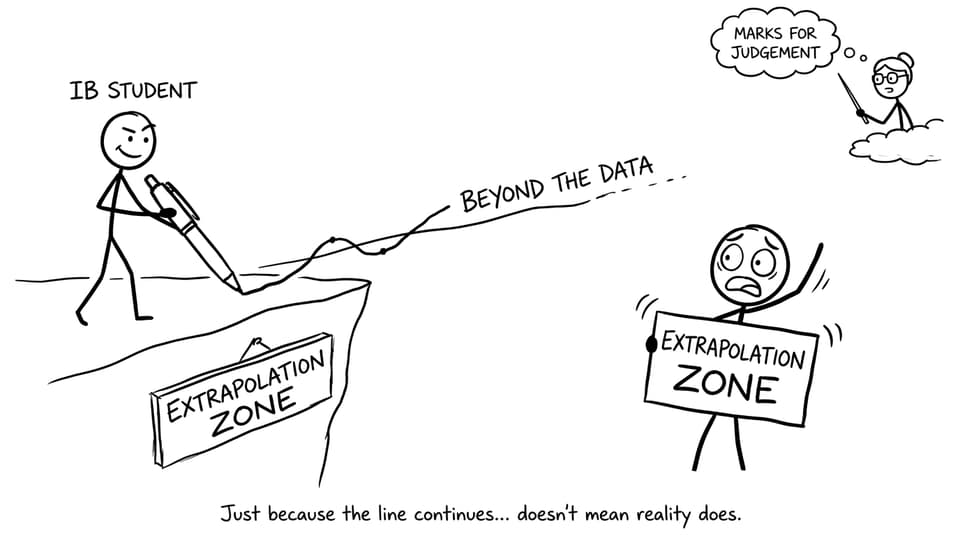
Extrapolation risk: predicting outside the data range is a leap.
-
Changing conditions: relationships shift as time passes.
-
Less data support: far from the centre, evidence gets thinner.
-
Random variation accumulates: small errors grow.
-
Hidden variables: unmeasured factors can rewrite the story.
To practise how IB phrases these questions, use the IB Math AI Questionbank and target regression + interpretation prompts.
Why regression predictions become less reliable over time
Regression is built on old relationships (not guarantees)
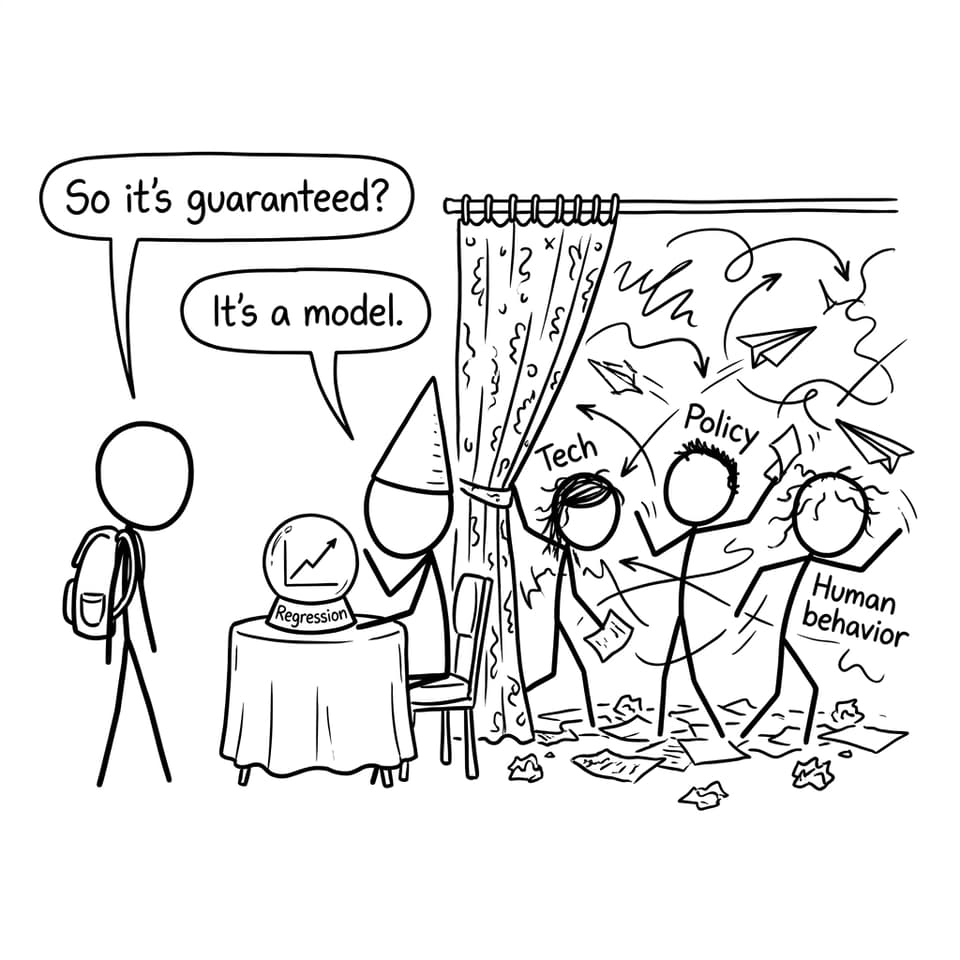
In IB Math, regression is always backward-looking. It summarizes how two variables behaved in the data you observed. Over time, the world changes: technology improves, policies shift, habits evolve, and environments fluctuate. Any of these can weaken (or completely flip) the relationship your regression captured.
This is why examiners reward cautious language. A regression equation is a model of a past pattern, not a contract with the future.
If you want the bigger picture of what IB expects you to say (not just calculate), read Why Is Interpretation Graded More Than Calculation in IB Statistics?.
Extrapolation stretches the assumption until it snaps
A regression line is most trustworthy within the range of your observed data. Predicting far into the future usually means predicting far beyond that range. In IB Math, that’s the definition of extrapolation, and it’s exactly where reliability drops.
Why? Because you’re assuming the same trend continues unchanged. But real trends often slow down, plateau, or reverse. Linear growth becomes saturation. A short-term relationship becomes noise.
For related examiner logic, see Why Strong Correlations Still Lead to Poor Predictions (because “strong” doesn’t mean “safe”).
The centre of the data is safer than the edges
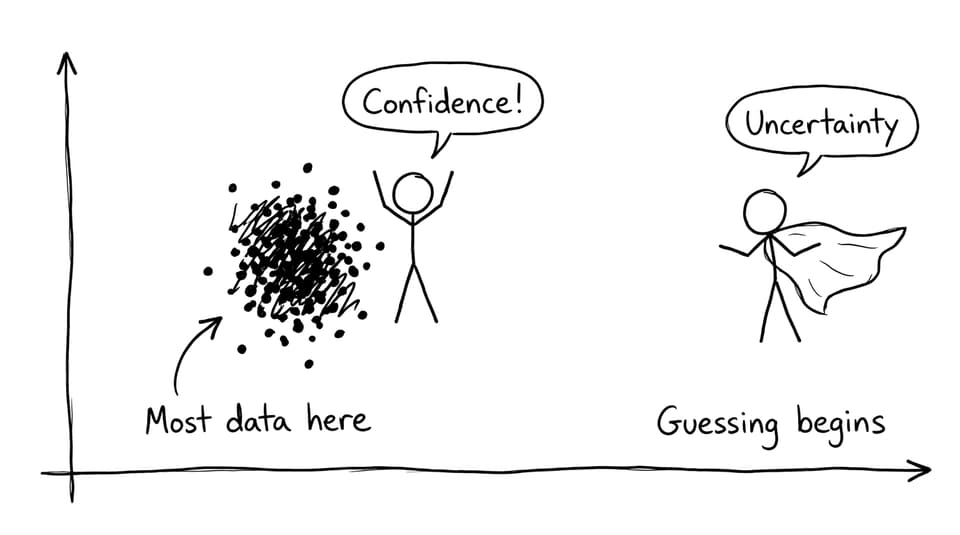
Students often miss this IB Math nuance: predictions tend to be more reliable near the middle of the data, where points are densest. As you move away from that region, the model is supported by less nearby information, so uncertainty increases.
That’s also why exam questions love asking about “a value far beyond the data” or “several years later”; it forces you to talk about evidence, not just equations.
Random variation compounds over time
Even if your model is reasonable, real data contains natural variability. A small mismatch early on can become a large gap later, especially if the prediction is extended repeatedly (year after year, step after step). In IB Math, this is a simple but powerful explanation: uncertainty doesn’t stay still.
To learn how IB wants you to evaluate model quality beyond the equation, read Why Residual Analysis Is More Important Than the Regression Equation.
Hidden variables can hijack the relationship
Regression only uses the variables you included. But real outcomes often depend on factors you didn’t measure: incentives, seasonality, demographics, economic changes, and countless “third variables.” When those shift over time, your regression equation can look mathematically fine and still become contextually wrong.
This links closely to reliability thinking in the syllabus; the AHL 4.12 Data Collection, Reliability and Validity Questionbank is a good place to train that judgement.
How to write the exam-style reliability sentence (IB Math)
In IB Math, a high-scoring comment often sounds like:
“This prediction may be unreliable because it involves extrapolation beyond the observed data range, and the relationship may change over time due to external factors and unmeasured variables.”
That one sentence hits what examiners want: range, time, assumptions, and caution.
For more support across topics, browse All IB Math posts.
Conclusion: in IB Math, regression is a tool for judgement
Regression in IB Math isn’t about pretending you can see the future. It’s about explaining why the future is uncertain, especially when you move far beyond the data and far forward in time.
If you want to get faster at the calculations and sharper in the explanations, RevisionDojo is built for that: use the Questionbank to drill regression prompts, Study Notes and Flashcards to lock in the language, AI Chat to practice examiner-style commentary, and Grading tools, Mock Exams, and Predicted Papers to rehearse full-paper decision-making under pressure. When regression questions feel tricky, that’s the point, and RevisionDojo trains you to answer them like an analyst, not a calculator.