
Writing in IB Chinese B rarely fails because you “don’t know enough Chinese.” It fails because the exam asks you to perform under pressure: choose the right text type, keep a clear message, and sound natural in Chinese, all while the clock quietly steals your confidence.
That’s why IB Languages writing is a skill you build the same way you build fitness: small reps, good form, and feedback that tells the truth.
In this guide, you’ll get a practical system for improving writing in IB Chinese B (especially Paper 1): what to practice, how to practice, and how to turn “I can say it out loud” into “I can write it clearly.”
A quick checklist for IB Chinese B writing (save this)
Use this as your weekly loop for IB Languages writing practice:
-
Pick a theme + text type before you write
-
Plan for 5 minutes (audience, purpose, 2-3 points)
-
Use connectors to guide your reader (not to decorate)
-
Upgrade vocabulary with theme-based word banks
-
Add one cultural detail that makes the message feel real
-
Leave 5 minutes to proofread characters, grammar, and format
-
Get feedback (teacher, peer, or tools) and rewrite once
If you want one place to organize that loop, start from the IB Chinese B hub, where you can pair prompts with tools like Questionbank, Flashcards, AI Chat, and Grading.
Know what Paper 1 is actually rewarding
Paper 1 isn’t a creativity contest. It’s closer to a “can you communicate appropriately?” test.
At SL you write 250-400 characters in 1h 15m. At HL you write 450-600 characters in 1h 30m. You choose one task out of three, linked to a prescribed theme.
To align your writing with the marking logic, read the criteria directly and keep it visible while you practice: Paper 1 writing criteria notes. In RevisionDojo’s ecosystem, this is where your Study Notes and Grading tools start speaking the same language.
For a deeper walkthrough of format, timing, and what to do with prompts, use How to Prepare for IB Chinese B Paper 1 (Writing Exam Guide).
Master text types (because the examiner is checking a template)
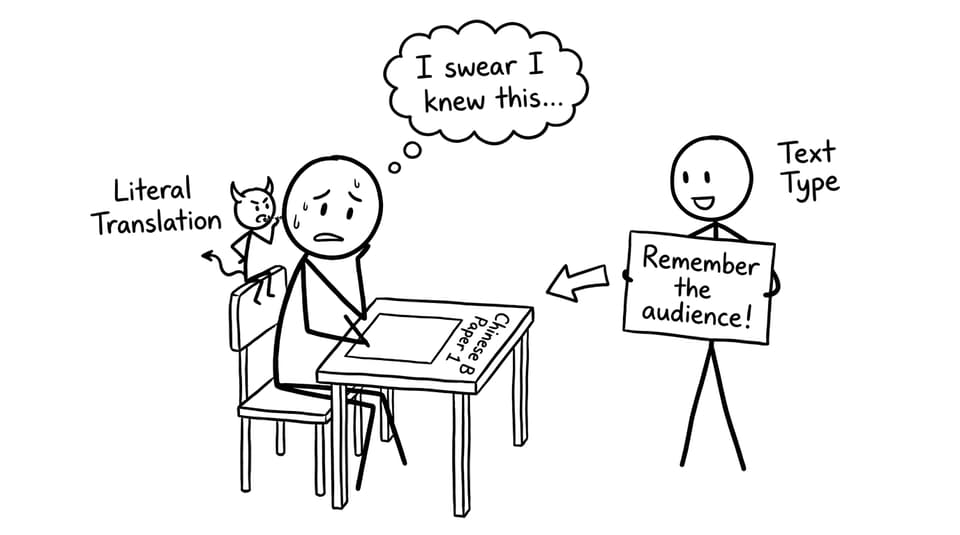
The fastest way to lose easy marks is to write the right ideas in the wrong container. In IB Languages, “conceptual understanding” often means: does this look and sound like the text type it claims to be?
Here are a few high-yield conventions to drill:
-
Diary entry: date/time cue, personal tone, reflection (今天…我觉得…)
-
Letter/email: greeting + relationship awareness (亲爱的… / 尊敬的…), clear closing (祝好 / 此致敬礼)
-
Speech: greeting to audience (大家好), rhetorical structure, call to action
-
Blog/article/report: title-like opener, clear paragraphs, informative register
A good practice method is “format first, content second.” Write a bare-bones version that nails the opening and closing, then add richer language.
To practice in an exam-like way, use IB Chinese B Resources and pull a prompt from the Questionbank or Predicted Papers workflow, then submit your draft to the Grading tools.
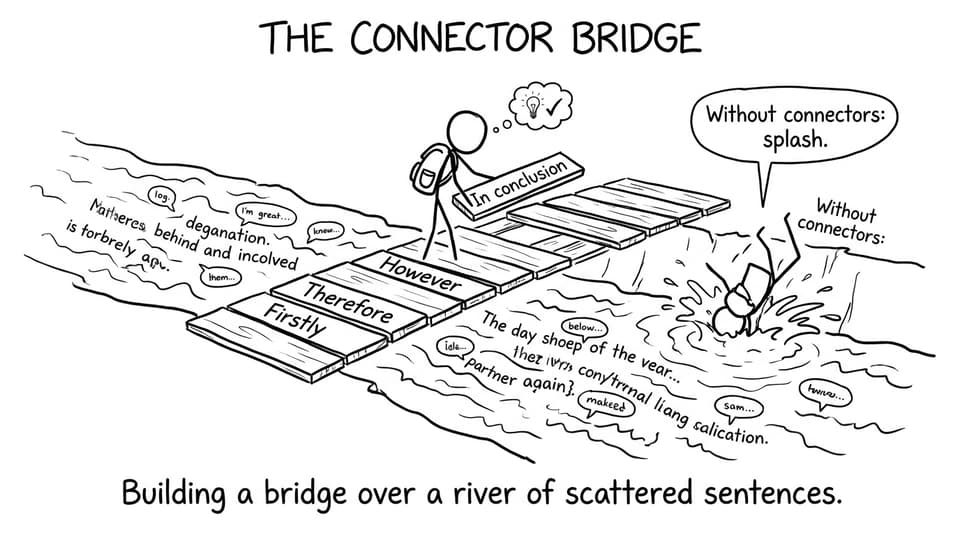
Build flow with connectors (so your paragraphs don’t feel like a list)
Most weak scripts read like stacked sentences: true statements that never become an argument.
Connectors fix that, but only if they create logic, not noise. Aim for variety across four jobs:
-
Sequencing: 首先, 其次, 然后, 最后
-
Cause-effect: 因为…所以…, 因此
-
Contrast: 虽然…但是…, 然而
-
Wrapping up: 总的来说, 总之
A simple rule: if you can remove the connector and nothing changes, it wasn’t doing work.
Upgrade vocabulary the smart way: theme banks, not random lists
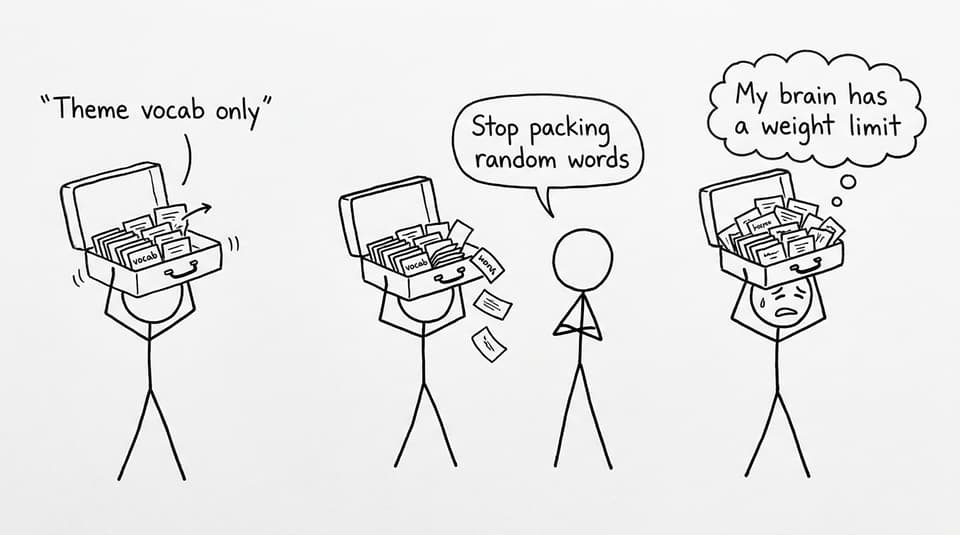
Cramming “advanced words” is comforting because it feels productive. It’s also why many students hit a ceiling: the words don’t match the themes, so they don’t show up in your writing.
Instead, build five small word banks (one per prescribed theme) and recycle them across text types. In IB Languages, controlled repetition beats novelty.
Example upgrades you can apply immediately:
-
Replace basic evaluatives (好, 很好) with specific adjectives (方便, 值得, 具有挑战性)
-
Add topic nouns that signal the theme (环境保护, 文化交流, 社交媒体, 公共交通)
-
Learn 2-3 idiomatic expressions you can actually use correctly (don’t force them)
On RevisionDojo, the quickest way to keep vocab usable is to turn it into spaced repetition: use Flashcards (or AI Chat to generate example sentences), then pressure-test it in the Questionbank.
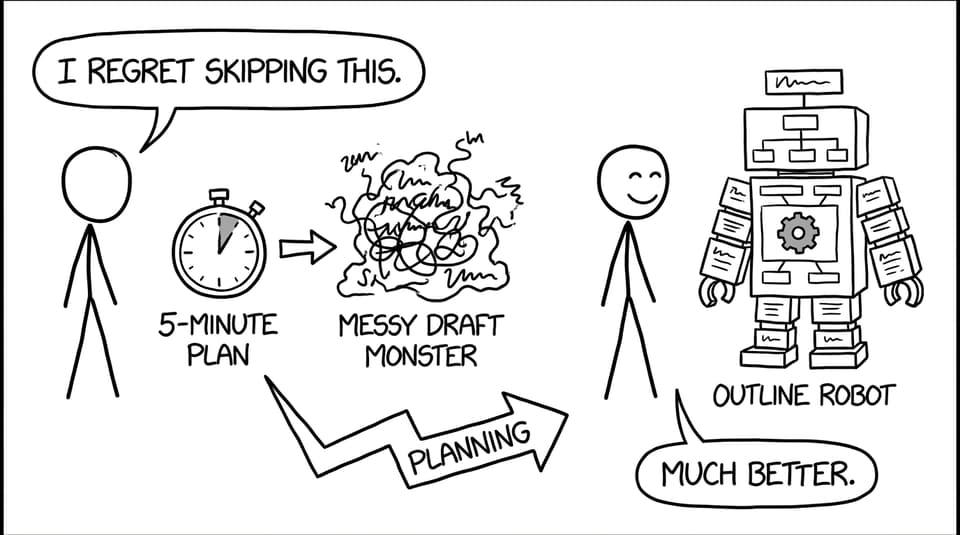
Plan for five minutes (it’s the cheapest score increase)
Planning feels like “lost writing time” until you realize it prevents the two big exam killers: repetition and drifting off-task.
A strong 5-minute plan includes:
-
Text type + audience (friend? school? public?)
-
Purpose (inform, persuade, reflect, request)
-
2-3 main points with one example each
-
A connector map (where contrast and conclusion will go)
If you struggle with structure, RevisionDojo’s Study Notes and model materials help you see patterns, and the Coursework Library gives you real high-quality exemplars to learn from: IB Chinese B Exemplars.
Practice by theme, then rotate text types
Paper 1 prompts always live inside the five prescribed themes, so your practice should too. If you haven’t revised them recently, revisit: The Five Core Themes of IB Chinese B Explained.
A simple rotation that works for most IB Languages students:
-
Week 1: Identities + blog
-
Week 2: Experiences + diary
-
Week 3: Human Ingenuity + article
-
Week 4: Social Organization + speech
-
Week 5: Sharing the Planet + report
Then repeat, but change the prompt and aim for cleaner language.
Proofread strategically (not emotionally)
Leave 5 minutes. Always. Proofreading isn’t “scan for vibes.” It’s a checklist.
Focus on:
-
Characters: common slips, missing strokes, wrong component
-
Grammar: word order, measure words, aspect particles
-
Register: too casual for a formal letter? too formal for a diary?
-
Text-type features: greeting, closing, title, call to action
If grammar accuracy is your biggest drag on marks, use How to Improve Grammar in IB Chinese B and turn the key patterns into Flashcards.
A quick before-and-after paragraph
Basic version
我喜欢旅游。我觉得很有意思。我去过中国。中国很好。
Stronger version (connectors + detail + reflection)
我非常喜欢旅游,因为它让我有机会认识不同的文化。比如,我去过北京,参观了长城和故宫。虽然行程很紧张,但是我学到了很多历史知识,也更理解中国人对传统文化的重视。总的来说,这次经历让我开阔了眼界。
Same topic. Completely different score potential.
Closing: make your writing predictable (in a good way)
The calmest writers in IB Chinese B aren’t calmer people. They just have a system: text type conventions, connector logic, theme vocabulary, a five-minute plan, and ruthless proofreading.
If you want that system in one place, RevisionDojo is built for the full workflow: Study Notes to learn patterns, Flashcards to keep vocabulary alive, Questionbank and Mock Exams to create pressure, AI Chat to troubleshoot phrasing, and Grading tools to turn each draft into a clearer next draft. Start with the IB Chinese B hub and treat IB Languages writing as something you train, not something you hope for.